

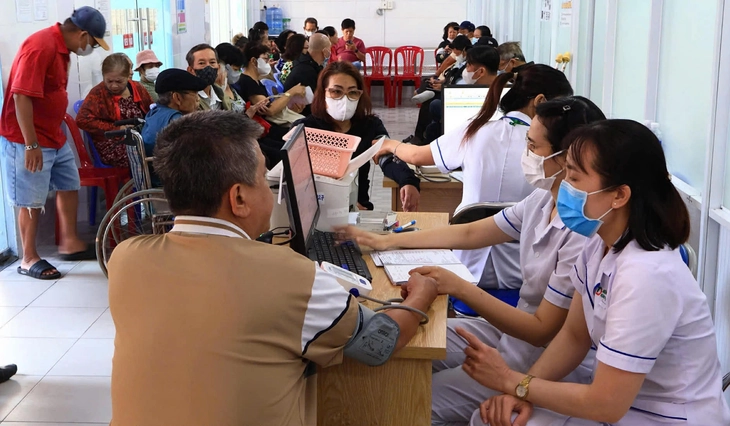
People came to the Binh Loi Trung Ward Health Station on the morning of January 9th for check-ups, blood pressure measurements, and registration procedures.
How can reforms in primary healthcare encourage people to return to local health centers?
The patient has "put up with" the health station.
According to observations by Tuoi Tre newspaper at several health stations, the number of people coming for medical examinations and treatment has increased by about 20-30% compared to before.
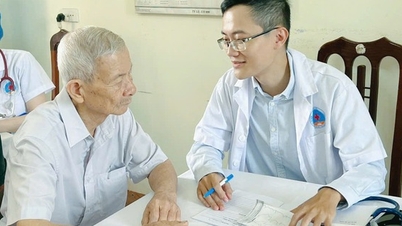
On the morning of January 9th, at the Binh Loi Trung Ward Health Station, many residents, especially the elderly, were present from early morning, lining up to wait for their turn for examination. Inside, medical staff quickly guided the elderly through the examination process, eliminating the need for long waits. Many residents said that instead of choosing hospitals, which are already overloaded, choosing the health station was faster and they received attentive care from the doctors.
Ms. My Hanh (77 years old, residing in Binh Loi Trung ward) shared that this was the first time she chose to visit the health station for a check-up instead of going to a higher-level hospital because she suffers from many underlying conditions such as high blood pressure, high cholesterol, and joint pain. She was very surprised that it took less than an hour to complete the examination.
"I had my blood pressure measured, blood tests done, ultrasound, X-rays taken… even though there were quite a lot of people, everything went quickly, and I didn't have to wait long. This time, I was quite surprised by the facilities and equipment at the health station; they are quite spacious and modern. The doctors and medical staff here are very enthusiastic and helpful, so I felt very comfortable," she added.
Similarly, at Tan Dinh Ward Health Station, many residents come for check-ups for common illnesses, vaccinations, and initial health consultations. The patient reception area is neatly arranged and has clear signage.
Mr. Minh Tuan (34 years old), who came for a check-up due to leg pain, said: "I heard that the health station had changed its model, so I was a little worried. But when I came for the check-up, everything was still the same as before. The doctor was skilled, examined me thoroughly, and the procedures were quick and efficient, so I felt reassured."
After the examination, Mr. Tuan received appropriate treatment advice from the doctor, a prescription for medication, and instructions to monitor his pain at home. He was also scheduled for a follow-up appointment if his symptoms did not improve.
Speaking to Tuổi Trẻ newspaper, Dr. Đoàn Văn Công, Deputy Director of the Bình Lợi Trung Ward Health Station (Ho Chi Minh City), said that in the initial period after the health station was transferred, many patients returned to the health station for examinations instead of going to higher-level hospitals. The number of people coming for medical examinations increased by 20-30%.
In addition, the staff from the former departments and divisions of the regional health center, after the merger, were reassigned to ward health stations, helping the team to be closer to the local area and the people, ensuring sufficient personnel to perform their professional duties.
"Ward health stations are the most accessible primary healthcare facilities, acting as 'gatekeepers' in the healthcare system. Doing a good job in initial medical examinations and treatment and epidemic prevention will help reduce the burden on higher-level hospitals," Dr. Cong emphasized.

Moving around in a wheelchair, Mr. Thang Long (77 years old) was assisted by medical staff in having his blood drawn for quick testing - Photo: HUYNH ANH
Strengthening the "gatekeeper" role of primary healthcare.
Dr. Nguyen Nguyet Cau, Director of Tan Dinh Ward Health Station, also said that after the reorganization, the station not only increased its staff but also significantly improved its professional skills with the participation of specialist doctors, masters, and officials with practical experience.
Previously, each ward health station only had about 6-8 staff members, making it difficult to fully meet the increasingly diverse demands of the job. Currently, ward health stations have a workforce of about 25-30 people, creating favorable conditions for clearer assignment of specialized tasks.
At the same time, we need to strengthen our workforce to stay close to the local areas, be closer to the people, and promptly understand their healthcare needs, especially in preventive medicine, primary health management, and disease prevention and control.
According to statistics from the Ho Chi Minh City Department of Health, as of October 2025, the city had over 50 million outpatient visits, with health insurance (BHYT) accounting for more than 47%.
However, specialized hospitals at the highest level (terminal hospitals, specialized clinics) and basic level hospitals (district hospitals) handle over 90% of outpatient cases. Meanwhile, the paradox lies at the primary healthcare level (health stations, polyclinics), which only accounts for 8% of outpatient patients.
Corresponding to this personnel allocation, which also leans towards the upper levels, the healthcare workforce forms an "inverted triangle," contrary to the ideal model of a healthcare system. Specifically, only 17% of healthcare staff (approximately over 16,000) are at the primary level, 32% at the basic level, and as many as 51% at the specialized level.
According to Nguyen Van Vinh Chau, Deputy Director of the Ho Chi Minh City Department of Health, interventions for disease prevention and early detection at the grassroots level are still relatively limited. Most patients, when ill, go directly to hospitals, from basic-level hospitals to even specialized hospitals, for diagnosis and treatment; very few patients seek treatment at the grassroots level.
Because there aren't enough healthcare workers at the primary healthcare level, there are no patients; conversely, because there are no patients at the primary healthcare level, there aren't many healthcare workers at the primary healthcare level either. This is a "chicken and egg" dilemma that needs to be resolved.
The model has been successfully implemented in many countries.
"The task of the health sector in the coming period is to break the vicious cycle, to reverse the triangle so that the primary level, the health station, truly becomes the level serving the largest number of people. This requires strengthening the 'gatekeeper' role of grassroots healthcare," Mr. Chau emphasized.
Mr. Chau explained that "gatekeeper" means that primary healthcare facilities are the first point of contact, where screening, management, initial treatment, and referral decisions are made when necessary. This model has been successfully implemented in many countries such as the UK and Germany through the family doctor system or general practitioner (GP) system.
According to Mr. Chau, after the merger and implementation of the two-tiered healthcare model, the Ho Chi Minh City health sector hopes that health stations can serve as the initial diagnostic and treatment centers for the people, only referring patients to specialized facilities when their capacity is exceeded. Regarding disease prevention, the primary healthcare level is responsible for disease prevention, early detection, initial treatment, management of the stable phase of treatment, and rehabilitation.
The Ho Chi Minh City health sector has been implementing many comprehensive solutions to strengthen the role of the grassroots healthcare system, including: developing health stations based on the principles of family medicine; and applying teleconsultation to connect with higher-level hospitals.
Simultaneously, train doctors in non-communicable disease management according to World Health Organization standards; implement centralized drug procurement to ensure drug availability at the grassroots level; and integrate practical training for young doctors with health stations.
Source: https://tuoitre.vn/lam-gi-de-nguoi-benh-chon-tram-y-te-20260113093654945.htm


![[Image] 500 regional dishes introduced to the people of Ho Chi Minh City and tourists.](https://vphoto.vietnam.vn/thumb/1200x675/vietnam/resource/IMAGE/2026/03/27/1774576163392_001-jpg.webp)












































































Comment (0)