

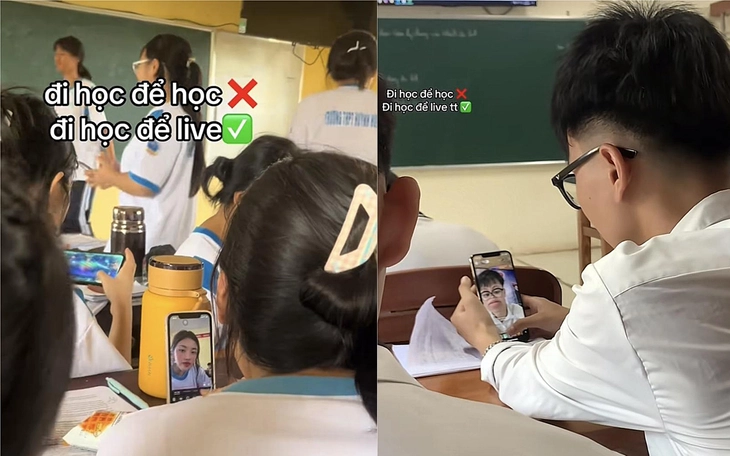
It's not uncommon to see students livestreaming during class these days - Screenshot
There are even clips showing the exam room, where teachers walk between rows of desks, with views reaching thousands, sometimes tens of thousands.
Plenty of fun things to do.
Clicking on the TikTok channel VIK that's livestreaming, the screen shows several students in a classroom bending down to film on their desks. On a white sheet of paper, lines of text appear one after another: "An loves My," "Khoi loves Truc"... The pen quickly fills the page at the viewers' request. Accompanied by soft laughter, someone urges, "Hurry up, write more."
Meanwhile, on the TA channel, a livestream was also taking place right in the classroom. Three or four people took turns trying out different "filters"—sometimes rabbit ears, sometimes face zooms, and sometimes glitter effects. One person commented, "What subject are we studying? What period?" A whispered reply came back, "Math, period three." The phone was on the desk, the teacher was lecturing in the distance, and the conversation on the livestream continued.
It could be said that livestreaming has become a classroom diary, perfectly in tune with the rhythm of social media. Everything happens quickly, spontaneously, and with virtually no barriers to sharing with strangers. But the more one observes, the more one will notice that the pedagogical space of the classroom is gradually being transformed.
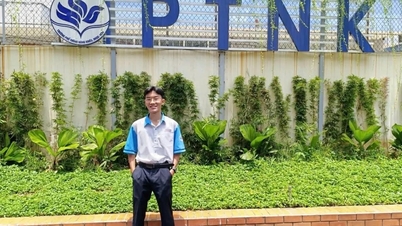
Suddenly, lectures become content for viewers outside the classroom; unintentional remarks can be taken out of context, and sometimes private moments are unexpectedly exposed. Student Trong Tan (Faculty of Science , Vietnam National University Ho Chi Minh City) shared that in his first year, he was very excited because he and his friends often live-streamed during class.
At the time, you said you only thought of going live for a few minutes for entertainment, not bothering anyone, so it wasn't anything too serious. "We just live streamed for fun, doing blindfolded quizzes, using filters, and laughing all the time. Sometimes we got so engrossed in live streaming that we looked up at the board and didn't understand what the teacher was saying, but when we reviewed the lesson later, it was fine," Tan laughed.
The fine line
Ms. Pham Diep Phuong Uyen, currently teaching at Louisiana State University (USA), views livestreaming in class as similar to turning the entire lesson into a public observation session, where people outside the class can observe and judge.
"We don't livestream during class time to protect lectures, personal information, and the safety of our students. When they know they're being watched, both teachers and students feel uncomfortable, the quality of the lesson is affected, and privacy is almost completely lost," Ms. Uyen said.
Taking a more assertive stance, Dr. Ngo Tuan Phuong (Ho Chi Minh City University of Law) stated that teachers livestreaming, especially scenes of students taking exams, violates professional standards and infringes on privacy rights. He argued that the examination space needs to be solemn and secure, and turning it into social media content is no longer an unintentional act.
According to him, students livestreaming during class reflects a conflict between online culture (showing off, interacting) and school discipline (emphasizing focus and respect). "The classroom is not a public space, so recording can only happen with clear consent and for legitimate learning purposes," Dr. Phuong stated.
Lecturer Tieu Minh Son, M.Sc., in the soft skills department at the Center for Student Competency Development (Van Lang University), believes that livestreaming during class directly affects the quality of teaching and learning. When a lesson is split between acquiring knowledge and interacting with an online audience, the focus of both the teacher and the students is distracted, turning the class into an impromptu stage where the content is simplified or diverted.
Mr. Son emphasized that using working hours or teaching time for personal activities such as livestreaming is inappropriate according to professional standards. "This is no longer a personal matter but relates to responsibility to the school, to the students, and to the role of educators themselves ," Mr. Son stated.
How is the world governed?
In many countries, livestreaming is seen as an activity that directly infringes on personal data and privacy, so schools often manage it according to data protection laws and internal regulations regarding recording equipment.
The U.S. Department of Education explains that student photos and videos can become part of academic records under privacy and academic record protection laws if they directly relate to a student and are retained by the school. In such cases, sharing is subject to student data privacy regulations.
Many universities in the US instruct faculty that, without the consent required by law, they must plan filming in a way that makes the footage unidentifiable to students (no name, face, or voice, no identifying information) or only share it within permitted areas.
In the UK, the International Data Protection Agency (ICO) emphasizes that schools have the right to restrict photography and videography if it disrupts educational activities. They also advise parents and students against posting images of others on social media if it is inappropriate. France, on the other hand, has opted for stricter controls on electronic devices. A 2018 law prohibits mobile phones and electronic communication devices in preschool, primary, and secondary schools.
In Australia, many states have their own policies regarding photographing and recording students. For example, Victoria requires that the collection and use of student images, audio, and video must comply with education laws and policies, adhering to clear principles, purposes, privacy, and consent. New South Wales, on the other hand, emphasizes safety principles, appropriateness to the school context, preventing information leaks, and minimizing digital risks when teaching via video.
We need to take stronger action.
According to Master's degree holder Tieu Minh Son, livestreaming in classrooms should not be a matter of "whether or not it should be done," but rather should be placed within a clear governance framework of the school. Educational institutions need to issue specific regulations on the use of recording and livestreaming equipment during class time, clearly stating permitted and infringing behaviors to avoid situations where everyone interprets it differently or handles it emotionally after the incident has occurred.
In the long term, sanctions are necessary. But more importantly, it is crucial to build the right awareness among faculty and students about the digital environment. The school could organize courses, seminars, or short-term training programs on digital citizenship, digital ethics, and online etiquette as part of professional competency in the new era.
"With sufficient knowledge and a clear framework, learners and teachers can fully utilize digital technology to support learning instead of letting it transform the school environment, which requires focus, respect, and safety for everyone," Mr. Son said.
Source: https://tuoitre.vn/livestream-trong-gio-hoc-khong-on-20260113092951372.htm
![[Photo] “Red Journey” 2026: Vietnamese Youth Continue Building the Bridge of Friendship Between Vietnam and China](https://vphoto.vietnam.vn/thumb/1200x675/vietnam/resource/IMAGE/2026/04/20/1776629730866_4055880775670638308-9618-4200-jpg.webp)















































































Comment (0)