Change your worries right at the beginning of the season.
Early in the morning in Tan Hiep commune, An Giang province, the lush green rice fields of the summer-autumn crop stretch out in a thin mist. Leading us along the edge of the fields, Mr. Nguyen Song Nguon observed the rice paddies while sharing a seemingly simple statement, yet one that holds the wisdom of someone who has been involved with farming for many years: “Rising costs are worrying, but a bad rice harvest is even more worrying.”
His concern wasn't the rising cost of agricultural supplies or labor, but rather the health of the rice plants from the very first days of planting. According to him, if the rice plants are weak and their root systems are poorly developed, then no matter how much fertilizer is applied or how carefully they are cared for, it will be difficult to achieve the desired yield.
Tan Hiep is a region that produces three rice crops a year. The time between crops is usually only 5-10 days, so dealing with rice straw is quite difficult. Many years ago, like many other farmers, Mr. Nguon chose to burn the fields to deal with the rice straw after harvest.

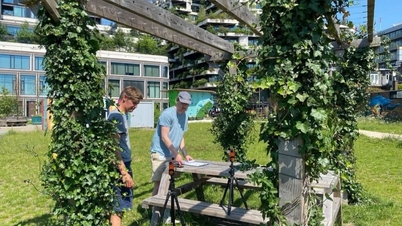
Farmer Nguyen Song Nguon (far left), from Tan Hiep commune, An Giang province, along with technical staff from the "Green Journey - Healthy Soil, Healthy Crops" program, assess the development of rice plants after treating rice straw and improving soil with Bio-Calcium. Photo: Ngoc Van.
However, burning rice straw not only depletes valuable organic matter, but the remaining straw in the fields continues to decompose incompletely, causing organic poisoning, soil compaction, poor root development, and reduced fertilizer efficiency.
According to Mr. Nguồn, burning the fields after the harvest is quick, but it also burns up the organic matter in the soil. The soil weakens over time without us noticing.
This year, instead of burning the fields during the summer-autumn crop season, Mr. Nguồn decided to change his approach. Right from the land preparation stage, he kept the straw on the fields and participated in the "Green Journey - Healthy Soil, Healthy Crops" program implemented by Binh Dien Fertilizer Joint Stock Company.
Through this program, Binh Dien's technical staff directly go to the fields with farmers to measure soil pH, assess the condition of the fields, and guide them on appropriate soil improvement solutions.
"Previously, we mainly relied on experience. Now, with technical staff inspecting the soil and monitoring the rice plants, we feel much more at ease," he shared.

Technical officer and farmer Nguyen Song Nguon directly inspects the growth status of the summer-autumn rice crop, monitoring the effectiveness of soil improvement and the development of the root system at the beginning of the season. Photo: Ngoc Van.
Healthy soil, healthy rice, lower costs for farmers.

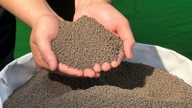
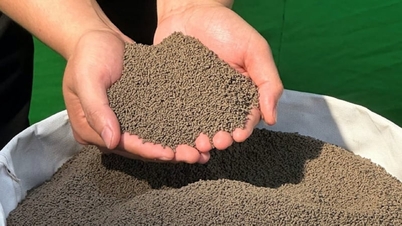
On his farmland, Mr. Nguồn uses Bio-Calcium fertilizer at a rate of approximately 100 kg/ha in the early stages of the crop to aid in the decomposition of straw and reduce soil acidity.
According to his assessment, the most noticeable effect is that the rice plants grow more uniformly, and the rate of post-sown losses has significantly decreased. Previously, with a sowing density of about 180 kg of seeds/ha, he often had to spend extra labor and money replanting rice in areas where plants died due to organic poisoning or acidity. Now, this phenomenon has significantly decreased.
Pulling up a rice plant from the field for observation, Mr. Nguồn said that the roots are now whiter, longer, and less affected by acidity compared to previous seasons. During the period from 10 to 20 days after sowing, the rice plants also showed less leaf whitening – a common sign of organic poisoning in the field.
"Healthy roots mean healthy plants. The soil is more aerated, so the rice takes root quickly, tillers early and evenly," he said.

Through the "Green Journey - Healthy Soil, Healthy Crops" program, farmers are guided to measure field indicators and assess soil health in order to apply appropriate farming solutions. Photo: Ngoc Van.
Not only did the Bio-Calcium treatment improve soil conditions, but it also helped him reduce the amount of fertilizer used in subsequent topdressing applications. Previously, he had to use 17-20 kg of fertilizer per hectare per application, but now it has been reduced to about 13-17 kg per hectare, while the rice plants still grow well.
After applying Bio-Calcium at the beginning of the season, he continued to fertilize with Dau Trau Bio-Rice 1 in two stages: 7-10 days and 18-22 days after sowing. Thanks to the improved soil, the rice plants absorbed nutrients more effectively, and the number of effective tillers increased.
According to him, the most encouraging aspect is the plant's ability to produce uniform tillers. The young branches develop almost to the same size as the mother plant, laying the groundwork for the formation of many effective flowers later on.
In particular, during the mid-season drainage phases, the reddish-brown scum on the surface of the rice fields almost completely disappears. The soil becomes darker, more porous, and there is less risk of acid toxicity.
Standing amidst the lush green fields, Mr. Nguồn believes that the additional investment cost for Bio-Calcium is actually not large, but the benefits are well worth it. It not only reduces the labor involved in transplanting rice seedlings and the amount of fertilizer used, but also helps the rice plants thrive from the beginning of the season, creating a foundation for the entire production process.
"Farming rice now can't just be about how much fertilizer to use or what pesticides to spray. To be effective, you have to take care of the soil first. Healthy soil means healthy plants, and healthy plants give farmers peace of mind," Nguồn concluded.

Healthy, white root systems and uniform tillering are positive signs in farmers' rice fields after applying a straw treatment solution combined with Bio-Calcium at the beginning of the season. Photo: Ngoc Van.


GREEN JOURNEY – HEALTHY SOIL, HEALTHY PLANTS
Starting from the Summer-Autumn crop season of 2025.
Implementation in the Mekong Delta and Tay Ninh .
Focus on restoring soil health through soil analysis, pH improvement, reduction of organic toxicity, and enhanced nutrient utilization efficiency with the Bio product line.
In partnership with Binh Dien Fertilizer Joint Stock Company, along with the advice of Prof. Dr. Nguyen Bao Ve and other agricultural experts.
Source: https://nongnghiepmoitruong.vn/lo-tu-goc-de-cay-lua-khoe-hon-d816969.html


![[Photo] General Secretary and President To Lam attends the 13th National Congress of the Ho Chi Minh Communist Youth Union](https://vphoto.vietnam.vn/thumb/1200x675/vietnam/resource/IMAGE/2026/06/25/1782356968989_ndo_br_1-jpg.webp)






















![[Photo] General Secretary and President To Lam attends the Central Public Security Party Committee Conference](https://vphoto.vietnam.vn/thumb/1200x675/vietnam/resource/IMAGE/2026/06/24/1782302063612_a1-bnd-9302-9166-jpg.webp)