

Intel's gradual expansion of semiconductor chip manufacturing across Europe is both helping the company realize its ambition to regain its leading position and boosting the region's capabilities in this field.
Intel recently announced plans to build a semiconductor chip assembly and testing plant in Wroclaw, Poland. According to Reuters, the nearly $5 billion plant in Poland, expected to be operational in 2027, will employ 2,000 workers and create thousands more jobs during the construction phase, through recruitment by suppliers. The company stated that Poland was chosen for its infrastructure, workforce, and convenient location relative to existing facilities in Europe. This is part of the company's efforts to increase investment in European Union (EU) countries.
Intel's development strategy outlines a $100 billion investment over 10 years in its entire semiconductor supply chain across Europe, from research and development to manufacturing and finishing technology. Specifically, in addition to Poland, Intel is building a high-tech semiconductor manufacturing hub in Magdeburg, Germany; a semiconductor research, development, and design center near Paris, France; and expanding and constructing new semiconductor chip molding and manufacturing lines in Ireland, Italy, and Spain. The goal of this plan is to double the EU's semiconductor market share from less than 10% currently to double that by 2030. "This investment is a significant step for both Intel and Europe," Reuters quoted Intel CEO Pat Gelsinger as emphasizing.
The announcement comes as Intel is experiencing a difficult first quarter of 2023. The company recently announced its first-quarter results, showing revenue down nearly 36% year-on-year due to decreased demand, particularly for computer chips – its flagship product line. For the next quarter, Intel forecasts a further 4% decline in earnings per share. The Financial Times assesses the American software giant's financial situation as quite strained.
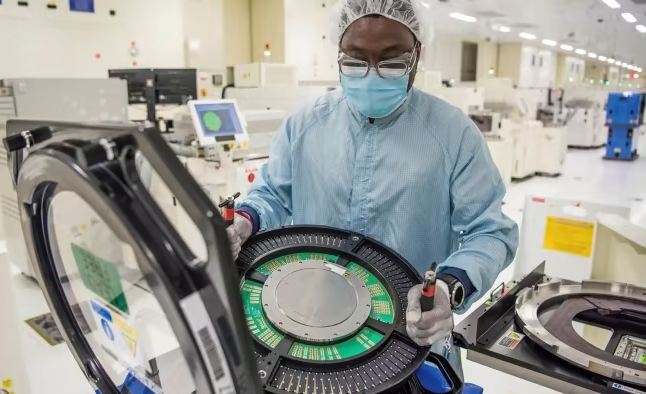 |
Inside Intel's semiconductor chip manufacturing plant in Ireland. Photo: Financial Times |
In the late 2000s, Intel was still the world's leading semiconductor chip manufacturer. But now, it has been overtaken by TSMC, Nvidia, Apple, and Samsung. Intel's products have fallen behind technologically compared to many of the industry's giants. Therefore, the Financial Times believes that Intel, under CEO Pat Gelsinger, has been, is, and will continue to actively invest in building a widespread infrastructure, including in Europe, in order to reverse its decline and compete better with rivals, restoring its dominant position.
Meanwhile, the COVID-19 pandemic has caused a supply shortage for semiconductors, leading to a global scarcity of electronic products. Europe, for its part, is eager to reduce its dependence on external semiconductor suppliers such as the US and Asia, while facing numerous challenges including the pandemic, the US-China trade war, and Russia's special military operation in Ukraine. However, building its own semiconductor chip design and manufacturing facilities would require significant time, money, and coordination from leading companies in the field.
To maximize the use of external resources, the EU passed the Chip Act in early 2023, offering significant incentives for semiconductor companies. This act is expected to boost innovative research in Europe, encouraging leading semiconductor companies to relocate their advanced production lines to the region to take advantage of these incentives. Intel is one of the companies seizing this opportunity. Reuters reports that Intel has been present in Europe for over three decades and is one of the high-tech corporations with strong partnerships with EU governments . In the past two years, the company has invested more than $10 billion in European suppliers and plans to double that amount by 2026.
VAN HIEU
Source
![[Photo] National Assembly Chairman Tran Thanh Man attends the groundbreaking ceremony for the National Highway 1A spatial axis project.](https://vphoto.vietnam.vn/thumb/1200x675/vietnam/resource/IMAGE/2026/05/19/1779161360398_ndo_br_bnd-1412-jpg.webp)
![[Photo] Capturing the moment the tide recedes at Yen Binh Son rapids - a million-year-old scenic spot in Quang Ngai.](https://vphoto.vietnam.vn/thumb/1200x675/vietnam/resource/IMAGE/2026/05/19/1779175463885_yen9-1199-jpg.webp)





























































![[Photo] General Secretary and President To Lam receives Indian Defense Minister Rajnath Singh](https://vphoto.vietnam.vn/thumb/402x226/vietnam/resource/IMAGE/2026/05/19/1779184046302_anh-man-hinh-2026-05-19-luc-16-46-58.png)




















Comment (0)