

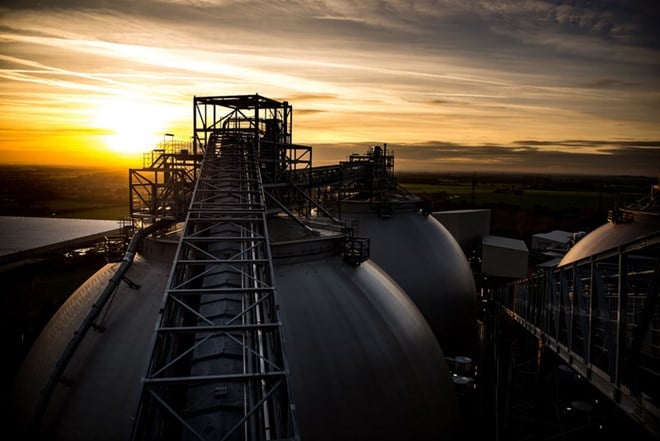
As nations gather for the 28th United Nations Climate Change Conference in the United Arab Emirates at the end of November, the question of the future role of carbon reduction in a climate-friendly world will be a central focus.
The most common method involves concentrating the gas from a single source, such as an industrial chimney. From there, the carbon can be directly transported to permanent underground gas storage. The previously extracted carbon emissions can then be used for other industrial purposes with corresponding variations. There are two types of variations: "Carbon Capture and Storage" (CCS) and "Carbon Capture, Utilization, and Storage" (CCUS).
According to statistics, there are currently 42 commercial CCS and CCUS projects operating worldwide with the capacity to store 49 million tons of carbon dioxide annually. These projects only meet about 0.13% of the total annual emissions of approximately 37 billion tons. About 30 of these projects use carbon for recycling into petroleum (EOR).
Another form of carbon capture is direct air capture (DAC), in which carbon emissions are captured from the air.
According to the International Energy Agency (IEA), approximately 130 DAC (Dynamic Carbon Capture) facilities are currently planned. However, only 27 have been put into operation. The amount of carbon captured is only 10,000 tons per year.
In August, the United States announced $1.2 billion in funding for two DAC centers in Texas and Louisiana with the goal of capturing 2 million tons of carbon annually, although final investment decisions for the projects have yet to be made.
One obstacle to the rapid deployment of carbon capture technology is the cost.
CCS costs range from $15 to $120 per ton of carbon, depending on the emission source. DAC projects are even more expensive, ranging from $600 to $1,000 per ton.
Some CCS projects in countries like Norway and Canada have been suspended due to financial reasons.
Countries, including the United States, have implemented public subsidies for carbon capture projects. The Inflation Reduction Act, passed in 2022, provided a tax credit of $50 per ton of carbon from CCUS, $85 per ton from CCS, and $180 per ton of emissions from DAC.
Benjamin Longstreth, global director of carbon capture at the Clean Air Task Force, said that while these incentives are meaningful, companies may still incur some additional costs to advance the projects.
Some CCS projects have also failed to prove effective. For example, a $1 billion project aimed at harnessing carbon dioxide emissions from a coal-fired power plant in Texas encountered technical problems and frequently failed to meet its targets. This project ceased operations in 2020.
Another issue is that the storage locations for carbon emissions can be limited by geology. According to the CCS Institute, the best carbon storage locations are in North America, East Africa, and the North Sea.
This means that transporting materials to storage locations may require extensive pipeline networks, or even entire fleets of transport vessels – posing new potential obstacles.
Source






































































































Comment (0)