From habitual spraying to disciplined production.
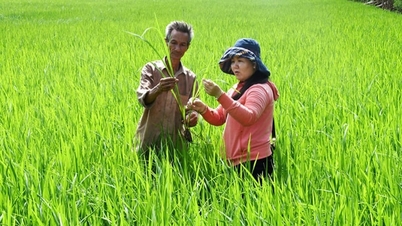
From early morning, while the night dew still clung to the lychee trees in Lan Thinh village, Phuc Hoa commune ( Bac Ninh province), Mr. Tran Van Dinh and Mrs. Nguyen Thi Xoa were already out in their garden, going from tree to tree, checking the white screens stretched around the branches.
Those screens are part of a pilot project implemented by his family in collaboration with local technical staff and Dragon Berry International Co., Ltd. From a distance, the lychee orchard looks like a series of low-rise greenhouses stretching along the hillside. Behind those white screens lies a significant shift in production thinking: reduced chemical intervention and safer pest control.
"Before, we would spray whenever we saw pests, spraying thoroughly to be on the safe side. Now we can't do that anymore. If they test one sample and it exceeds the standard, an entire container of fabric has to be thrown away. If one household makes a mistake, the entire area suffers the consequences, so we're all telling each other that no one dares to take the risk," said Mr. Tran Van Dinh.

Ms. Nguyen Thi Xoa, along with officials from the Department of Crop Production and Plant Protection and representatives from Dragon Berry International Co., Ltd., inspect the situation regarding lychee fruit stem borer infestation. Photo: Pham Minh.
Mr. Dinh's sharing reveals that the biggest pressure during the current lychee season is not just yield, appearance, or price. It's the discipline in the use of pesticides. For demanding markets like Japan, the United States, Australia, or Europe, each shipment must pass strict regulations on pesticide residue levels. A small mistake by one farmer can affect the entire growing area's registration, and even cause businesses to lose export contracts.
In Mr. Dinh's orchard, 18 lychee trees were tested using netting to control stem borers – one of the most worrying pests affecting lychee trees. Initial results showed a significant reduction in the number of spray applications and considerable control of stem borers. This is not just a technical solution implemented by one household, but a new approach: plant protection no longer means frequent spraying, but rather integrated pest management, implemented at the right time, at the right threshold, and in accordance with market regulations.
Technical staff stay in the orchards, maintaining standards in the growing area.
Behind every lychee orchard that meets export standards is the constant presence of technical personnel. From the beginning of the season, the Department of Agriculture and Environment of Bac Ninh province established a lychee production steering committee consisting of 21 professional staff members, assigned to closely monitor key communes and wards. This force collaborates with cooperatives and export businesses to guide farmers from cultivation and pest control to the pre-harvest stage.
To date, the Department has directed the development of a set of guidelines and a list of plant protection products that comply with the regulations of each importing market. This is a crucial step because each market has its own requirements regarding permitted active ingredients, maximum allowable residues, and pre-harvest withdrawal periods.
“The hardest thing isn't teaching farmers which pesticides to use, but helping them change their habits. Before, they would just spray pesticides whenever they saw pests, just to be sure. Now, they have to look at the schedule, the quarantine period, and even the planting area code. One household's mistake can affect the whole area. Sometimes we have to go down to the orchards and guide them step by step to reassure them,” shared Ms. Cap Thi Can, an officer at Station No. 4 of the Plant Protection and Quarantine Department (Bac Ninh Province).

Technical staff and Mr. Dinh's family inspect and remove the protective coverings in preparation for harvesting the lychees. Photo: Pham Minh.
The days leading up to harvest are the most stressful. Plant protection officers must closely monitor the orchards, check for pests and diseases, provide guidance on treatment if necessary, and collect samples for chemical residue analysis before harvesting. Strict internal monitoring is maintained to ensure that no household in the growing area uses pesticides improperly or without sufficient waiting periods.
Currently, Bac Ninh maintains 241 export-oriented lychee growing area codes with a total area of 17,450 hectares, targeting markets in China, Japan, Australia, the United States, and Thailand. Each growing area code represents a collective commitment. In this model, farmers no longer produce individually but share responsibility with cooperatives, businesses, and specialized agencies.
Businesses that partner from the beginning.
Changes in plant protection management have also altered how businesses participate in the lychee production chain. Instead of simply purchasing the fruit when it ripens, many businesses are involved from the beginning of the season, working with technical staff to monitor pests and diseases, guide cultivation processes, and check the optimal harvesting time for each market.
"Foreign customers now don't just ask whether the fruit is beautiful or not. They ask who manages the growing region, how many times samples are taken per season, and how mistakes are handled. They buy the entire system, not individual containers," said a representative of Dragon Berry International Co., Ltd.
This accurately reflects the new competitive nature of Bac Ninh lychees. Importing markets now buy not only the product but also the management process. A standard-compliant lychee is the result of a continuous control chain from pest and disease forecasting, pesticide use, sample testing, harvesting, processing, rapid cooling, to packaging...
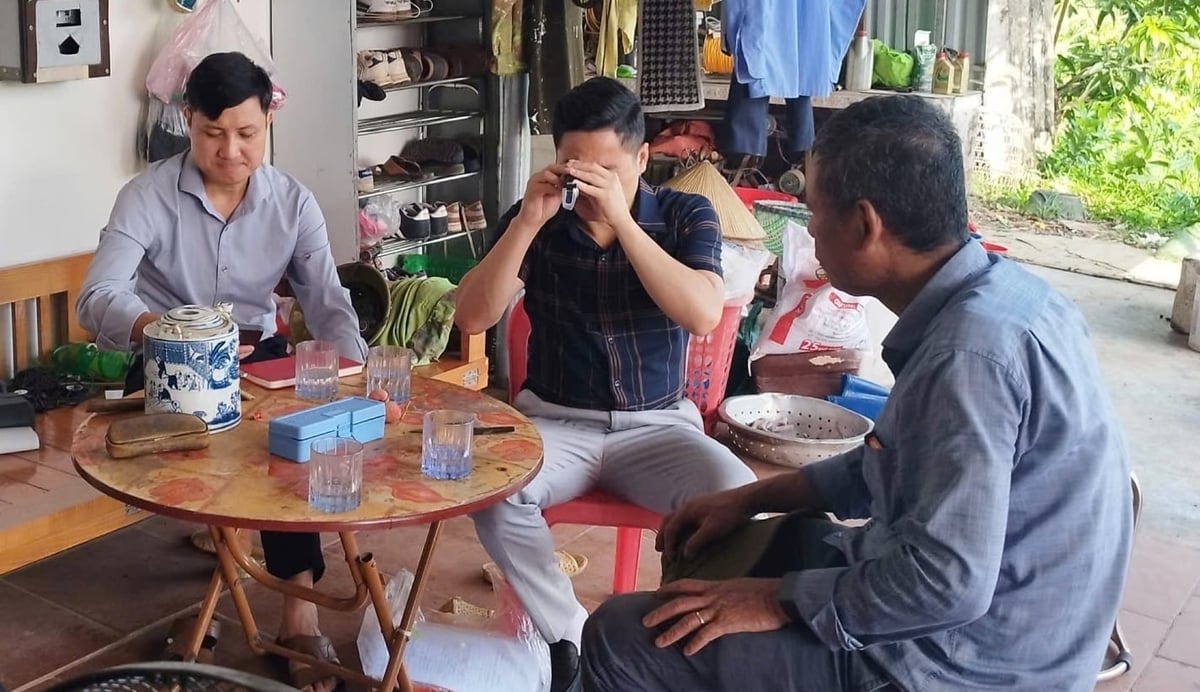
Mr. Do Van Tuan (center) - a specialist from the Bac Ninh Department of Crop Production and Plant Protection - checks the Brix level (sugar content) in lychee fruit. Photo: Pham Minh.


Currently, the province has 42 export-oriented packaging facilities that have been granted codes. In 2026, Bac Ninh plans to evaluate and grant codes to an additional 5 facilities to meet growth demand. However, packaging is only the final link in the chain. Real quality must begin in the orchard, from the decision to spray pesticides, what type to spray, when to spray, and whether the pre-harvest waiting period is ensured.
From the story of the white screens in Phuc Hoa to the team of technical staff working in the orchards, from the planting area codes to the list of pesticides for each market, it is clear that Bac Ninh lychee is entering a production phase based on discipline and belief.
When lychee growers understand that a single incorrect pesticide application can jeopardize the entire region's opportunities, plant protection becomes the most important "technical barrier" to maintain brand recognition, secure markets, and enhance the value of lychees on the global agricultural map.
Source: https://nongnghiepmoitruong.vn/mac-man-cho-vuon-vai-d814453.html
![[Photo] Opening Ceremony of the 13th National Congress of the Ho Chi Minh Communist Youth Union](https://vphoto.vietnam.vn/thumb/1200x675/vietnam/resource/IMAGE/2026/06/24/1782286753905_ndo_br_1-8510-jpg.webp)
![[Photo] General Secretary and President To Lam attends the Central Public Security Party Committee Conference](https://vphoto.vietnam.vn/thumb/1200x675/vietnam/resource/IMAGE/2026/06/24/1782302063612_a1-bnd-9302-9166-jpg.webp)

![[Photo] The 13th National Congress of the Youth Union conducts personnel work.](https://vphoto.vietnam.vn/thumb/1200x675/vietnam/resource/IMAGE/2026/06/24/1782299943080_ndo_br_1-6868-jpg.webp)