

 |
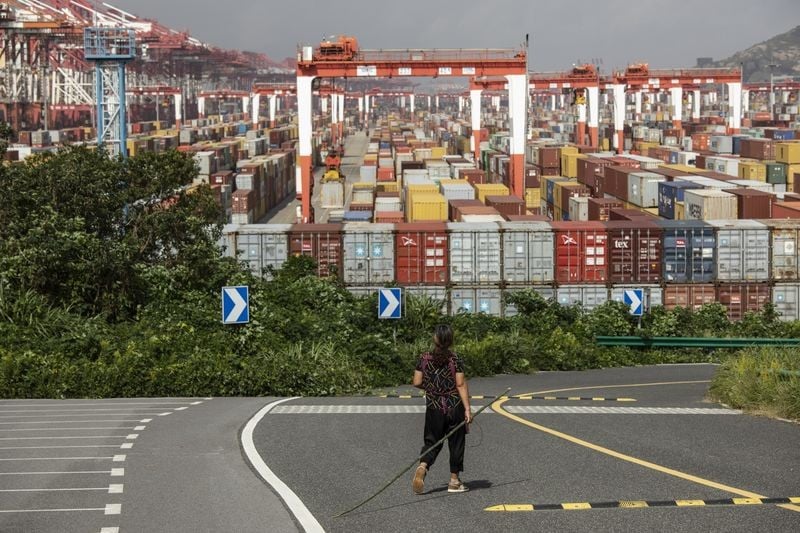
| China's economic recovery is facing difficulties. (Source: Bloomberg) |
A series of major problems are weighing heavily on the table.
The trade restrictions implemented by the Trump administration caused the Chinese economy to slow down in 2019. The Covid-19 pandemic in 2020 exacerbated the problem and increased the challenges for the world's second-largest economy.
After nearly three years of fighting the pandemic, life in China is now returning to normal. However, the country's economy continues to show signs of emerging problems and contradictions.
Under Chinese President Xi Jinping, the country has consolidated its position as a manufacturing giant while lifting its people out of poverty. In 2012, the nation's Gross Domestic Product (GDP) was $8.5 trillion. By 2022, GDP had risen to $18.5 trillion, an astonishing growth rate of over 100%.
However, the Chinese economy grew by only 4.5% in the first quarter of the current fiscal year. That's an improvement over 2022 – which saw growth of just 3% – but still below Beijing's target of 5%.
Some observers believe that China's slowdown is a sign that deeper problems may soon emerge.
Most recently, China's National Bureau of Statistics (NBS) reported that the official Purchasing Managers' Index (PMI) for the manufacturing sector – a key measure of factory output – fell to 48.8 in May 2023, below the 50-point mark that separates growth from contraction.
This figure follows a decline of 49.2 in April 2023, reversing a three-month growth trend and falling short of the average estimate of 49.5 from economists surveyed by Bloomberg .
In addition, official data released on May 28th also showed that profits of industrial enterprises in China fell sharply in the first four months of 2023. Companies continue to struggle with pressure to increase profit margins amid weak demand due to the economy not recovering as strongly as expected.
According to China's National Bureau of Statistics, industrial profits fell 20.6% in the first four months of this year compared to the same period last year. In April alone, the decline was 18.2%, following a 19.2% drop in March.
Risk of local debt crisis
Following the 2008-2009 financial crisis, China allowed cities to use local government financing vehicles (LGFVs) to borrow money to pay for infrastructure projects.
However, this is a risky game as real estate growth has been frozen for an extended period and government spending has increased. These issues have raised the possibility that some local governments may default on their debt obligations, triggering a broader economic crisis.
A recent analysis by Rhodium Group suggests that, of the 205 cities surveyed in China, 102 were struggling to repay their debts in 2022.
Goldman Sachs analysts also noted that “risks are increasing locally in the world’s second-largest economy, particularly in less developed inland regions.”
Real estate accounts for approximately 25% of China's GDP. This sector is crucial to the country's economic health. However, the industry remains ailing. Compared to April 2023, home sales in May fell by nearly 15%.
Furthermore, between 2012 and 2022, China's public debt increased by $37 trillion, while the US debt increased by only $25 trillion.
As of June 2022, China's debt totaled $52 trillion, more than the combined debt of all other emerging economies. This massive debt also casts a dark cloud over the world's second-largest economy.
Consumer confidence is shaken.
Amid weakening foreign investment and exports, China's biggest hope this year is that domestic consumers will increase spending.
Although people are spending more after three years of the Covid-19 pandemic, China is not experiencing the same explosive growth as other economies after returning to normalcy.
Household spending accounts for only about 38% of China's annual GDP growth, compared to 68% in the US.
Pepsi's chief financial officer, Hugh Johnston, stated: "Consumer confidence remains weak."
In addition, foreign investors are withdrawing from China – another not-so-optimistic sign.
Most analysts believe that Chinese consumers and businesses will eventually regain confidence, while Beijing will revive other sectors of the economy. "But that could take years," Yahoo News noted.
Source



![[Image] National Assembly discusses the implementation of the socio-economic development plan.](https://vphoto.vietnam.vn/thumb/1200x675/vietnam/resource/IMAGE/2026/04/20/1776696707422_ndo_br_img-20260420-185419-jpg.webp)

![[Photo] General Secretary and President To Lam meets with National Assembly delegates from ethnic minorities.](https://vphoto.vietnam.vn/thumb/1200x675/vietnam/resource/IMAGE/2026/04/20/1776696701056_a1-bnd-8331-3342-jpg.webp)





















































































Comment (0)