|
| At the very first session of the 16th National Assembly, National Assembly Chairman Tran Thanh Man signed and promulgated Resolution No. 28 dated April 24, 2026, of the National Assembly on the development of Vietnamese culture, institutionalizing Resolution No. 80-NQ/TW of the Politburo . Photo: VGP/Nhat Bac |
The "key" to unlocking cultural development.
The full and timely institutionalization of the Politburo's Resolution No. 80-NQ/TW on the development of Vietnamese culture into Resolution 28 of the National Assembly is the "key" to paving the way for culture to truly become the spiritual foundation, endogenous resource, driving force for development, and soft power of the nation. This is an essential requirement in the process of renewing development thinking, and also an important political and legislative task of the National Assembly to concretize and promptly put the Party's policies and resolutions into practice.
This task is all the more prominent because the country is facing the need to build a new value system suitable for the era of development. The economy can create material wealth, science and technology increase labor productivity, and infrastructure expands the space for development, but culture is the decisive factor in determining the depth, character, and resilience of the nation and its people.
A country that wants to go far cannot be strong only in capital, technology, infrastructure, or markets, but must also have people with rich character, a society with high standards, a community with a distinct identity, and a nation with cultural appeal.
Alongside significant achievements, cultural life still exhibits deviations from norms, with superficial and shallow entertainment, sometimes even straying from truth, goodness, and beauty. Furthermore, there is an increasing number of products that chase fleeting trends, lacking the humanistic qualities of art; literary and artistic activities have somewhat stagnated, lacking high-quality works of art with the power to inspire and move people…
In particular, in a rapidly changing modern social context, with the expansion of social media, the rapid development of cross-border digital platforms, the dramatic transformation of the entertainment industry, and the diversification of public tastes, traditional values are facing immense competitive pressure.
In his speech at a meeting with artists and writers on December 30, 2024, General Secretary and President To Lam reiterated President Ho Chi Minh's view that "Culture must guide the nation," while emphasizing that culture and art cannot stand outside of economics and politics.
This shows that, from the 1943 Vietnamese Cultural Outline to Resolution 80 of the Politburo and institutionalized by Resolution 28 of the National Assembly, there has been a consistent continuation of the Party and State's "source" regarding the role of guiding, regulating, and improving the quality of development, always considering culture as a front, a spiritual strength, a method of gathering and supporting people.
The resolutions in this new phase serve as a "drumbeat" urging innovation in thinking, institution building, investment methods, and ways to make culture more accessible and closer to the people.
 |
| Ambassadors and their spouses wearing Vietnamese ao dai at the Quang Ninh Ao Dai Festival 2022. |
In other words, the current development strategy not only affirms the important role of culture, but also requires it to be concretized through mechanisms, policies, and a legal framework to support and protect culture. Therefore, in the new era, the thinking on cultural development needs to shift from merely affirming and emphasizing the role of culture to creating a legal framework and practical conditions for sustainable cultural development.
While Resolution 80 provided strategic political guidelines for cultural development, the National Assembly's resolution focuses directly on addressing bottlenecks. The first bottleneck is resources. For a long time, investment in culture has been low and fragmented, with many places even considering it an area that can be cut when budgets are tight.
The resolution stipulated the need to ensure adequate resources, including a target of allocating at least 2% of the total annual state budget expenditure to culture, with a gradual increase based on practical needs. This is a very important suggestion, because for culture to become a driving force for development, it must first be ensured by substantial, stable resources capable of leading society.
The second bottleneck lies in institutions, procedures, planning, land, and operational models. Many localities want to build creative spaces, performance centers, museums, theaters, and cultural parks with distinctive architecture and unique cultural tourism products, but they are hampered by planning, land issues, financial mechanisms, and governance models.
Resolution 28 has removed barriers hindering social resources from investing in culture, paving the way for cultural creative industrial clusters and complexes; it also provides policies to support access to land and production/business premises, and tax incentives for organizations and individuals investing in digital infrastructure, high-tech solutions, and key cultural industries such as cultural tourism, film, performing arts, fine arts, and electronic games with educational content promoting Vietnamese cultural and historical values.
The third bottleneck is how to integrate culture into the community. For culture to thrive in people's lives, a truly vibrant and functional institutional system is needed.
Cultural institutions here are not just cultural centers, libraries, museums, theaters, exhibition centers, squares, stages, and creative spaces, but also schools, residential areas, digital platforms, community clubs, and lifelong learning centers where people can meet, learn, create, perform, enjoy, and share cultural values.
A grand cultural center that serves only for meetings is not a living institution. A museum that opens its doors to visitors but lacks educational activities, experiences, and interaction cannot truly become a part of community life. A theater that is brightly lit but whose programs are detached from the public, whose stage lacks "transcendental sounds," whose great works "transcend their time," and whose ticket prices are exorbitant, cannot become a space that nurtures the soul of society.
All institutions and policies must be people-oriented.
 |
| The author of this article, Dr. Vu Van Tien, Member of the 16th National Assembly, and full-time member of the National Assembly's Committee on Culture and Society. |
Therefore, Resolution 28 of the National Assembly sets out very specific requirements such as: Assigning the People's Committee at the commune level to decide on assigning self-governing organizations of the local community to manage, operate, exploit, and utilize grassroots cultural and sports facilities. This is a key shift from having facilities to facilities that are operational, becoming places that nurture spiritual life, connect the community, and cultivate identity right from the grassroots level.
Because culture and art enter the community not by building many cultural centers, but by making those institutions into meeting places for spiritual activities, where people can participate, create, and dialogue, rather than just receiving information in a one-way manner.
To achieve this, each cultural institution must have a regular program of activities tailored to each target group in the community: children, youth, the elderly, workers, farmers, ethnic minorities, people in remote areas, people with disabilities, etc.
On the other hand, from the perspective of businesses and investors – those who expect a flourishing new cultural industry – what policies are they waiting for to ensure investment in culture, and what specific incentives are supporting it?
Therefore, the Resolution not only calls on businesses to embrace culture, but also establishes businesses and entrepreneurs as important entities in cultural development. Policies on land incentives, corporate income tax exemptions and reductions for innovative startups in the cultural sector, prioritizing the cultural and entertainment industries; supporting businesses in accessing advanced technology, producing digital content, developing cultural products and services, and protecting intellectual property rights in the digital environment are all very clear provisions in the policy.
This is particularly significant for fields such as: film, music, performing arts, painting, architecture, fashion design, cultural tourism, creative media, and digital cultural products...


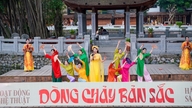
Culture needs a market to thrive and renew itself, but it cannot be subjected to extreme marketization. Cultural institutions need social resources, but they cannot turn public assets, heritage, and community memory into tools for short-term exploitation.
Therefore, alongside incentives, there must be criteria such as transparency, strict post-audit, commitment to serving the community, protecting cultural identity, and measuring social effectiveness. A good cultural project not only generates revenue but also creates a public, fosters cultural habits, provides opportunities for artists, generates livelihoods for the community, and enriches the national image.
From a broader, deeper, and more groundbreaking perspective, all institutions, mechanisms, and policies must ultimately be geared towards the people. Artists and writers need to stay close to the rhythm of people's lives, delve into new issues that reflect the breath of life, so that the artist's life experience resonates with the rhythm of society and people's lives.
This spirit also aims to ensure that culture and institutions keep pace with the new era, remaining close to social life, combining tradition and modernity, nurtured within the community, always present among the people, flexible, open, internationally integrated, absorbing the best of humanity, close, attractive, humane, capable of nurturing the soul and improving the quality of life for the people.
Source: https://mattran.org.vn/giam-sat-phan-bien-xa-hoi/mo-khoa-the-che-danh-thuc-van-hoa-70863.html

![[Photo] General Secretary and President To Lam attends the 13th National Congress of the Ho Chi Minh Communist Youth Union](https://vphoto.vietnam.vn/thumb/1200x675/vietnam/resource/IMAGE/2026/06/25/1782356968989_ndo_br_1-jpg.webp)


















![[Photo] General Secretary and President To Lam attends the Central Public Security Party Committee Conference](https://vphoto.vietnam.vn/thumb/1200x675/vietnam/resource/IMAGE/2026/06/24/1782302063612_a1-bnd-9302-9166-jpg.webp)