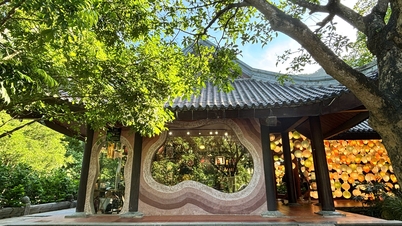
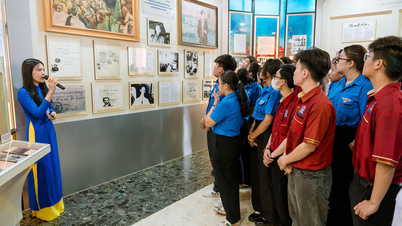
Art exhibition space at the Indochina Museum of Culture and Arts. Photo: Dinh Trung.

We need "midwives" from corporate capital flows.
1. In Hai Phong's business circles, Cao Van Tuan's name is associated with the edgy title of "King of Crocodiles." But stepping away from the fierce business world, this man finds himself in a boundless, romantic "quiet space" dedicated to antiques. He began collecting antiques and works of art in his twenties – a journey spanning over 40 years, from a quiet personal passion to building a cultural institution with one of the largest collections in the port city. Mr. Tuan says that to date, his collection comprises over 18,000 items, including approximately 2,000 antiques.
Mr. Tuan had long harboured the idea of building a museum, but it only recently became a reality. On a 13,000m2 plot of land, he constructed two buildings: one for displaying antiques and another for displaying paintings. He also devoted his efforts to collecting and restoring a traditional Northern Vietnamese house with Vietnamese worship spaces and a large house displaying artifacts related to rivers and waterways… The museum currently houses sets of plates, bowls, jars, and vases dating back 2,000 years, ancient pottery, rare Dong Son bronze drums, wooden artifacts, and artifacts of Japanese and Korean culture from several hundred years ago to the modern era. Alongside these are boats over a thousand years old, ancient couplets from the Ngo Quyen temple, a piano, and a chest containing the personal belongings of Empress Nam Phuong… The museum's art gallery contains over 300 works by famous Vietnamese artists. These include works by artists from the Indochina art period, paintings by musician and painter Van Cao; renowned artists such as Trinh Huu Ngoc, Nguyen Tien Chung, Luong Xuan Nhi, Bui Xuan Phai... and many paintings by contemporary artists.
“ The Indochina Museum of Culture and Arts is my love, my heartfelt wish, something irreplaceable. For me, culture is the territory of the nation, something of eternal value. If culture is lost, it means the territory is also lost. Therefore, cultural values must be preserved and spread through generations and within the community,” Mr. Tuan said.

Mr. Cao Van Tuan introduces his Phung Nguyen pottery collection. Photo: Dinh Trung.
2. There's a question almost everyone who visits the museum asks Mr. Tuan: Where did you get the money to buy such precious artifacts? Perhaps people are overwhelmed by the sheer volume of rare and valuable artifacts, so asking this question is understandable, but it's a question he always avoids answering. Because, according to him, culture is a journey of accumulation and building; it's like tiny grains of silt that can create vast delta plains. Many artifacts in the museum he had to buy, with a lot of money, but many others were gifts from acquaintances, friends, or antique enthusiasts. If you only thought about money and economic value, there wouldn't be an Indochina Museum of Culture and Art, and looking more broadly, no museum in the country would survive. The reason is that currently, museums are operating at a loss, unable to balance their income and expenses. If you only think about money, no one would be foolish enough to start a museum.

“Cultural values cannot be measured in money. If I didn't build the museum, I could rent out this 13,000 square meters of land to someone to sell excavators or use as a warehouse, and I would still get at least 30,000 VND/square meter/month. So, in terms of economics, I'm losing 400 million VND every month. That means I'm living a luxurious life, but to maintain this museum, I'm throwing away 400 million VND a month. Therefore, the question: 'Where did you get the money to build the museum?' was wrong from the start ,” Mr. Tuan explained.

3. Currently, the Indochina Museum of Culture and Arts is temporarily closed for upgrades and digitization of its exhibits, but it remains open to welcome student groups from schools free of charge. Mr. Tuan stated that significant investment of effort and resources is still needed, as the current state of the museum only fulfills 30% of his aspirations. He hopes that in the future, as people's spiritual lives improve, families will develop the habit of bringing their children to the museum every weekend. The museum will then become an open cultural space with a full range of services including entertainment, food, souvenir sales, and experiential activities. Museums also need to be connected with historical sites and included in tourist tours.
"We're not even thinking about selling tickets right now, but we're still trying to find an organization to run the museum so that it can become self-sufficient, " Mr. Tuan shared.


Currently, to maintain the museum, Mr. Tuan has to spend nearly 100 million VND each month. To get that money, he says there's no other way than to "work for hire," using his "special talents" to do many other jobs. "It's a bit difficult, but it will preserve the true values ," Mr. Tuan said.
However, what saddened Mr. Tuan was that despite his work being widely known, he still had to toil alone at the museum every day, receiving very little attention or support. Deep down, he still wished he could rent or borrow one of the many vacant government offices to use as an exhibition space. If possible, he could remove some of the exhibits from the current museum to free up space for rent, thereby using the funds to renovate the interior and invest in the exhibits to create a better museum for the public.
Although acknowledging that this is very difficult due to current regulations, Mr. Tuan believes that if there were a mechanism to remove obstacles related to land and premises, it would create a strong impetus for the development of private museums. “To prevent negative consequences, the State could completely enact strict regulations such as criteria for classifying private museums based on their scale and reputation before they can access public land; regulations on loan/lease terms; and the application of a strict ‘post-audit’ mechanism to prevent profiteering and the misuse of public land for other commercial purposes ,” Mr. Tuan boldly proposed.
Related news
Can Tho: Preserving and promoting the traditional cultural values of the Khmer ethnic group.
Discover the centuries-old citadel on Lam Thanh Mountain.

Vietnam encourages US businesses to expand investment in high technology.On the morning of June 26th, at the Government Headquarters, Deputy Prime Minister Ho Quoc Dung received Mr. Jeff Place, Supply Chain Director of Coherent Group (USA). During the meeting, the Deputy Prime Minister affirmed that Vietnam encourages US businesses to expand investment, especially in high-tech, innovation, and semiconductor industries. Lao Cai implements cultural and artistic activities on pedestrian streets to serve tourism.
Keywords:
#museum #antiques #Indochina Museum of Culture and Art
Source: https://congluan.vn/mong-cho-bao-tang-tu-nhan-duoc-tiep-can-dat-cong-post350093.html





![[Image] A look back at the capital's preparations for the century-long master plan.](https://vphoto.vietnam.vn/thumb/1200x675/vietnam/resource/IMAGE/2026/06/29/1782750453122_quy-hoach-100-nam-minh-duy-1-2118-jpg.webp)


















![[Photo] General Secretary and President To Lam works with the Party Committee of the Government on the work of preventing and combating storms, floods, extreme natural disasters and climate change.](https://vphoto.vietnam.vn/thumb/1200x675/vietnam/resource/IMAGE/2026/06/29/1782729441945_a1-bnd-0385-9454-jpg.webp)