

The emergence of ChatGPT and other AI-generated tools marks a major breakthrough in the field of artificial intelligence development. At this point, however, how AI will impact relations between nations remains a big unknown.
 |
| The European Union's proposed Artificial Intelligence (AI) Act is causing considerable controversy. (Source: CNN) |
The picture will become somewhat clearer if the following questions are answered.
Balance of power
The first question is: How will AI change the balance of power between nations? Will it narrow the power gap between countries or concentrate more power in the hands of a few major nations?
Historically, national power has often been measured solely by economic potential and military strength. In the future, the capacity to develop AI technology, as well as the ability to apply and integrate AI into national governance, will create a significant advantage, allowing the system to operate more smoothly, efficiently, and stably. This is likely to benefit leading nations in the technology race, such as the United States and China – two countries that have been leveraging AI to gain strategic advantages in key areas such as economics, military, diplomacy, and social management.
AI will therefore be more likely to concentrate power in the hands of a few countries rather than disperse it, because only a select few possess both the vast data repositories and the technological and financial infrastructure to continuously operate and update AI systems effectively. The overwhelming advantage these two superpowers already have in the field of AI will solidify their position on the international stage, preventing the current order from shifting towards a multipolar system. Overall, AI could widen the gap between countries with advanced AI technology and the rest.
However, this outcome is not certain. Several factors could influence the impact of AI on the balance of power between countries. One is the emergence of unexpected AI breakthroughs in small and medium-sized countries, inadvertently breaking the AI "monopoly" of larger nations. A second factor is the varying speed of AI adoption and integration among countries. Smaller nations may lag behind and not create the most advanced AI systems, but theoretically, they can utilize AI technology more effectively and intelligently than larger nations.
Armed conflict in the age of AI
The second question is: How will AI change the likelihood and intensity of armed conflict? In other words, will conflict occur more or less frequently, with more or fewer casualties, in an AI world ?
The emergence of AI in the military creates a paradox regarding future armed conflicts. On the one hand, AI can significantly reduce casualties in war. Precision targeting techniques and algorithmic support in decision-making could lead to a more precise form of warfare than ever before, minimizing damage to both sides.
However, AI making armed conflict "cheaper" and "cleaner" could lead to countries increasingly engaging in it. More wars are likely if the risk of casualties for both sides is significantly reduced. Leaders may be more willing to use military options if AI-driven warfare promises faster, more effective, and clearer results.
Nevertheless, the impact of AI on the frequency and intensity of conflict will be highly complex and multifaceted. The risk of escalation remains, as does the potential for a violent international reaction against nations engaging in AI-driven warfare without adequate consideration of human judgment and accountability. Furthermore, the international community's response, through potential legal frameworks, could also regulate the level of AI integration into military operations.
Solving global problems
The third question is: Can AI significantly assist humans in addressing global issues such as combating climate change?
The potential of AI in addressing global challenges is enormous, as it can provide groundbreaking solutions across many fields. AI's unparalleled data processing capabilities allow it to synthesize vast amounts of information across multiple formats to develop appropriate strategies for addressing pressing global issues such as climate change.
 |
| The emergence of ChatGPT and other AI generation tools marks a major breakthrough in the field of artificial intelligence development. (Source: Internet) |
By continuously analyzing data, AI can predict environmental changes with high accuracy, optimize energy consumption, and develop innovative methods to reduce carbon emissions. In the field of public health , AI can act as a "wall" against the spread of diseases and pandemics. It can improve the speed and accuracy of predictions, help control outbreaks quickly by leveraging public health data, and distribute vaccines rapidly to the most critical areas.
Furthermore, AI's contribution to addressing global challenges has the potential to extend to international security and humanitarian aid. It can help monitor conflict zones, predict refugee flows, and optimize aid delivery to the most severely affected areas. AI could therefore serve as the backbone of a new, more responsive and efficient system for international cooperation and aid distribution, reducing response times to humanitarian disasters and enhancing the effectiveness of those responses.
Controlling AI: Is it possible?
The final, and perhaps most important, question is: Will countries reach an international agreement to regulate AI before it's too late?
The UK, under Prime Minister Rishi Sunak, recently hosted its first global summit on "AI safety," representing a significant step toward international cooperation in managing the risks associated with artificial intelligence. The result is a united front not only among political leaders and technology companies in establishing AI safety protocols, but also between the two superpowers fiercely competing technologically: the US and China.
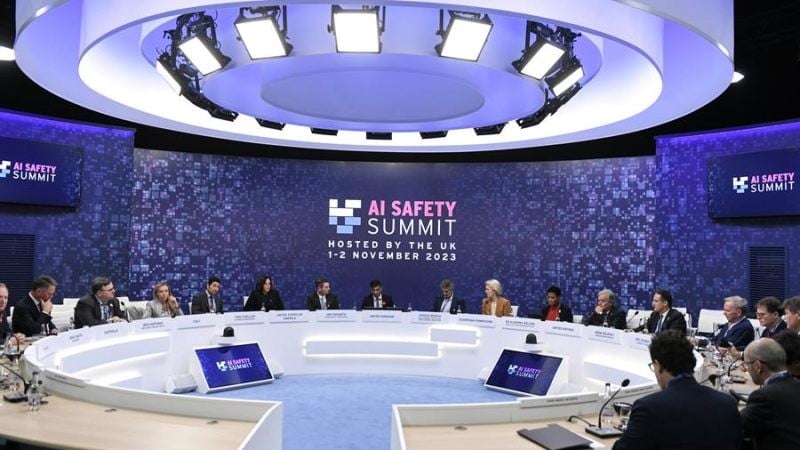 |
| The world's first summit on artificial intelligence (AI) took place in Bletchley, north of London, United Kingdom, on February 1-2, 2023. (Source: Euronews) |
However, this summit is merely a symbolic first step. The likelihood of countries reaching a meaningful agreement to regulate AI in the future will depend on the complex interplay of many factors.
It is crucial that countries with an AI advantage and those lagging behind find common ground when they face clear conflicts of interest: Stronger nations will prioritize exploiting AI to gain economic benefits and maintain power, while weaker nations will favor stricter regulations. However, we have precedents such as the Chemical Weapons Convention (CWC), which show that even in a highly competitive environment, common ground can still be found when the benefits of jointly restricting a potentially dangerous technology outweigh the benefits of allowing it to develop unchecked.
In addition, strengthening the international community's oversight capacity is also necessary. Establishing controls capable of adapting to the rapid pace of AI development will require unprecedented technical expertise and coordination among nations. Transparency in AI research and development will be paramount to ensuring compliance, much like the verification protocols that are central to nuclear arms control treaties.
Finally, and most importantly, it's about public awareness. After all, leaders will be most motivated to act decisively when their own citizens demand it. If people in every country support their governments taking concrete action to ensure the safety of AI, countries will have the incentive to cooperate in this ambitious endeavor. Otherwise, we risk being overwhelmed by the AI wave.
Source


![[Photo] Young people in Da Nang radiate the spirit of spring in traditional ao dai dresses.](/_next/image?url=https%3A%2F%2Fvphoto.vietnam.vn%2Fthumb%2F1200x675%2Fvietnam%2Fresource%2FIMAGE%2F2026%2F02%2F05%2F1770283565383_ndo_br_d7fd33c1bcc2329c6bd3-3439-jpg.webp&w=3840&q=75)





Comment (0)