

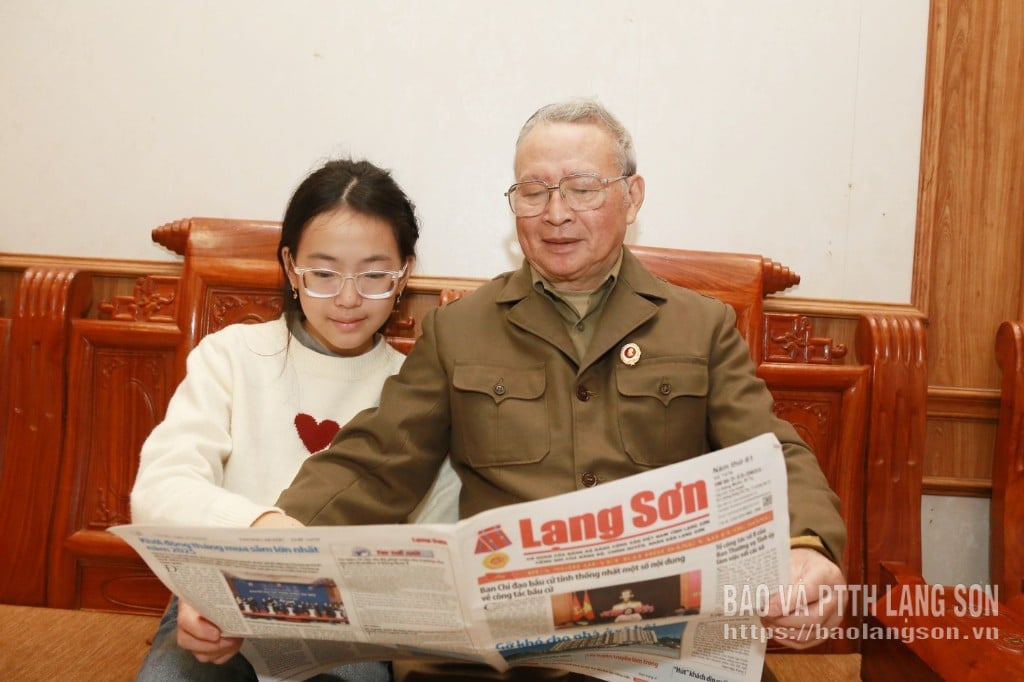
Unlike many veterans we met and talked to, who kept mementos from the war, veteran Nong Van Ninh had no mementos from his time in the resistance, because he belonged to the "special branch" A72 (a unit specializing in shoulder-fired missiles).
The story of the "special forces"
Mr. Nong Van Ninh was born in 1951 in Cho Hoang village, Thuong Cuong commune, former Chi Lang district, now Bang Mac commune. In August 1971, at the age of 20, he put aside his studies and volunteered to enlist in the army to defend the Fatherland.
After enlisting, he and his unit received training in Dong Anh district, Hanoi , specializing in the use of the A72 shoulder-fired missile. According to him, this was a heat-seeking missile supplied by the Soviet Union to the air defense forces of the Vietnam People's Army. The forces trained in this weapon were considered a "special branch" because they had to maintain absolute secrecy, were forbidden from writing letters or contacting their families, were absolutely loyal, and if captured by the enemy, had to find a way to destroy the launch mechanism (the part used to fire the missile), not reveal their unit's name or location, and be ready to sacrifice themselves to protect their comrades.
After a period of training, in January 1972, he and his unit were ordered to march into the Quang Tri battlefield. At this time, he was assigned to Company 2, Battalion 172 (an independent battalion). After more than a month of marching, his unit arrived in Quang Tri. In this battlefield, the enemy heavily bombed and attacked, especially the Thach Han River section and Quang Tri town – the only direct supply route to the Citadel and Quang Tri town. From the end of June 1972, our troops officially entered the battle to defend the Citadel. “Day after day, night after night, we lived and fought on a battlefield of only about 3 square kilometers. When one fell, another was brought in to replace them; before we even knew each other's names, the unit was worn down. And so, for 81 days and nights of glorious fighting, our troops successfully defended the Quang Tri Citadel,” Mr. Ninh recalled.
He recounted that, on the Quang Tri front, his missile unit was stationed in the An Ho hill area. During the fighting in this area, his unit shot down two enemy aircraft. According to his recollections, on the Quang Tri front, our A72 missile units, in addition to intercepting and ambushing enemy aircraft and being vigilant against enemy air bombs, also had to be wary of artillery fire from the enemy's 7th Fleet at sea. In this battle, our side suffered many casualties. He himself, during the fighting in the An Ho hill area, was hit by a bomb fragment in the head; the fragment pierced his helmet and lodged near the top of his head. Due to the pressure of the bomb and the wound, he fainted.
One detail that impressed and moved us was that during his time on the Quang Tri front, he was chosen by his superiors to carry out a plan to infiltrate deep into enemy territory and launch an attack from within. “The equipment I was given was a grenade, to be used in a suicide attack if captured by the enemy. This had been emphasized from the moment we trained in the ‘special forces.’ For us, ‘going to the battlefield means not regretting our youth,’ ready to sacrifice for the independence and freedom of the Fatherland, so being chosen for this mission felt very honorable and proud,” Mr. Ninh recalled. However, the operational plan later changed, so the above plan was not implemented.
Returning with a head wound, he felt he was much luckier than many of his comrades. That summer, the Quang Tri front experienced three rainy seasons: the rain of enemy bombs and bullets, the rain of the weather with a historic flood, and the "red rain." "Red rain" was the blood, bones, and bodies of countless soldiers who fell, merging into the earth and the Thach Han River during the battle to defend the ancient citadel. Mr. Ninh reminisced: "Those days, the resilience of our comrades was extraordinary, but the casualties were too high. Some people were buried, only to have bombs dig up the ground again..." The verses of author Le Ba Duong reflect the feelings of veterans like us about our fallen comrades.
"Boat going up the Thach Han River... row gently."
My friend still lies at the bottom of the river.
At twenty years old, I became like waves on the water.
"The shore will be calm, forever and ever..."
Rapid march
After the Quang Tri front, in early 1973, he and his unit returned to the North, training in Nam Dinh province in preparation for the Southern battlefield. In March 1973, his unit was ordered to march south to prepare for the Ho Chi Minh Campaign. At that time, he was assigned the role of the number one A72 missile gunner. Following the urgent telegram from General Vo Nguyen Giap: "Speed, even greater speed, boldness, even greater boldness, seize every minute, every hour, rush to the front, liberate the South. Decisive battle and total victory," his unit marched day and night, taking sick comrades to the front lines, and leaving damaged vehicles by the roadside. At that time, the US was no longer bombing, and the South Vietnamese army was weakened, so our march was very smooth.
By early April 1975, his unit arrived in Thu Dau Mot town, Binh Duong province. The most fiercely contested stronghold there was Phu Loi airfield. Our infantry and tanks, supported by timely and accurate artillery, launched a fierce offensive, crushing enemy resistance. Throughout the operation, he and his comrades received very close coordination from local units. By approximately 10:30 AM on April 30, 1975, our troops had taken control of the Phu Loi base. Building on this victory, the units advanced, liberating Thu Dau Mot town and capturing all the puppet regime's personnel. Afterward, his unit continued its advance to take over the Tan Thuan Dong base in Ho Chi Minh City.
Dedication in peacetime
After the liberation and reunification of the country, he returned to his hometown and continued to pursue his unfinished dream of studying. In 1976, he passed the entrance exam to the Department of Mathematics, Viet Bac Teacher Training University, now Thai Nguyen University of Education, Thai Nguyen province. After graduating in 1980, he worked at the Education Department of Chi Lang district. From 1988 to 1990, he studied at the Nguyen Ai Quoc Central Party School, now the Ho Chi Minh National Academy of Politics. After completing the course, he worked at the Hoang Van Thu Political School. He worked there for many years before transferring to the Provincial Party Committee's Propaganda Department, retiring in 2011.
After retirement, he continued to make many contributions to the neighborhood and the education sector, serving as Secretary of the Party Branch of Cua Nam neighborhood, Luong Van Tri ward, and Vice Chairman of the Provincial Association for the Promotion of Learning. For many years, he has been elected as a respected figure in the Cua Nam neighborhood.
In recognition of his contributions to the resistance war, he was awarded the Second Class Resistance Medal and the Third Class Glorious Soldier Medal by the State. During peacetime, he received numerous commendations, certificates of merit, and prestigious awards from various levels and sectors.
Ms. Ngo Mai Tram, Party Secretary and Head of the Cua Nam Block in Luong Van Tri Ward, said: "While working or performing duties in the block, Mr. Ninh always upheld the spirit of Uncle Ho's soldiers, always being exemplary and responsible, making important contributions to the development of the locality, and was highly trusted, loved, and respected by the people in the block."
Source: https://baolangson.vn/hoi-uc-thoi-binh-lua-5066895.html
![[Photo] A vibrant celebration of generations of Nhan Dan Newspaper staff](https://vphoto.vietnam.vn/thumb/1200x675/vietnam/resource/IMAGE/2026/03/11/1773228432744_cb-75-nam-7-7034-jpg.webp)





















































Comment (0)