


The extended family, including grandparents, in their new home - Photo: Provided by the author
My maternal grandparents' house was in Binh Duong (now Ho Chi Minh City), formerly Song Be. Back then, my father would take my mother and me on his rickety bicycle from the old Ho Chi Minh City. In the memory of a three or four-year-old child sitting behind, clinging tightly to my father's sweat-soaked back, the road to my grandparents' house seemed endlessly long.
In the dry season, clouds of dust swirl up under the wheels; and in the rainy season, the red dirt road is full of potholes, and I arrive home covered in mud.
Before electricity, my grandmother's house was dimly lit by oil lamps at night. The darkness of the countryside was thick and deep, inspiring children's imaginations to conjure up all sorts of frightening things, but it also gave me incredibly beautiful moonlit nights.
The moonlight bathed the courtyard, and everyone gathered around the wooden platform. There was no wine, tea, cakes, or sweets, just a few rambling conversations that nonetheless filled a corner of the garden with lively chatter.
The leisurely afternoons in the countryside also left many unforgettable memories in my mind. In the late afternoon, as the sun began to set, my grandfather would take me to the garden to gather dry firewood to start a fire.
My grandfather and I would go to the sapodilla tree, searching for fruit among its lush green foliage, or visit the cherry bush to pick ripe, red berries hanging from the branches. Sometimes he would pick cashews for me; the flesh would be dipped in sweet and sour salt, and the nuts would be roasted over a fire. The rich, nutty aroma of roasted cashews lingers in my mind, a strangely fragrant and memorable scent!
Every spring, my grandmother would make banh chung (traditional Vietnamese rice cakes). She'd pick the leaves from her garden, use pork from pigs she raised, and harvest the sticky rice from her own fields – everything was readily available from her garden, simple and rustic.
The whole family gathered around the well to wash the leaves, rinse the sticky rice, and marinate the meat. Grandma wrapped the cakes without molds, using only her nimble, practiced hands to make each cake perfectly square and neat. Those nights spent lying on mats and under blankets by the kitchen hearth, watching the cakes simmer, the smell of kitchen smoke mingled with the scent of leaves and the rich aroma of sticky rice still brings tears to my eyes whenever I remember them.
After about ten seasons of making bánh chưng (traditional Vietnamese rice cakes), my family advised my grandmother to rest because they were worried she would get tired. Everyone was hesitant to speak up, afraid of upsetting her by thinking her grandchildren didn't know how to preserve the old traditions. But my grandmother just smiled and said that this year she was "retiring."
My grandmother used to scold my uncles and aunts for buying everything, wasting money, because back then our family was struggling. Now that life is better, we can make things ourselves or buy them, as long as everyone is happy and comfortable; that way, Tet will be truly fulfilling.
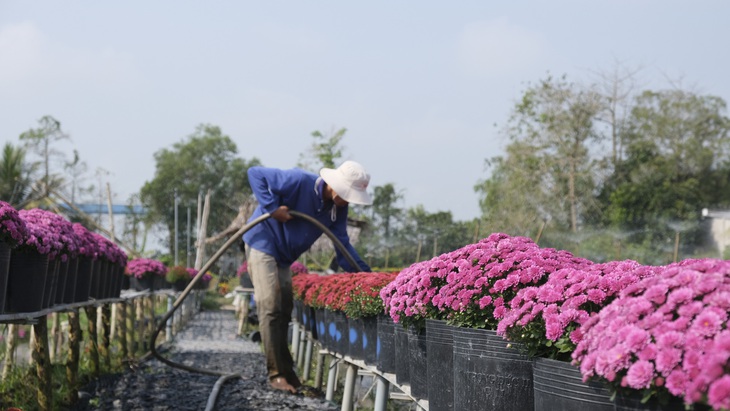
Caring for flowers to meet the demand for flowers for Tet (Lunar New Year) celebrations - Illustration photo
Life went on, and my maternal grandparents' house underwent several major renovations, but my grandmother absolutely refused to let them replace the old, worn-out tiled floor. My mother recounted that in the old days, whenever they saved up a little money, my grandfather would take my grandmother to buy each brick individually to save up for building the house.
When we finally had enough money to build, the bricks had become stained from being left unused for so long. My grandparents would take them to the well and painstakingly scrub each one clean so that we, their grandchildren, could have a beautiful, decent house. These bricks, which paved a long period of my grandmother's life, remind us of a time of poverty but also of hard work and unity. That is the greatest asset my grandparents left for their descendants.
The old house seemed impenetrable, but as my cousins grew in number, my grandmother told my uncles and aunts to tear it down and build a new one. We were indifferent, excitedly celebrating the new, spacious house, thinking that my grandmother would only be slightly upset, like she had been during previous house renovations.
After Grandma passed away, while cleaning the room, we found an old, chipped brick hidden deep at the bottom of the cupboard, and suddenly everyone's eyes welled up with tears. There are things that, by the time we understand them, there's no longer a chance to say sorry.
By loving her grandchildren more than herself, my grandmother taught us that preserving family traditions doesn't mean clinging to outdated customs. What she wanted us to secure was a happy and fulfilling future for her descendants.
Every spring, when the whole family gathers together, I feel as if my grandmother is still sitting in her familiar chair, her eyes dimmed by time but sparkling with joy as she watches my siblings and me laugh and play happily.
The house is different now; the old brick floor is gone, but the traditional architecture my grandmother left behind remains intact. It's been six years since she passed away…
We invite readers to participate in the "Springtime Home" writing contest.
As a source of spiritual nourishment during the Lunar New Year season, newspapers Youth Together with our partner, INSEE Cement Company, we continue to invite readers to participate in the "Springtime Home" writing contest to share and introduce your home – your warm and cozy haven, its features, and unforgettable memories.
The house where your grandparents, parents, and you were born and raised; the house you built yourself; the house where you celebrated your first Tet (Lunar New Year) with your small family... all can be submitted to the competition to introduce to readers nationwide.
The article "A Warm Home in Spring" must not have previously participated in any writing competition or been published in any media or social networks. The author is responsible for copyright, and the organizing committee has the right to edit the article if it is selected for publication in publications. Youth They will receive royalties.
The competition will take place from December 1, 2025 to January 15, 2026, and all Vietnamese people, regardless of age or profession, are welcome to participate.
The article "A Warm Home on a Spring Day" in Vietnamese should be a maximum of 1,000 words. Including photos and videos is encouraged (photos and videos taken from social media without copyright will not be accepted). Entries will only be accepted via email; postal mail will not be accepted to avoid loss.
Entries should be sent to the email address maiamngayxuan@tuoitre.com.vn.
Authors must provide their address, phone number, email address, bank account number, and citizen identification number so that the organizers can contact them and send royalties or prizes.
Newspaper staff Youth Family members may participate in the "Springtime Warmth" writing contest but will not be considered for prizes. The organizing committee's decision is final.
The Springtime Shelter Award Ceremony and the Launch of the Youth Spring Special Edition
The judging panel included renowned journalists, cultural figures, and representatives from the press. Youth The judging panel will review the entries that have passed the preliminary round and select winners.
The awards ceremony and launch of the Tuoi Tre Spring special issue are scheduled to be held at Nguyen Van Binh Book Street, Ho Chi Minh City, at the end of January 2026.
Prize:
1st prize: 10 million VND + certificate, Tuoi Tre Spring issue;
1 second prize: 7 million VND + certificate, Tuoi Tre Spring issue;
1 third prize: 5 million VND + certificate, Tuoi Tre Spring issue;
5 consolation prizes: 2 million VND each + certificate, Tuoi Tre Spring issue.
10 Readers' Choice Awards: 1 million VND each + certificate, Tuoi Tre Spring Edition.
The voting points are calculated based on interaction with the post, where 1 star = 15 points, 1 heart = 3 points, and 1 like = 2 points.
Source: https://tuoitre.vn/mua-xuan-ngoai-de-lai-20260113082948323.htm








![[E-Magazine]: Footprints leave their mark on the paths of the homeland](https://vphoto.vietnam.vn/thumb/402x226/vietnam/resource/IMAGE/2026/03/13/1773406981537_e-magazine-chan-w1200t0-di2610d199d5160716t11920l1-cn-029.webp)













































![[Photo gallery] Nhon Trach is ready to transform into a modern and civilized city.](https://vphoto.vietnam.vn/thumb/402x226/vietnam/resource/IMAGE/2026/04/02/1775104005524_hinh_1_20260402085339.jpeg)

![[Photo gallery] Dong Phu aims for modern and sustainable urban development.](https://vphoto.vietnam.vn/thumb/402x226/vietnam/resource/IMAGE/2026/04/02/1775104023925_111_20260402104322.jpeg)






Comment (0)