Maximum deduction of 47 million VND/month
In the draft Decree detailing several provisions of the Personal Income Tax Law, currently open for public comment, the Ministry of Finance proposes two options for deducting medical and education expenses for taxpayers and their dependents. Option 1 allows a deduction of no more than VND 20 million per year for medical expenses, excluding expenses covered under Article 23 of the Health Insurance Law; and no more than VND 21 million per year for education expenses at domestic institutions. Option 2 allows a deduction of no more than VND 23 million per year for medical expenses, excluding expenses covered under Article 23 of the Health Insurance Law; and no more than VND 24 million per year for education expenses at domestic institutions. To qualify for these deductions, taxpayers must have complete invoices and supporting documents as required by law. For medical expenses specifically, a detailed list of medical examination and treatment costs as prescribed by the Minister of Health is also required.
The Ministry of Finance explained that this proposal is based on the average spending on healthcare and education as determined by recent surveys on living standards. Specifically, the proposed deduction for healthcare expenses is 2-2.3 times the average individual spending on inpatient healthcare in 2024 (an average of 10.2 million VND), and the deduction for education is 2.3-2.5 times the average individual spending on this activity in 2024 (an average of 9.6 million VND).
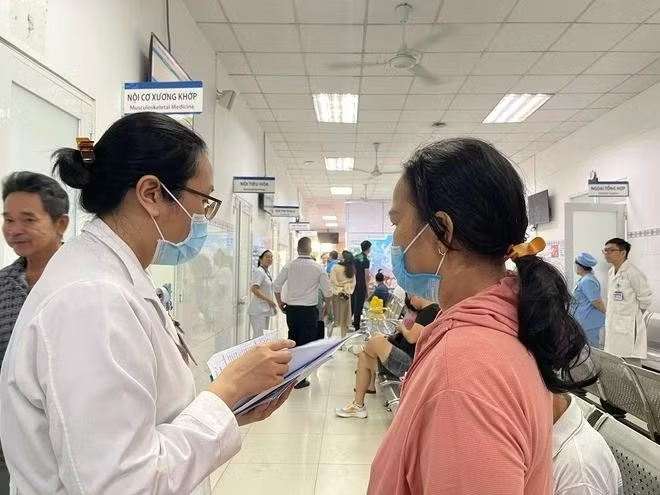

Experts recommend increasing the deductions for medical and education expenses before calculating personal income tax by 3-4 times compared to the Ministry of Finance's draft proposal.
Commenting on the draft, many tax and economic experts believe the deduction levels are still quite low. According to financial expert Nguyen Ngoc Tu, the two options for deducting medical and education expenses have insignificant differences. Notably, the drafting agency leans towards option 2 (maximum medical deduction of 23 million VND and education deduction of 24 million VND/year) to provide for future years. Applying a deduction ceiling instead of an absolute deduction is considered a balanced solution in the context of the state budget's difficulties, while still ensuring the rights of citizens. However, the proposed deduction levels are still low compared to the actual spending of citizens as well as compared to some countries in the region.
Tax expert and lawyer Tran Xoa, Director of Minh Dang Quang Law Firm, stated frankly that the proposed maximum deduction of 47 million VND per year for medical and education expenses is too low. In reality, the cost of education for a single dependent (child) varies at each educational level and increases progressively over time. Similarly, the annual medical expenses for a family are substantial, especially for dependents like elderly parents who often have chronic illnesses. For families with members suffering from serious illnesses, medical costs become a significant burden for taxpayers. Therefore, it is necessary to consider raising the maximum deduction for these two essential expenses.
Increase the total deduction amount to 3-4 times the proposed amount.
Expressing surprise at the deduction levels in the aforementioned draft, tax expert Nguyen Thai Son raised the question: "Why are medical and educational expenses capped for taxpayers?" He argued that the history of personal income tax implementation shows that absolute deduction amounts tend to change very slowly, while inflationary pressures and the prices of medical and educational services increase annually. If a fixed amount is set, will the policy be flexible enough to increase in line with market price increases in subsequent years? Instead of haphazardly choosing between 20 million or 24 million VND for an activity, Mr. Nguyen Thai Son suggested a long-term solution such as applying a deduction rate instead of a fixed amount. For example, the drafting committee could consider allowing taxpayers to deduct 50% of the total actual expenses incurred for medical and educational services. This approach would allow the deduction amount to automatically adjust to price fluctuations without the need for continuous law amendments. Regarding medical expenses, Mr. Son emphasized that "no one wants to be sick." Therefore, for serious and incurable diseases, tax policies need to demonstrate the highest level of humanity by allowing the full (100%) deduction of medical examination and treatment costs from taxable income.
Sharing the same viewpoint, lawyer Tran Xoa analyzed: if the Ministry of Finance's second option is followed, the deduction for education and training costs of 24 million VND/year, equivalent to 2 million VND/month, is insufficient. In reality, a family with one child attending a public primary school in Ho Chi Minh City (tuition-free) still pays 1.3 - 1.4 million VND per month, including lunch and related expenses such as drinking water, life skills training, and IT application facilities. Families with two children attending school pay at least 2.6 - 2.8 million VND per month. Families with children in integrated programs pay an additional 3.6 million VND per month for integrated English tuition. Therefore, for one child in a public primary school, the family has to pay up to 5 million VND per month, and a family with two children would pay up to 10 million VND per month. Not to mention the initial fees for items like uniforms and textbooks. Meanwhile, as children progress to higher grades, more expenses will arise. "At university, tuition fees alone range from 20 to 40 million VND, with many majors potentially reaching 100 million VND per year, not including fees for extra language courses, extracurricular activities, etc. Therefore, the deduction for education should be increased according to each educational level. For example, primary school should be 24 million VND per year, but gradually increase to secondary school at 36 million VND per year, high school to 48 million VND per year, and university and vocational training to 60 million VND per year. Simultaneously, medical expenses are a significant cost if illness arises. Long-term and life-threatening illnesses often require treatment with many specialized medications that are not covered by health insurance, so families have to pay out of pocket. Therefore, consideration should be given to allowing deductions up to a maximum of 50 million VND per year for those with long-term illnesses (illnesses requiring lifelong care) and up to a maximum of 100 million VND per year for those with life-threatening illnesses," Mr. Son proposed. In that case, families in this situation will receive more support.
Expert Nguyen Ngoc Tu also suggested that instead of the proposed figures of 20-24 million VND/year, which is only equivalent to 1.7-2 million VND/month, the medical deduction for treatment of common illnesses should be raised to approximately 4 million VND/month, equivalent to 48 million VND/year. For critical illnesses included in the medical list, 100% of actual costs should be deducted from pre-tax income. Because when lives and livelihoods are threatened, providing maximum tax support is not only an economic consideration but also a social welfare responsibility. Regarding education costs, Mr. Tu proposed increasing it to 5 million VND/month, equivalent to 60 million VND/year. "In the context of the country striving to boost growth and improve the quality of human resources, the education tax deduction needs to be 1.5 times higher than that for healthcare. This is considered a necessary leverage to encourage investment in knowledge and avoid the risk of falling behind in the region. Therefore, a higher education tax deduction is needed; this is also a policy to encourage learning and self-development, contributing to the country's economic development. Investing in education is a long-term endeavor, so supportive policies are necessary," Mr. Nguyen Ngoc Tu shared.
Do people with incomes over 28 million VND/month have to pay taxes?
According to calculations by the Ministry of Finance, in the case of a taxpayer with one dependent and incurring medical and education expenses, under Option 2, the individual could receive a total deduction of up to VND 307.4 million per year (including personal and dependent deductions, maximum deductions for medical and education expenses, not including social insurance and health insurance deductions...). Correspondingly, a taxpayer with one dependent and incurring medical and education expenses at the maximum level would have an income of VND 28 million per month after deductions, which would not be subject to personal income tax.
The scope of reimbursement for medical and educational expenses incurred abroad should be expanded.
The scope of medical and educational expense deductions needs to be considered. It shouldn't be limited to domestic services but should be extended to overseas, taking a more comprehensive approach in the context of integration. People should only seek medical treatment abroad as a last resort due to the nature of their illness or geographical distance (especially in border regions). Once the maximum deduction limit is set, discrimination based on location of medical treatment becomes unnecessary. Regarding education, families investing in their children's education abroad should be treated equally. Education shouldn't be limited to primary and university levels but should be extended to all, including senior citizens studying technology, foreign languages, etc. As long as there is learning to enhance knowledge, the individual should be entitled to a deduction.
Financial expert Nguyen Ngoc Tu
Mr. Nguyen Ngoc Tu analyzed: When medical and education expenses are deducted, many people will not have to pay tax or will pay less. However, the drafting committee's calculation of an income of 28 million VND/month as tax-exempt is only an illustrative scenario under maximum conditions; not every case will have the maximum deduction for medical and education expenses. In reality, the amount of deduction largely depends on the actual medical and education expenses incurred by the taxpayer. If the employee uses health insurance or sends their children to public educational institutions with lower costs than the assumed amount, the total deduction will decrease accordingly. Furthermore, from July 1st, the Government plans to increase the base salary from 2.34 million VND to 2.53 million VND, which will automatically increase the income of employees. Those with salaries calculated according to salary grades of around 10 million VND/month will see an increase of over 800,000 VND. This means that the taxable portion of income may also increase, reducing the effectiveness of personal deductions under the Personal Income Tax Law.
Similarly, Mr. Nguyen Thai Son emphasized that while income increases are coupled with inflation and rising living costs, the actual benefits for taxpayers may not be as significant as expected. Typically, when assessing the impact of tax policies, the drafting committee will propose tax reductions if implemented. However, in reality, revenue sometimes doesn't decrease but actually increases in subsequent years. A prime example is the personal income tax, which has repeatedly adjusted the personal allowance upwards, yet revenue in subsequent years is always higher than the previous year. Currently, the personal income tax rates are presented as absolute figures, so during the consultation period, rising prices and inflation render those figures outdated, and when implemented, they are even further removed from reality. This time, the increase in wages is intended to support workers in the context of rising inflation and fluctuating prices, including healthcare and education costs. Therefore, adjustments to allowances should not be based on absolute figures but should be adjusted based on price fluctuations each year to avoid obsolescence and prevent taxpayers from suffering further losses.
Allows for maximum reduction in education costs.
The Ministry of Finance has considered whether to require public schools this year to issue invoices to parents (upon request). If the invoice system in public schools and training centers is not yet standardized, it is not feasible to require invoices for this expense deduction. Furthermore, if a maximum deduction amount is stipulated, it could be simplified for both taxpayers and tax authorities to allow automatic deductions (for those with school-aged children).
Lawyer Tran Xoa
Lawyer Tran Xoa also commented that the possibility of maximizing deductions for medical and education expenses as proposed by the drafting committee is very rare. According to the draft, taxpayers who want to deduct education expenses must have invoices and supporting documents as required. He noted that, to his knowledge, most public schools at all levels do not issue invoices for fees collected from parents. Even if they do, it's usually just a receipt, which would likely not be accepted. Regarding medical expenses, no one wants to get sick, so hundreds or even thousands of taxpayers might not incur medical expenses during the year, thus preventing the deduction (in which case, the state budget would not suffer a reduction in revenue as proposed in the draft). This is not to mention the recent surge in fuel prices and the skyrocketing prices of numerous goods and services, forcing many families to be increasingly frugal in their spending. Therefore, the government should expand the deduction limits to support the people, provide additional assistance to taxpayers, and nurture revenue sources.
thanhnien.vn
Source: https://baolaocai.vn/muc-giam-tru-chi-phi-y-te-giao-duc-van-thap-post897269.html




































































































Comment (0)