

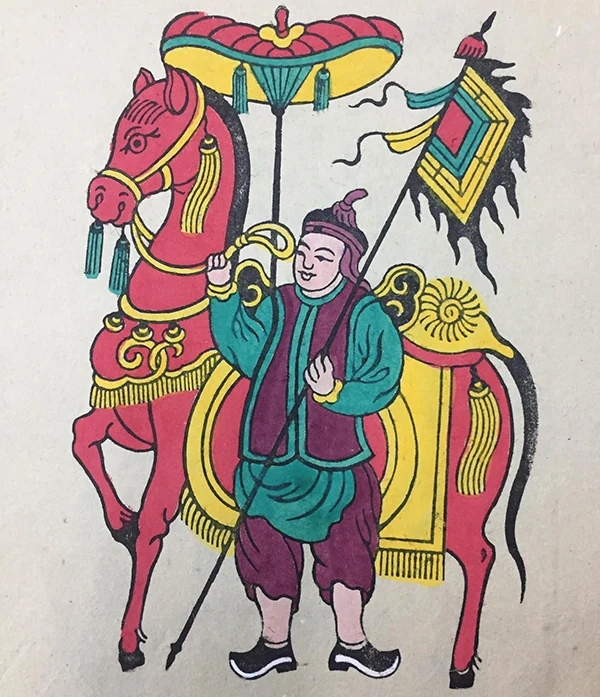
The painting "Horse Watching" belongs to the Dong Ho folk painting style. Illustration: BH
In the cycle of the twelve zodiac signs, each year carries its own unique feeling. For the Year of the Horse, the essence of spring arrives in the rhythm of movement: not noisy, not hurried, but persistent and expansive, like the leisurely sound of horse hooves on long roads unfolding before us. It's the feeling of powerful, purposeful steps, enough to make one think more deeply about the journey, about the continuation of paths already traveled and the journeys that lie ahead.
Throughout human history, few animals have been as closely associated with humankind as the horse. Since domestication, horses have accompanied humans across grasslands, mountains, forests, and plains, becoming a means of transportation, carrying goods, fighting, and earning a living. On the roads of territorial expansion, in trade, or in battles to defend the country, the hoof prints of horses have been an indispensable part of history.
From winged horses in Western mythology to the sacred horse of the East, and then the familiar horse in Vietnamese life and beliefs – this animal remains a steadfast companion on long journeys. The horse's powerful yet graceful, resilient yet free-spirited form has instilled in people a simple belief: if one is persistent enough, new horizons will eventually appear.
For the Vietnamese people, the horse is not just a figure from history; it has been present in everyday life. In the past, horse hooves left their mark on the long roads, accompanying officials and soldiers on patrols, fighting alongside troops to defend the borders, or silently pulling plows and carrying goods, contributing to the rhythm of agricultural life. In many regions, especially mountainous areas, the image of pack horses remains closely associated with the lives of the people, becoming a symbol of diligence, resilience, and perseverance throughout the years.
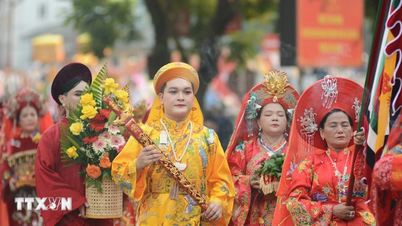
In folk religious beliefs, the image of the horse takes on a sacred significance. Horses appear in rituals of processions to deities, and in spirit medium ceremonies with elaborately decorated "sacred horses." In these contexts, the horse is not merely an animal, but also a bridge between humans and the spiritual world , between earthly life and beliefs that have been nurtured over generations.
Vietnamese folk language also preserves many traces of horses. Familiar idioms such as "a horse knows its old path," "a young horse is eager to kick," "when one horse is sick, the whole herd stops eating," or "only on a long journey can you tell a good horse" not only speak about animals, but also use these images to remind people about habits, nature, loyalty, and how to live together. Simple, easy to understand, yet profound, this is how our ancestors conveyed life experiences through everyday speech.
In visual arts, the horse has been a recurring theme for centuries. From ancient statues and carvings in village temples to folk paintings hung during Tet (Vietnamese New Year), the horse is depicted with a strong, sturdy posture, a long neck, and a flowing mane—simple yet full of character. In particular, the painting "Horses Galloping to Success" is often hung during the New Year or given as a gift for opening ceremonies or new ventures; it's not just a wish for good luck, but also carries a profound meaning: a hope that all endeavors will be successful and complete. Because, in folk belief, the horse not only moves quickly, but more importantly, it always reaches its destination.
In literature, the horse takes on many different forms. Sometimes it represents the strength to protect the land, sometimes it is the silent companion of mountain people, and sometimes it becomes a metaphor for freedom, loyalty, and resilience in the face of challenges. Through each era, this image continues to evoke much reflection, because it touches upon things very close to human life: perseverance, honesty, and the ability to travel long distances.
Therefore, mentioning the Year of the Horse also means mentioning the spirit of purposeful progress. It's not about hasty movement, but rather a pace formed from experience, from past lessons, and from the ability to adapt to change. Like a horse on a long journey, each step forward requires perseverance, alertness, and a clear awareness of the destination.
The Spring of the Year of the Horse 2026 is approaching with the gentle movement of nature. Amidst this springtime beauty, may each person maintain steadfastness in their choices, calmness in their mindset, and faith in what lies ahead. May each step along the long road ahead be peaceful and confident, like the hooves of a spring horse.
Phuong Anh
Source: https://baothanhhoa.vn/nam-ngo-noi-chuyen-ngua-277202.htm

![[Photo] “Red Journey” 2026: Vietnamese Youth Continue Building the Bridge of Friendship Between Vietnam and China](https://vphoto.vietnam.vn/thumb/1200x675/vietnam/resource/IMAGE/2026/04/20/1776629730866_4055880775670638308-9618-4200-jpg.webp)



























































Comment (0)