The sacred mission of the artist-soldier
Beginning with the historic milestone of 1945, when President Ho Chi Minh read the Declaration of Independence, artists of the "golden generation" of the Indochina Fine Arts School, such as Tran Van Can, To Ngoc Van, and Luong Xuan Nhi, keenly sensed the great turning point that opened a new chapter in the country's history. From then on, they created works of art brimming with emotion.
From propaganda posters reflecting revolutionary movements to sculptural works created using diverse materials such as lacquer, oil paint, silk, and watercolor, all bear the strong imprint of Vietnamese revolutionary art.
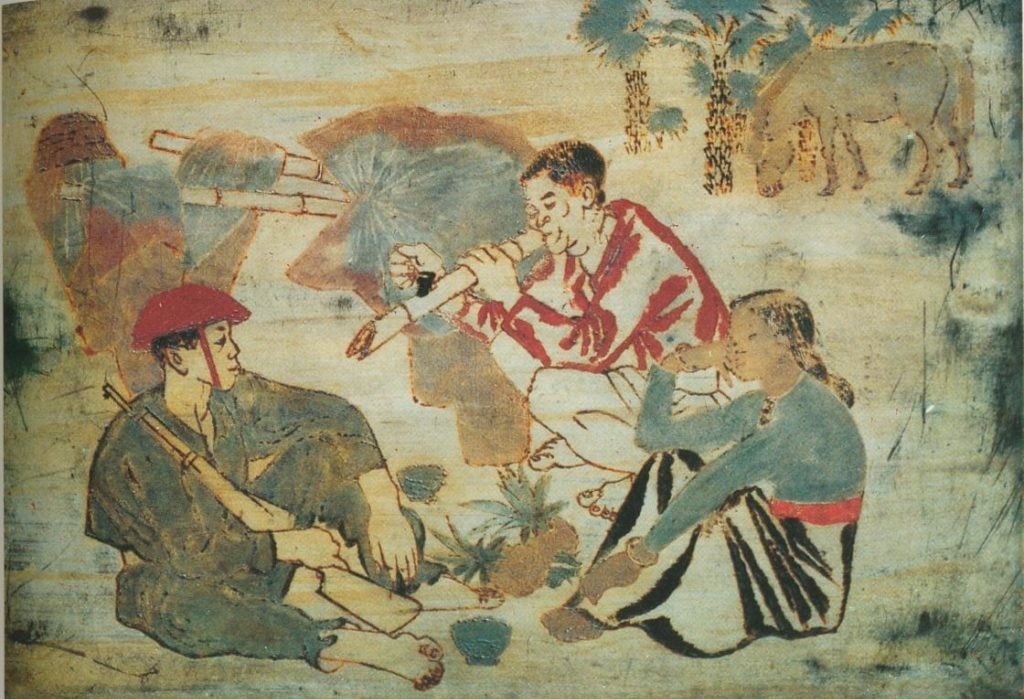
After the August Revolution, many artists went to the Viet Bac war zone, immersing themselves in the nine-year struggle against the French. Immediately afterwards, they joined the resistance war against the US to save the country. They contributed to the transformation of Vietnamese art by closely following the intense atmosphere of the battlefield.
Particularly noteworthy in the art of the anti-American war period were the battlefield sketches. Artists worked incredibly quickly on small scraps of paper from notebooks, cigarette packs, drawing with pens, ink, and even creatively using homemade colors from soot and tree sap… The works of Huynh Phuong Dong, Le Lam, Nguyen Duc Du… were as valuable as timely, authentic news reports transmitted directly from the front lines.
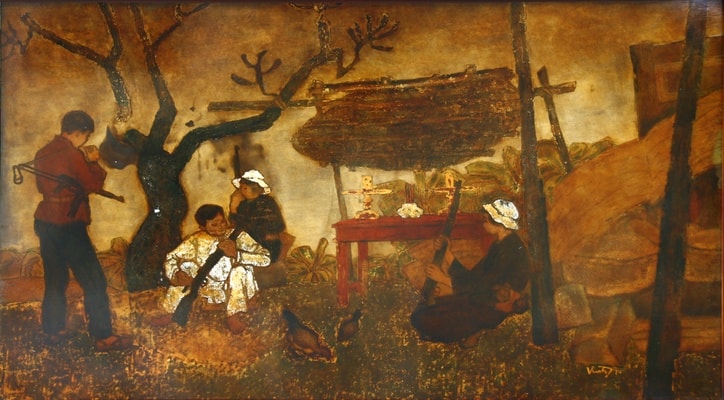
A theme frequently depicted by artists in their wartime paintings was the strength of solidarity between the military and the people. An example is the lacquer painting " Military-Civilian Solidarity" by artist Nguyen Sy Ngoc, created in 1949.

The awareness of protecting our ancestral heritage is also strongly expressed in the works. For example, the lacquer painting "This Land Belongs to Our Ancestors," created by artist Nguyen The Vinh (Nguyen Vinh Nguyen) in 1970, depicts the quiet moment after a battle.
Through the skillful hands of the artists, these works are a powerful affirmation of our inviolable sovereignty and the determination of our people and soldiers to preserve every inch of our ancestral land.
Distilling beauty amidst bombs and bullets.
What gives the art of the resistance war its vitality lies not only in its depiction of the brutality of bombs and bullets, but also in its ability to distill beauty from loss and sacrifice. Through these works, the vitality of the nation is present, lingering in every peaceful corner.
Amidst the gray haze of gunpowder smoke, one can still find the smile of a young volunteer or the vibrant scenery of a corner of the Truong Son forest stretching out with life...
.jpg)
The silk painting " Beside the Trenches of Vinh Linh" was created by artist and People's Artist Dao Duc during his field trip to Vinh Linh, Quang Tri , in the early 1970s. In this place, where tree trunks are scorched by artillery fire, green shoots still sprout beside soldiers resting, conveying a fervent desire for peace amidst the flames of war.
That sense of peace also permeates the woodcut painting "Soldiers Returning Home," created by artist Le Thanh Tru in 1973. The painting depicts a tranquil and poetic village scene in the Southern Vietnamese riverine region, with thatched roofs along the riverbanks and rows of water coconut trees.
Interspersed with the scenery are images of villagers joyfully welcoming the advancing troops on small boats or across distant monkey bridges. The work is full of foreboding and longing for the day of peace and reunification.

.jpg)
Chairman of the Vietnam Fine Arts Association, Luong Xuan Doan, assessed that the works of art created during the resistance war recorded a beautiful chapter in the history of Vietnamese revolutionary art. They were closely linked to the mission of the artist-soldiers, and to the voluntary sense of social responsibility in the context of the entire nation going to war.
In each artwork, every artist contributes to showcasing and preserving the beauty of Vietnam's land and people from generation to generation, a beauty that has never faded. Through their brushstrokes and use of color, they have fulfilled the glorious mission of their time.
Source: https://daibieunhandan.vn/net-co-no-hoa-trong-lua-dan-10415512.html