

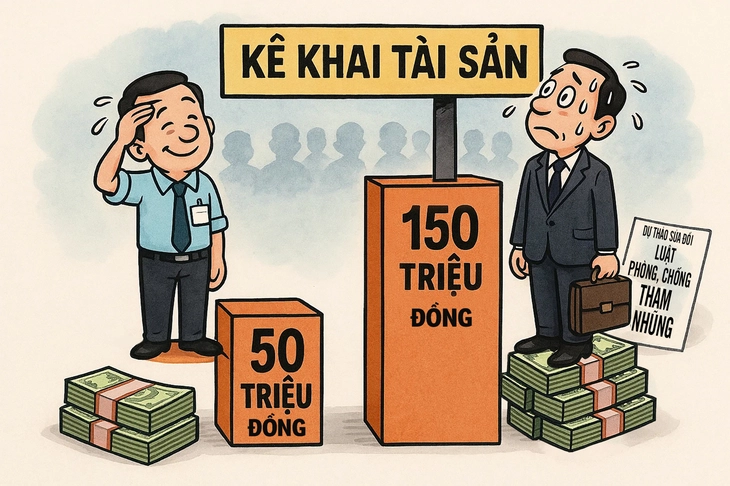
AI-generated image - Created by: TAN DAT
Notably, the bill stipulates an increase in the value of assets that must be declared from 50 million VND to 150 million VND, and supplementary declarations will be required when the person obligated to declare experiences changes in assets or annual income of 1 billion VND or more (the current law stipulates 300 million VND).
Any unusual changes in assets must be explained.
Representative Nguyen Tam Hung (Ho Chi Minh City) assessed that the 1 billion VND threshold is appropriate in the current economic context. However, he proposed legalizing the principle that all unusual changes in assets, inconsistent with income, even if under 1 billion VND, must be explained. This is an important mechanism to prevent the "techniques for evading declaration" that have been very common recently.
On the other hand, according to Mr. Hung, the bill only stipulates monitoring asset fluctuations. He proposed expanding it to include the development of a corruption risk analysis system, scoring the risk level of each individual based on the degree of asset fluctuations, declaration history, scope of authority, and sensitive areas (land, public investment, bidding, finance - budget).
"Individuals with high risk scores should be placed on a priority monitoring list. This is a strategic approach, shifting from passive detection to proactive monitoring," Representative Hung analyzed.
National Assembly representative Mai Van Hai ( Thanh Hoa ) also agreed with the above regulation threshold. However, instead of listing in detail precious metals, gemstones, money, etc., he suggested that the law stipulate that all assets valued at 150 million VND or more must be declared.
At the same time, he raised the question: "Assets acquired in the current year under 1 billion VND do not require supplementary declaration. However, if the accumulated assets from previous years exceed 1 billion VND, the regulations for declaration are unclear."
From another perspective, Mr. Hai pointed out that the current Anti-Corruption Law requires those obligated to declare assets and income to declare both their own and their spouse's. According to him, this would create difficulties in cases where the husband and wife fall under the jurisdiction of two different agencies: the Provincial Inspection Committee and the Provincial Inspectorate.
This representative argued that if both agencies conducted the verification simultaneously, it could lead to duplicate verification of the same joint property of the husband and wife subject to declaration. To avoid duplication, he proposed adding a principle of coordination to the draft law.
Specifically, in cases where a person obligated to declare assets falls under the jurisdiction of the Provincial Inspectorate and their spouse is subject to asset and income verification by a competent Inspection Committee, the Provincial Inspectorate should not conduct a re-verification of assets and income for that person during the same period.
Conversely, if the Provincial Inspectorate has already verified assets and income, the Inspection Committee should not re-verify them with the same individual at the same time.
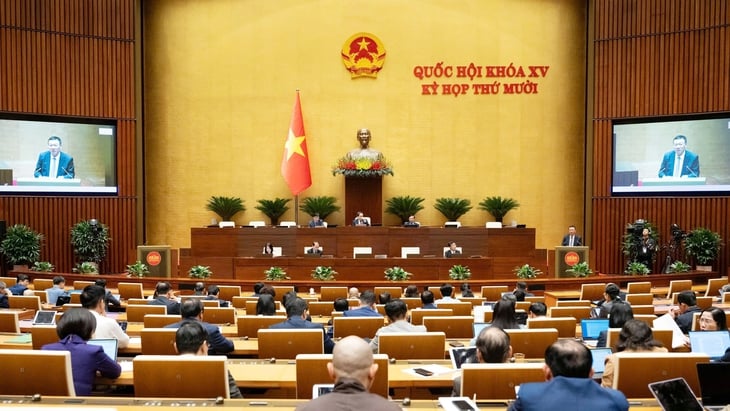
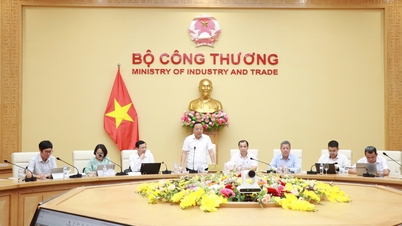
Discussion session on November 18th regarding the draft Law amending and supplementing a number of articles of the Law on Prevention and Combat of Corruption - Photo: GIA HAN
Using technology to detect signs of risk
Meanwhile, delegate Pham Van Hoa (Dong Thap) particularly emphasized that asset declaration should be an important criterion for evaluating officials annually. Untruthful declarations could result in being classified as failing to complete duties and facing disciplinary action.
Regarding the asset and income verification process, Representative Nguyen Van Huy (Hung Yen) noted that the draft law has established a relatively complete, transparent, and clearly defined procedural framework, while also creating conditions for competent authorities to proactively collect information and request explanations.
However, he pointed out that the new regulations only list the steps without clarifying the methods, timeframes, authority, and rights of the person being verified.
Therefore, he suggested adding details to each step, specifying concrete deadlines for each stage, and categorizing the forms of public disclosure of verification conclusions to ensure both transparency and the protection of business secrets and privacy.
Meanwhile, delegate Trinh Thi Tu Anh (Lam Dong) argued that currently, asset control still relies mainly on manual declarations and paper documents; this situation leads to overload, fragmentation, and delays in detecting unusual changes.
Therefore, the bill's provision regulating the application of information technology in asset and income management is entirely appropriate. She suggested that the National Assembly consider adding a provision assigning the Government to develop a suitable roadmap to gradually integrate the national database on assets and income with existing databases such as those on population, land, taxes, banking, and securities.
"The application of information technology allows for a change in the philosophy of control, shifting from waiting for officials to declare and explain to a system that automatically detects risk signs," she emphasized.
Furthermore, she also suggested considering expanding the use of public asset declarations on the National Electronic Information Portal. This is an effective social prevention mechanism, ensuring the principle of "power matches responsibility," and promoting openness and transparency.
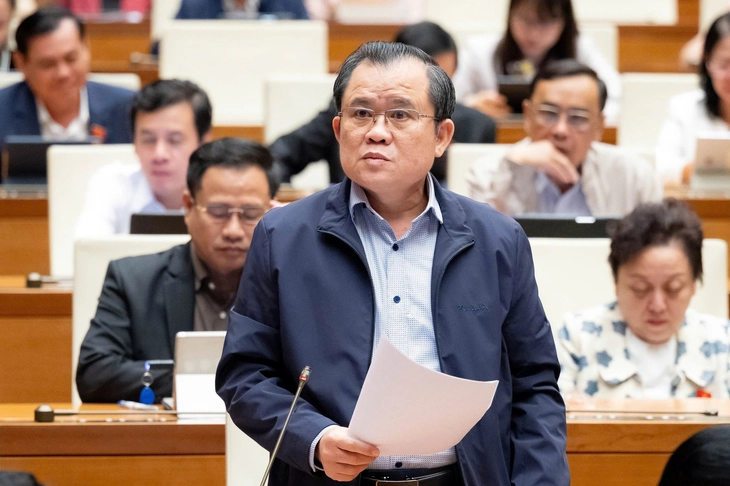
National Assembly representative from Ho Chi Minh City, Nguyen Tam Hung, giving a speech - Photo: GIA HAN
Why is the declared asset value increasing?
In explaining and responding to the delegates' opinions, the Inspector General of the Government, Doan Hong Phong, stated that the regulation increasing the declared value from 50 to 150 million VND and the value of additional income and assets that fluctuate during the year from 300 million to 1 billion VND is based on two main factors.
Firstly, there have been three salary increases since 2018. Secondly, due to the nearly threefold increase in socio-economic development, especially the significant price fluctuations in the market compared to 2018, "Here, it's assets and income that fluctuate during the year, not inherited balances from the previous year carried over to the next," Mr. Phong clarified.
Another issue of concern to National Assembly deputies is the scope of individuals obligated to declare assets and income in state-owned enterprises. Some opinions suggested clarifying the feasibility and practical relevance of controlling assets and income in cases where foreigners or individuals from the non-state sector participate in the management of state-owned enterprises.
Meanwhile, delegate Pham Van Hoa (Dong Thap) argued that for enterprises with less than 50% state capital, for example 49%, where the State assigns management personnel, these individuals should also be required to declare their assets and income. According to Mr. Hoa, there is no guarantee that these cases are free from corruption.
"This is a very large and expanding area of management, production, and business. Therefore, I propose that these cases be added to the list of those required to declare their assets, similar to the current law. If they are not declared, we will miss out on and overlook eligible individuals," Mr. Hoa added.
In explaining this matter, the Inspector General of the Government affirmed that the regulation requiring individuals assigned to manage and operate state-owned enterprises holding more than 50% of the charter capital to declare their assets and income is appropriate.
This is to meet the requirements of anti-corruption work in the current context and to comply with the provisions of the Enterprise Law and the Law on Management and Use of State Capital Invested in Production and Business at Enterprises.
"The government will stipulate that those required to declare assets and income in state-owned enterprises will be the direct owners, representatives of state capital, and certain positions and titles within state-owned enterprises, excluding foreigners or individuals from the non-state sector," Mr. Phong said.
Should digital assets be added to the declaration list?
Previously, regarding asset value, income levels to be declared and supplemented, there were suggestions to add "digital assets" to the declaration list; clarify how to determine "total income between two declarations" and to clearly define the types of assets that must be declared, including assets attached to land or assets jointly owned.
Regarding this matter, the Government Inspectorate stated that current laws do not yet have comprehensive regulations on digital assets, so it has not been included in the draft law and will continue to study it when sufficient legal grounds are available.
On the other hand, the concept of total income between two declarations remains as in current law and will be specifically guided in the decree. Assets owned by the declarant, their spouse, and minor children (including land use rights, houses and assets attached to the land, or jointly owned) must all be declared; the list of assets and the forms will be specified in detail by the Government in the decree guiding the implementation of the law.
Maintaining random verification is appropriate.
Regarding the random verification method, the Government Inspectorate assessed that this helps increase objectivity and transparency, while optimizing resources given the large number of people required to declare their assets. The current regulations still ensure rotation, as at least 20% of agencies and units, and at least 10% of individuals obligated to declare their assets in each unit, are verified annually, prioritizing those who have not been verified in the last four years. Therefore, maintaining the random verification method is appropriate.
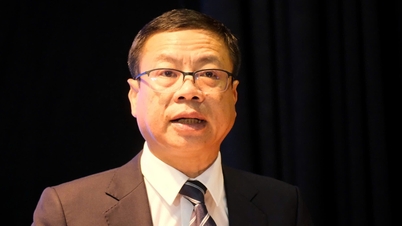
Mr. LE NHU TIEN (former Deputy Chairman of the National Assembly's Committee on Culture and Social Affairs):
Assets and income that have been declared must be verified.
Mr. LE NHU TIEN
In fact, conducting an annual random draw to select at least 20% of agencies and units, and at least 10% of individuals obligated to declare their assets in each unit, is also a viable solution when the number of people required to declare assets is very large.
However, this is only a short-term solution; in the long run, it will not meet the requirements, will not be comprehensive, and will also be somewhat risky, with those who need verification not being verified while those who don't need it are being verified.
Therefore, in the future, solutions should be implemented to strengthen the verification of declarations. This should focus on verifying those holding positions of authority within agencies and units, those showing signs of corruption, or those with the potential and conditions to engage in corruption, such as those in charge of finance, planning and investment, procurement, bidding, and large projects.
Furthermore, recent cases and incidents have revealed that the flow of money and assets of many corrupt officials is very circuitous and unpredictable. Some even transfer assets to their underage children, to close family members, or abroad...
Therefore, asset declaration should not only be required for individuals showing signs of violations, dishonesty, or a risk of corruption, but also for family members, not just spouses.
At the same time, once the declarations are completed and verified correctly, they must be made public so that the people and competent authorities are aware. If the declarations are simply kept in a filing cabinet at the office, they are of no use.
Representative HOANG VAN CUONG (Hanoi):
Proposal to avoid drawing lots for random verification of assets and income.
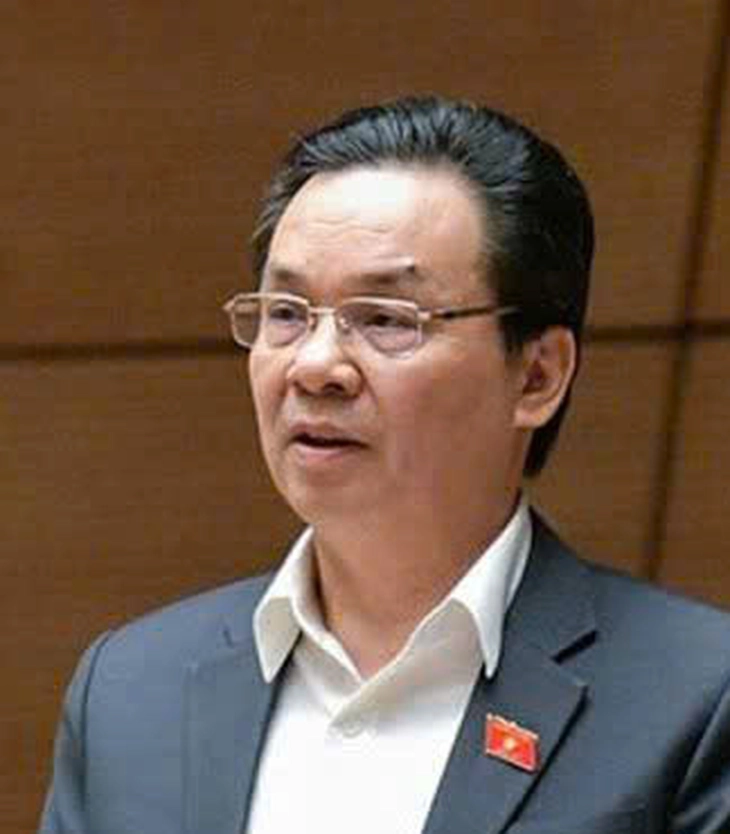
Representative HOANG VAN CUONG
I suggest that a lottery system should not be used to randomly verify assets and income.
This makes the implementation of anti-corruption efforts somewhat "hit-or-miss," lacking a legal basis.
Instead, periodic verification could be implemented on a rotational basis, for example, checking 20% of those who declare their assets each year, so that the entire population would be verified once every five years.
This approach ensures fairness and transparency, making the verification process normal and free from negativity or pressure.
Furthermore, the recovery of assets obtained through corruption is a matter of great public concern. In reality, corrupt individuals often try to conceal or distribute their assets among their children, siblings, and other family members, making the investigation process difficult.
Therefore, I propose that regulations should stipulate that in cases where individuals have been prosecuted for corruption and causing asset losses, the investigation into the recovery of assets should not only focus on the individual's personal assets but also on the assets of related parties to prevent their dissipation. Doing so would ensure a stronger deterrent effect in the recovery of assets obtained through corruption.
The most important aspect of asset declaration is whether it provides a clear and reasonable explanation for the assets acquired. If the declarant has legitimate documents and evidence of the purchase or transfer of assets, verification should not be mandatory, avoiding a waste of time and resources. Verification should only be conducted when there are signs of dishonest declaration, accusations, or suspicions about the origin of assets.
Representative HOANG VAN CUONG (Hanoi)
Source: https://tuoitre.vn/ngan-ne-ke-khai-tai-san-2025111908275349.htm


![[Photo] General Secretary and President To Lam meets with National Assembly delegates from ethnic minorities.](https://vphoto.vietnam.vn/thumb/1200x675/vietnam/resource/IMAGE/2026/04/20/1776696701056_a1-bnd-8331-3342-jpg.webp)
![[Image] National Assembly discusses the implementation of the socio-economic development plan.](https://vphoto.vietnam.vn/thumb/1200x675/vietnam/resource/IMAGE/2026/04/20/1776696707422_ndo_br_img-20260420-185419-jpg.webp)





![[Image] National Assembly discusses the implementation of the socio-economic development plan.](https://vphoto.vietnam.vn/thumb/402x226/vietnam/resource/IMAGE/2026/04/20/1776696707422_ndo_br_img-20260420-185419-jpg.webp)











































































Comment (0)