


Prime Minister Pham Minh Chinh attended the conference introducing successful digital transformation models at the ministerial and sectoral levels within the People's Court system.
The conference, organized by the Supreme People's Court, connected online with more than 800 people's courts at all levels nationwide. Attending the conference were Politburo member, Secretary of the Central Committee of the Communist Party of Vietnam, and Chief Justice of the Supreme People's Court Nguyen Hoa Binh; Minister of Information and Communications Nguyen Manh Hung; and leaders from central ministries, agencies, and the judicial sector.
Opening the event, Chief Justice of the Supreme People's Court Nguyen Hoa Binh stated that the Supreme People's Court being selected by the National Committee on Digital Transformation to host the Conference on Introducing Successful Digital Transformation Models at the Ministry and Sector levels is a great honor and a significant event, marking a turning point in the process of innovating and modernizing the court's operations towards professionalism, modernity, fairness, strictness, integrity, and service to the nation and the people.
The rapid development of digital technology is opening up many opportunities to improve national governance and the administration of justice worldwide. Particularly in the context of the COVID-19 pandemic, digital transformation in the court system has become more urgent than ever.
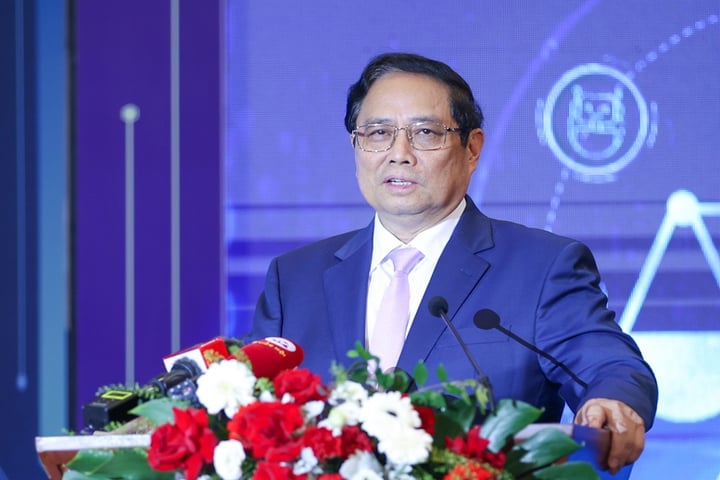
Prime Minister Pham Minh Chinh: Building an e-court system is a key and ongoing task.
International practice shows that countries with advanced science and technology that have prioritized digital transformation in judicial activities have achieved significant progress in improving the operational standards of this field. In Vietnam, accelerating the digital transformation process and building an e-court system has been identified as an urgent and central task. Recently, the Supreme People's Court has implemented many advanced IT systems to handle court work in a digital environment, helping to improve operational efficiency and enhance the professionalism, openness, and transparency of the courts.
Digital transformation is the result of a continuous process. Digital transformation cannot succeed if it is merely a fleeting trend.
At the conference, Minister Nguyen Manh Hung highly appreciated the implementation of digital transformation at the Supreme People's Court, noting the initial successes. The greatest success is that digital transformation has become a daily working tool for 12,000 judicial officials. This is the result of three years of digital transformation. Digital transformation cannot succeed if it is merely a movement; it must be the result of a continuous process.
From the outset, the Supreme People's Court has chosen strategic partners to collaborate with, because digital transformation is not about buying software for use, but about developing software for oneself. Digital transformation software is not something that is written and then finished; it will be refined during the usage process. This requires close cooperation between digital technology businesses and government agencies, walking together on a long journey and becoming strategic partners.
State agencies must clearly define the challenges for digital technology businesses, provide vocational training and specialized skills training in their respective fields, and supply businesses with data and industry knowledge to develop products. These businesses should then directly use the products daily and continuously provide feedback for improvement. This is the requirement for state agencies to successfully achieve digital transformation. The software has been written, but making it smarter day by day is the responsibility of the state agencies. The Minister gave an example: after more than two years of the Supreme People's Court using the system, users have submitted 27,000 difficult legal cases for consultation. From these, 18,000 standardized cases have been created and entered into the system for future reference, enriching the knowledge base of the judiciary.
According to Minister Nguyen Manh Hung, in the initial phase, the most knowledgeable people in the organization must teach and impart their knowledge to the digital transformation software and virtual assistant so that others in the organization can use them. When employees use the virtual assistant to handle their daily work, they will discover things that the virtual assistant doesn't know and then seek knowledge to supplement it. In the later phase, once the virtual assistant is in use, the people who make the assistant smarter are the users themselves.
Digital transformation is not just about automating what you're doing or automating old processes; it's a revolution in how you do things, how you operate your organization, a revolution for change rather than a technological revolution. Therefore, leadership is crucial. The fact that the Chief Justice of the Supreme People's Court directly undertook the first digital transformation project and directly led the digital transformation of the judicial sector is a prerequisite for successful digital transformation.

Chief Justice of the Supreme People's Court Nguyen Hoa Binh: The Supreme People's Court has put into use many advanced IT systems to handle court work in the digital environment, helping to improve operational efficiency and enhance the professionalism, openness, and transparency of the Court.
From the outset, the digital transformation of the Supreme People's Court has focused on serving its core target: its officials and employees. It has created digital tools and virtual assistants to reduce their workload, shorten working hours, and improve the quality of their work. Digital transformation will not succeed without the support and daily use of its officials and employees.
Digital transformation has reached every street, every house, and every target group.
Speaking at the conference, Prime Minister Pham Minh Chinh emphasized that the Party and the State have always paid attention to and identified digital transformation as an important political task, an inevitable trend, and an objective requirement in the country's development. Digital transformation is a task that is both a long-term strategic undertaking and requires monitoring, evaluation, urging, and decisive and effective implementation.
"Vietnam has determined that digital transformation must be nationwide and comprehensive, with the people as the center, subject, goal, driving force, and resource. Therefore, digital transformation has reached every street, every house, and every target group," the Prime Minister said.
Project 06 is considered a key and important task of national digital transformation, serving as a foundation for changing the way people and businesses live, work, produce, and conduct business based on digital technology.

Minister of Information and Communications Nguyen Manh Hung: Digital transformation is a revolution in the way things are done, the way organizations operate, a revolution for change rather than a technological revolution.
Building an e-court system is a central and ongoing task.
The Prime Minister emphasized that the development of e-courts is a central and continuous task in the judicial reform process, and an urgent task aimed at improving the efficiency of the court system and strengthening people's trust in the law and justice.
The Prime Minister highly appreciated the achievements in the digital transformation of the judicial sector. The Prime Minister also frankly pointed out some difficulties and challenges in the national digital transformation in general and the digital transformation of the judicial sector in particular, such as the slow pace of building and perfecting the institutional framework serving digital transformation, the low quality of online public judicial services, the inadequate digital infrastructure to meet development needs; limitations in data connectivity, integration, and digitization; and insufficient attention to cybersecurity and information security in many areas…
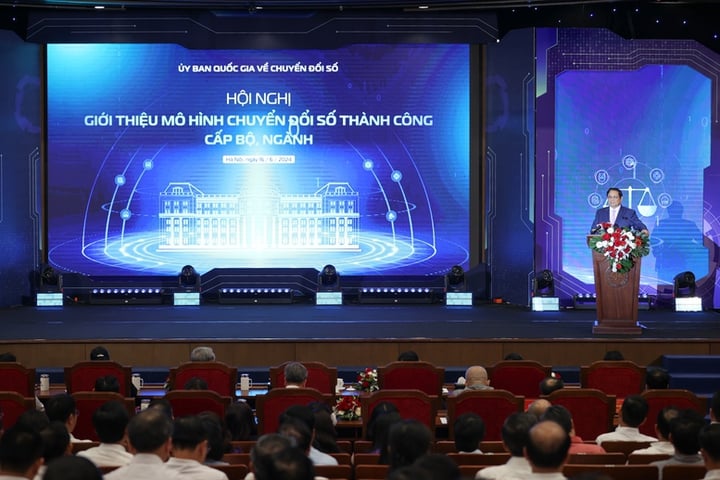
Overview of the event
Prime Minister Pham Minh Chinh requested the judicial sector to continue strongly promoting digital transformation and building e-courts with the spirit of "5 accelerations," including: Accelerating the improvement of institutions, mechanisms, and policies in digital transformation and the construction of e-courts; accelerating the development of digital infrastructure and platforms to create an important foundation for building e-courts and ensuring cybersecurity and information safety in all situations; accelerating the creation of digital data, developing digital human resources, digital skills, and professional training to meet the requirements of e-court development; and accelerating widespread dissemination of information within the judicial sector so that all officials, civil servants, and judges wholeheartedly participate in the digital transformation process and the construction of e-courts.
The Prime Minister hopes and believes that the judicial sector will continue to implement the digital transformation and the development of e-courts in a comprehensive and effective manner, in accordance with the spirit of Resolution No. 27/NQ-TW of the Central Committee, contributing to the successful achievement of the goals and requirements set forth in the Resolution of the 13th National Congress of the Party: "Building a professional, modern, fair, strict, honest, and dedicated Vietnamese judicial system that serves the Fatherland and the people."
Some notable achievements in the digital transformation of the judicial sector.
- The judicial sector has implemented the development of numerous digital platforms in managing the operations of the People's Courts, such as: litigation activities, work management, leadership and management, personnel management, case file management and archiving, asset management, online meetings and conferences, statistics, aggregation, monitoring of court information on the internet, and monitoring and operation of the People's Courts…
- Digital transformation has been accelerated to provide public judicial services in a modern, convenient, cost-effective, and transparent manner through the electronic environment; many online public judicial services have been implemented on the National Public Service Portal, with over 1.4 million judgments and decisions published and serving over 180 million accesses for searching and accessing information.
- Online trials have been implemented at all levels of courts, bringing many practical benefits to the people and society. Accordingly, from the beginning of 2022 to the present, people's courts at all levels have coordinated with prosecuting agencies to conduct online trials for nearly 20,000 cases, saving approximately 100 billion VND.
- Initial steps have been taken to apply artificial intelligence and build virtual assistants to support judges; over 168,000 documents, over 1.4 million judgments, and over 24,000 legal questions have been integrated. To date, there have been over 5.7 million inquiries, averaging 10,000-15,000 per day.
Source: https://mic.gov.vn/nganh-toa-an-nhan-dan-mo-hinh-chuyen-doi-so-thanh-cong-cap-bo-nganh-197240616224716488.htm

![[Image] Checking the security conditions at the exam site, ready for the 10th grade exam.](https://vphoto.vietnam.vn/thumb/1200x675/vietnam/resource/IMAGE/2026/05/28/1779943458889_z7872507660648-d764421a26e8cd7b61d70d142a48a685-jpg.webp)



![[Photo] Opening Ceremony of the National People's Council Conference on the Implementation of Directions and Tasks for the 2026-2031 Term](https://vphoto.vietnam.vn/thumb/1200x675/vietnam/resource/IMAGE/2026/05/28/1779939257690_ndo_br_bnd-1991-jpg.webp)


![[Photo] General Secretary and President To Lam presents appointment decisions to Supreme People's Court Judges and Deputy Chief Justices.](https://vphoto.vietnam.vn/thumb/402x226/vietnam/resource/IMAGE/2026/04/09/1775731918158_ndo_br_1-317-jpg.webp)



























































































Comment (0)