A man seeking to rediscover the old ways of a land of learning.
In a conversation with Mr. Bui Tan Nam (formerly Vice Chairman of the People's Committee of Duc Chanh commune, currently Deputy Head of the Party Building Committee - Party Committee of Mo Cay commune), I was moved when I heard about Mr. Dinh Tam - a veteran Party member who has dedicated almost his entire life to preserving the cultural, historical, and ethical values of his hometown, Mo Cay.
This temple was once considered a symbol of the scholarly tradition of Quang Nam province. Built in 1854, when Nguyen Ba Nghi initiated the Confucian revival movement, it became a place to honor learning and the talented individuals of this region.
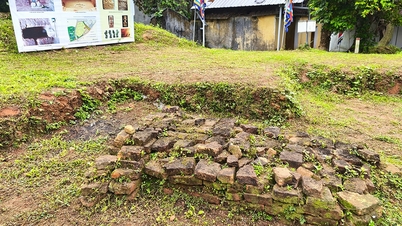
However, through wars and the vicissitudes of time, the temple is left with only a few time-worn stone steles, old laterite stone walls, and a thick layer of weeds growing around the former foundation.
Amidst that desolate landscape, Mr. Dinh Tam, who has dedicated his entire life to his hometown of Mo Duc, has taken on a quiet "duty": to rediscover the memories of his homeland.
Mr. Dinh Tam shared that every day he goes to the temple, sitting for hours beside the weathered laterite stones, remembering the teachings of his ancestors: for a land to be sustainable, it must value learning and preserve its cultural roots.
"Preserving and protecting the Temple of Literature means preserving the tradition of studiousness of a region. It is also a way to educate the young generation of today and tomorrow," he said slowly but with great passion.
From the fragmented documents that remained, he painstakingly searched for translations of the stele inscriptions listing the names of the scholars and graduates of the Mộ Đức region in the past; he diligently collected images and met with elderly people to piece together fragments of memories that were gradually being obscured by time. Each meeting, each old page, was, for him, like "gathering back time."
Not stopping at Van Thanh, he also repeatedly proposed the restoration of the Ba Noa Tunnel - a site that was once an important revolutionary base but had seriously deteriorated after the war and the passage of time.
For him, each historical site is not simply an old structure, but the very soul of his homeland. "Each historical site is a part of the soul of our homeland; losing it means losing that soul as well," he said.
It was precisely because of this persistence that the local authorities and the province began to pay attention to the site, including the Ba Noa Tunnel in the list of protected historical relics and classifying it as a historical monument.
Perhaps he understood better than anyone else that preserving culture and knowledge is not just about keeping old stones or ancient temples, but also about preserving the way of thinking, morality, and how people treat their ancestors and the history of their homeland.
For many years, he has consistently petitioned authorities at all levels regarding the restoration, preservation, and promotion of the value of historical sites.
During meetings with constituents, one often sees the elderly party member slowly stand up, his voice not loud but clear, when mentioning Van Thanh as if it were a part of his homeland's very being: "What is the soul of our homeland cannot be lost."
A simple statement, yet behind it lies the arduous journey of several decades of someone who refuses to let the memories of their homeland be buried under the dust of time.



Complete faith in the Party
Mr. Dinh Tam had the honor of joining the Party at a very young age. He participated in Party work, mass mobilization work, and contributed many years to the local government apparatus.
But perhaps what made the people respect him was not the positions he had held, but the way he lived up to his oath as a party member.
Even in his nineties, he regularly participates in Party branch meetings, carefully recording every new policy and directive, and patiently explaining them to the villagers.
During meetings, that senior party member always frankly offered suggestions on issues related to combating corruption and negative practices, and upholding the ethics of cadres and party members.
Within his family, he was a role model of character and morality. He often taught his children and grandchildren: "Respect your elders and be considerate of your juniors. Learn the ways of being a good person before learning to read and write."
He lived a simple, honest life and was always willing to help others. It was this sincerity that earned him the respect of the villagers, like a silent, ancient tree casting its shade in the countryside.
From the spirit of the past to the beliefs of today.
The story of Mr. Dinh Tam is a story of continuity between the past and the present; between the cultural traditions of his homeland and the responsibility and beliefs of a Party member in today's life.
As he quietly wiped the ancient stone tablets at the Temple of Literature, he was also preserving the memory of an entire region known for its scholarship.
When he stood up to speak at branch meetings, it was also a moment when the sense of responsibility and faith of a veteran party member continued to be passed on to the next generation.
The commune of Mỏ Cày is changing day by day. Concrete roads have been built, stretching through every small hamlet, and the lives of the people are improving day by day.
But amidst the hustle and bustle of modern life, the image of Mr. Dinh Tam remains a necessary moment of quiet reflection, reminding everyone that if we lose tradition, we can easily lose our own roots.
Just as the Van Thanh Temple was once a gathering place for generations of Quang Ngai people who valued learning and morality, Mr. Dinh Tam today quietly preserves those values in community life.
Without fanfare or ostentation, simply with unwavering loyalty to the homeland and the Party.

In Mo Cay commune, people still speak of him with special respect: "Mr. Tam was not only the guardian of the temple, but also the guardian of people's hearts."
Amidst the turbulent currents of modern life, there are still people who quietly and persistently gather fragments of their homeland's memories to preserve for future generations a belief in knowledge, culture, and the beautiful traditional values of the nation.
With all his simplicity and dedication, Mr. Dinh Tam not only contributed to the reconstruction of an ancient temple, but also helped to preserve the cultural essence and the compassionate traditions of the resilient Mo Cay region.
Watching him stand silently amidst the twilight sky in the courtyard of the Van Thanh Temple, I suddenly remembered President Ho Chi Minh 's teachings in his work "On Cultural and Artistic Work" : "Whether Western or Eastern, whatever is good, we should learn from it to create a Vietnamese culture. That is, we should take the good experiences of ancient and modern cultures, cultivate a purely Vietnamese spirit in Vietnamese culture, and align it with the spirit of democracy."
That teaching remains just as valuable today, when preserving national cultural identity has become a crucial foundation for national development in the context of deep integration.
And people like Mr. Dinh Tam, with their dedication and unwavering faith, are quietly continuing to uphold the good values of their homeland for future generations.
Source: https://baovanhoa.vn/van-hoa/nguoi-gin-giu-hon-que-227427.html