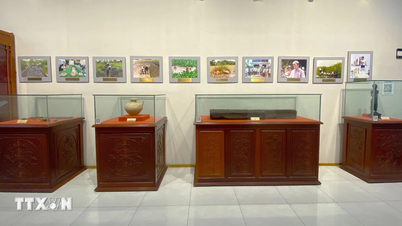
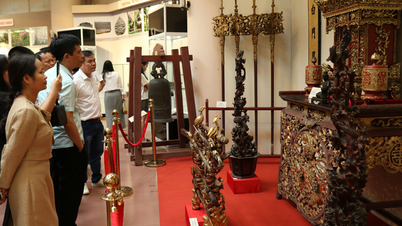
Located at 21B, Doan Nhu Hai Alley (Cua Nam Ward, Hanoi ), the To Hoai Memorial House covers an area of approximately 100m², displaying hundreds of documents and artifacts related to his participation in revolutionary journalism, literary creation, and his enduring commitment to the Party organization throughout various periods.
Stepping through the doors of the memorial house, visitors can admire documentary images recording the period when writer Tô Hoài was involved in revolutionary activities. In 1943, Tô Hoài joined the National Salvation Cultural Association. This pivotal choice clearly shaped Tô Hoài's ideological path: from a writer who wrote for a living and to affirm his artistic individuality, Tô Hoài proactively adjusted his writing to serve the resistance and society.
 |
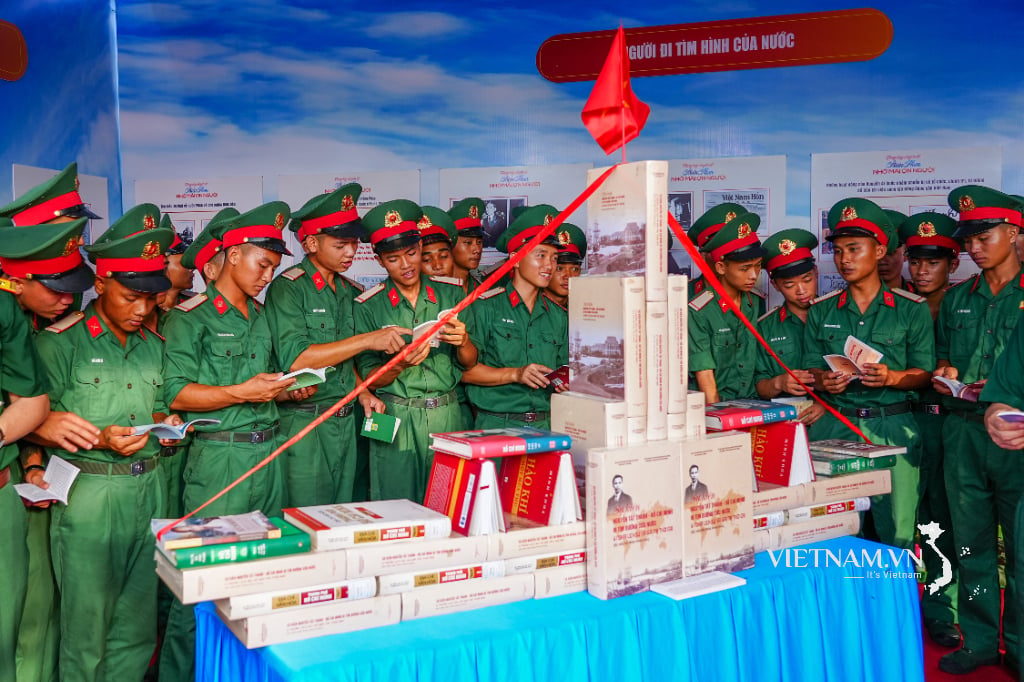
The public visits the Tô Hoài writer's memorial house. |


After the August Revolution of 1945, writer Tô Hoài worked at the Cứu Quốc newspaper, participating in campaigns in Việt Bắc and Tây Bắc, closely connected to the realities of the resistance and the lives of the people. From there, he persistently accumulated creative material and produced many works deeply connected to the era, especially the short story collection "Stories of the Northwest" (1953).
Further milestones in the late writer's life are reflected in the documents and memorabilia displayed on the second floor of the memorial house. From 1950, To Hoai worked at the Vietnam Association of Literature and Arts, holding the position of Editorial Secretary of the Literature and Arts Magazine, and later held many important positions such as: General Secretary of the Vietnam Writers Association (1957-1958), Deputy General Secretary of the Vietnam Writers Association (1958-1980), and President of the Hanoi Association of Literature and Arts (1986-1996).
In the display case, the 40-year and 50-year Party membership badges, carefully preserved by the late writer's family, quietly recount the 67-year journey of writer Tô Hoài's Party membership. Alongside them are simple clothes and household items, reflecting the unpretentious lifestyle of a Party member and writer who considered creative work a lifelong responsibility. Each artifact demonstrates the enduring consistency in Tô Hoài's ideological stance, not only in words but also in his actions, works, and daily life.
“The third floor has been preserved and decorated almost exactly as my father worked when he was alive. The writing desk, bookshelves, stacks of manuscripts… show his familiar, simple lifestyle,” shared Mr. Nguyen Phuong Vu (son of writer To Hoai). Throughout the exhibition floors, the memorial house does not recount his biography in a dry, chronological way, but lets the artifacts speak for themselves. All of them portray the journey of an intellectual steadfast in his ideals, placing social responsibility above personal gain, and using literature as a tool to serve the people and the country.
"The To Hoai Writer's Memorial House, inaugurated during the 14th National Congress of the Party, is not only a place to preserve literary memories but also serves as a reminder of the role and responsibility of artists and writers towards the Party and the nation," writer Nguyen Trong Tan emphasized.


Illuminated through various artifacts, the literary journey of writer Tô Hoài not only recalls a past period but also spreads enduring ideological values, clarifying the connection between literature and the revolutionary cause. Although his writings have ended, the sense of responsibility and belief he pursued continues silently, becoming a spiritual anchor for writers today.
Source: https://www.qdnd.vn/tien-toi-dai-hoi-xiv-cua-dang/niem-tin-ky-vong/nha-van-to-hoai-tron-doi-theo-dang-1022862



![[Image] National conference summarizing one year of operation of the overall organizational model of the political system, the three-tiered government model.](https://vphoto.vietnam.vn/thumb/1200x675/vietnam/resource/IMAGE/2026/07/01/1782882811691_ndo_br_1-jpg.webp)