Many businesses assert that greening is no longer an option, but a mandatory requirement to expand into international markets. For businesses, enhancing environmental responsibility is now the key to survival and sustainable development. However, there is still a significant gap between theory and practice, between awareness and action, from mobilizing massive capital for environmental treatment systems to changing the production mindset of some small businesses.
Along with that come the concerns of entrepreneurs directly involved. For example, Mr. Dang Van Huy, Director of Huy Hung One-Member Limited Company, pointed out the specific "bottlenecks" of the locality, stating that for agricultural production to be green, it must be clean from the source, requiring systematic planning of planting areas and strict control of the use of pesticides and fertilizers in each specific area. Currently, agricultural processing businesses are facing difficulties due to the lack of centralized waste treatment areas, while investing in treatment systems requires a very large amount of capital. In addition, farmers and processing units urgently need specific guidance on techniques for direct composting of organic fertilizer and methods for on-site waste treatment to utilize agricultural by-products.
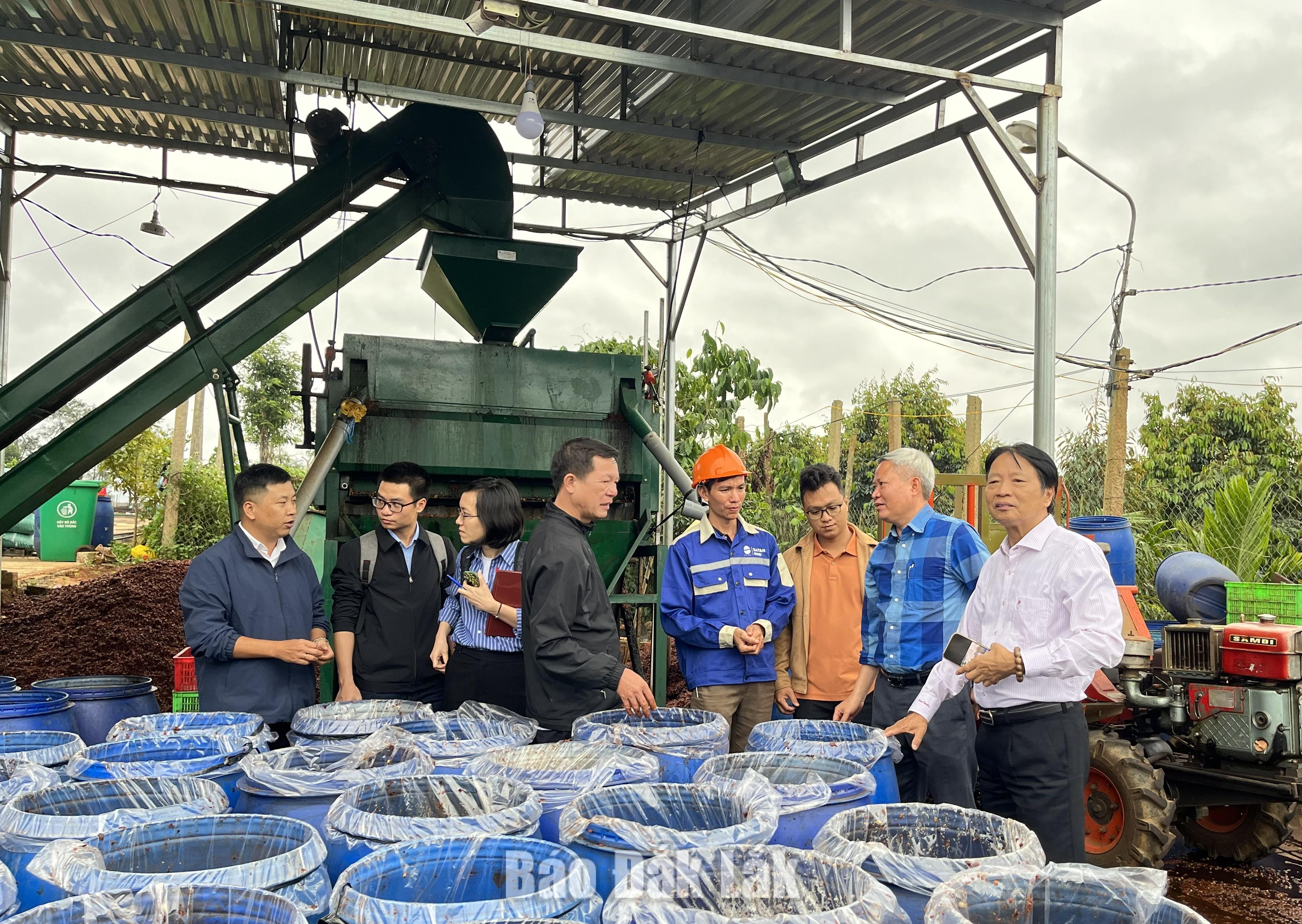 |
| Businesses in the coffee industry have adopted circular technology to reuse water and utilize by-products to produce organic fertilizers or fuel. |

According to economic experts, to transform the challenges of green transformation and development into opportunities, the business community needs to implement three main pillars simultaneously. First, proactively raising awareness and building a corporate culture closely linked to environmental protection. Next, prioritizing investment in technology to transition to clean, energy-efficient production processes. Finally, creating strong linkages to form green supply chains, connecting farmers to distributors and processors.
According to Pham Dong Thanh, Chairman of the Dak Lak Provincial Business Association, in the coming time, the Association will strengthen training programs on green management and actively connect with green credit sources to support the business community in transforming itself. This is considered a necessary "boost" to help businesses overcome financial and technological barriers.
The "greening" journey in Dak Lak is not just a story for businesses alone, but also requires synchronized involvement from management agencies in planning raw material areas, planning processing sites, and supporting waste treatment infrastructure. Once the challenges of capital, technology, and planning are resolved, Dak Lak province will make solid progress on the path to sustainable development.
Le Ho



Source: https://baodaklak.vn/kinh-te/nong-nghiep-nong-thon/202606/nhung-bai-toan-can-loi-giai-e426f04/



![[Image] National conference summarizing one year of operation of the overall organizational model of the political system, the three-tiered government model.](https://vphoto.vietnam.vn/thumb/1200x675/vietnam/resource/IMAGE/2026/07/01/1782882811691_ndo_br_1-jpg.webp)