

 |
| Illustration photo: GC |
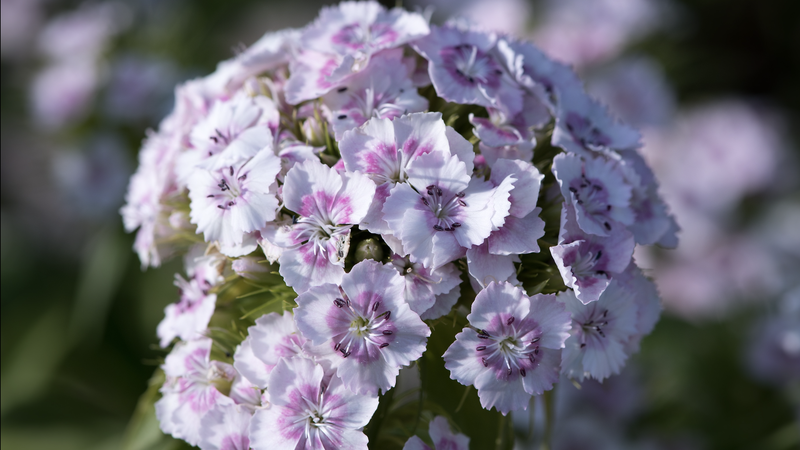
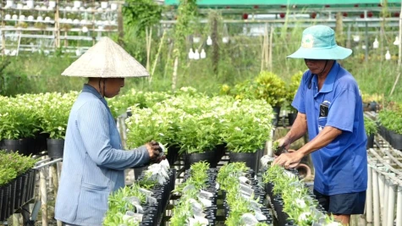
Those flowerbeds were planted quietly. They nestled against the wall, tucked beside the steps, sometimes just an old milk can repurposed as a pot. Portulaca, impatiens, a few clumps of evening primrose, a couple of slender petunias... The alley was poor, land was scarce, but there was never a shortage of colorful flowers.
In the mornings, when the adults rush off to work and the children go to school, only the women remain at home. They sweep the yard, wash the clothes, and then, while they're at it, water the potted flowers in front of the door. This work happens as naturally as breathing. The flowers grow silently, just like the way they live each day.
At the end of the alley lives Ms. Lien, who runs a general store. She grows a small row of chrysanthemums along the wall. Every afternoon, after closing her shop, she sits picking up fallen leaves while listening to the radio. Her husband has been at sea for many years and hasn't returned; people say he disappeared in a storm. Since then, she has lived a quieter life, but the flowers in front of her house are always fresh. When someone asks why she doesn't remove some of them to make things easier, she just smiles and says that looking at the flowers helps her remember that the days are still passing.
In the middle of the alley is the low-roofed house of Ms. Thuy, a garment factory worker. She comes home after dark, but still takes a few minutes to water the gourd vines in front of her door. The vines not only provide fruit but also shade the house from the sweltering midday sun. The long vines cling to the old iron bars, just like how she clings to life after her failed marriage. People always see her smiling, but sometimes her eyes are distant, as if she's thinking of somewhere else.
The flowers in the alley are not uniform. Some pots are vibrant, others have only a few leaves. Each house has its own color, just like each woman carries her own story.
Nowadays, people often say that women must be strong, successful, and go out into society to assert themselves. But in the small alleys, strength is sometimes much simpler. It's the mother who wakes up before dawn to prepare breakfast for her children. It's the wife who shoulders the burden of the whole family when her husband is unemployed. It's the old woman who still tends to her potted plants even though her knees ache whenever the weather changes. They don't call it sacrifice. They are simply "living."
One rainy afternoon, the wind tossed the entire alleyway. Many flowerpots were knocked over, soil spilling onto the path. The next morning, as soon as the rain stopped, the women quietly brought out brooms to clean up. Some helped their neighbors set up the pots, others gathered the soil around the base of the plants. The crushed petals were quickly replaced by new sprouts. The alley was soon tidy again. I stood watching them, and suddenly understood that the vitality of flowers lies not in their fragile appearance, but in their ability to revive after a storm. And so it is with women.
There are those who abandoned their youthful dreams, who went through days of weariness unknown to anyone. But they still continued to nurture their lives, still kept a gentle corner in their hearts. Like flowers, even growing beside an old wall, they still find a way to reach for the sunlight.
In recent years, the alley has seen the arrival of many young families. New flower pots have appeared. Some grow succulents, others hang orchid baskets, and a young woman who opened a small bakery even placed a few pots of pale purple lavender in front of her door. The colors of the flowers change, but the spirit remains the same. Everyone wants to preserve a green space to make life less barren.
As evening falls, the last rays of sunlight glide across the time-worn walls. Flowers sway gently in the breeze, and the silhouettes of women are cast upon the old cement pavement. They have gone through a long day, perhaps tired, perhaps worried, but they still stop to admire the blooming flowers, as if reminding themselves that life is not just about the burden of making a living.
The small alley is not famous, and the flowerbeds are not exhibited. But it is in this simple place that the beauty of the women is most clearly revealed. And perhaps, thanks to those flowerbeds, the alley is not just a place to pass through, but a place to remember. Because there, each flowering season is also a season when the women continue to flourish, continuing to soothe the world with their remarkably gentle perseverance.
ORIGINAL
Source: https://baokhanhhoa.vn/van-hoa/202603/nhung-bong-hoa-trong-ngo-8da3068/

![[Image] Nguyen Tat Thanh Street is expected to be widened, reducing traffic congestion.](https://vphoto.vietnam.vn/thumb/1200x675/vietnam/resource/IMAGE/2026/03/24/1774326200262_ndo_br_3-6869-jpg.webp)






































































Comment (0)