


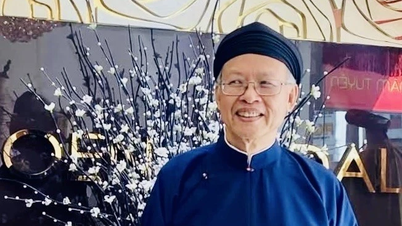
Mr. Nguyen Viet Dua, from Hoang Anh commune (now Tao Xuyen ward, Thanh Hoa city), still maintains good health and optimism in his old age.
Mr. Le Van Dan (Phu Son Ward, Thanh Hoa City) emotionally recounted: “Right after graduating from high school, I enlisted in the anti-aircraft artillery unit, Battalion 14, Division 304 – the unit directly fighting to protect Ham Rong Bridge. My job was to use the rangefinder (measuring the distance of aircraft approaching the battlefield). The work required extreme accuracy, so I had to always be calm and quick-eyed to spot targets as quickly as possible and report to the commander so that he could issue the combat order.” Recalling the moments of fighting alongside his comrades at the artillery position, Mr. Dan's eyes welled up with tears: “My squad had about 150 people, of whom about 20 were killed, and many were wounded. I witnessed the courageous sacrifice of many comrades, such as the deputy squad leader who was severely wounded, almost having his arm severed, his body covered in blood, but still urging the soldiers to fight. He lay there, his eyes still following enemy aircraft, reporting their flight path to his comrades so they could destroy them.”
The Ham Rong Bridge in Thanh Hoa province was once known as the "cauldron" of the entire country during the years when the US military bombed North Vietnam. This vital transportation hub on National Highway 1A possessed all three essential elements: water, road, and rail transport, providing manpower and resources to the Southern battlefield. Therefore, both the Vietnamese and American forces recognized its crucial importance. The US military relentlessly bombarded the area, while the Vietnamese people and soldiers were determined to "rather sacrifice themselves on the artillery platform than let the bridge collapse."
The image of Nguyen Viet Dua, the militia commander of Hoang Anh commune (now Tao Xuyen ward), constantly moving about in the battlefield and villages to command and deploy troops to protect the bridge and support the wounded, remains deeply etched in the minds of many former female militia members. Mr. Dua had served for over four years in Company 5, Battalion 4, Regiment 57 (Sam Son). Returning to his hometown in May 1964, he became the militia commander at the very moment the US expanded the war to North Vietnam with air and naval forces. He immediately plunged into the fight with all his enthusiasm and sense of responsibility to the Fatherland and the People. He commanded the entire commune's militia during the days of resistance against the US bombing campaign with unwavering determination. He was wounded, but his injuries did not affect him; he remained steadfast, holding his ground and protecting the Ham Rong bridge. For his contributions throughout the years of fighting against the US to protect the Ham Rong bridge, Mr. Dua was recognized as a "Determined Victory Soldier" at the military region level. He was awarded the Second Class Order of Military Merit and had the honor of representing the militia forces to go to Hanoi to meet President Ho Chi Minh and attend the 1967 ceremony celebrating the victory of the entire army.
During the frenzied American bombing raids on Ham Rong Bridge, in the villages of Dong Son, Nam Ngan, Hac Oa, Phuong Dinh, and others, from the elderly to the young, without being told, many went to the front lines. The women prepared food and water, the children carried the wounded and supplied ammunition. The militia in these villages, organized and trained, fought the enemy as skillfully as they cultivated the land. Ms. Le Thi Thoa, a female soldier from the Truong Son - Ho Chi Minh Trail Veterans Association of the province, told us: "In 1965, when I was only 13 years old, I joined the soldiers of Regiment 228 in rescuing civilians and soldiers defending Ham Rong Bridge, which was being bombed by American planes. Seeing the devastation and the dead filled me with sorrow and indignation. I decided I would join the army and contribute my strength to the struggle for national independence. Although I didn't participate in the battle to defend Ham Rong Bridge in 1972, I always thought that fighting anywhere on Vietnamese soil is defending the Fatherland."
In 1972-1973, the American invaders continued their bombing of North Vietnam. The Ham Rong Bridge once again suffered extremely fierce bombing by the American forces. Mr. Le Huu Be, from Tan Long 1 Street, Ham Rong Ward, still "burns with passion" as he recounted to us the years of life-or-death struggles he faced while serving as a traffic police officer protecting the bridge. “Back then, I was a student at the People's Police Academy assigned by the Ministry of Public Security to protect several traffic routes from the Do Len ferry in Ha Trung district to the Long Dai ferry in Quang Binh province. My assigned traffic control point was south of the Ham Rong bridge. The station had four people, and I was given the authority of station chief, responsible for directing traffic and ensuring that vehicles carrying weapons and food supplies to the Southern battlefield, as well as vehicles transporting wounded soldiers from the South to the North for treatment and recuperation, did not experience traffic congestion. Because this was a vital traffic artery, with 500 to 600 vehicles passing through daily, but only five points of passage: pontoon bridge 1, pontoon bridge 2, ferry 1, ferry 2, and one iron bridge (Ham Rong bridge), traffic control and management had to be carefully planned, meticulous, and efficient. I remember most vividly the day of June 14, 1972, when I met Mr. Le Ta Phan, the project commander and former Chairman of Dong Son district.” (Old) and Vu Danh Lan, the principal of Dong Son High School and deputy commander of the project, told me: "Tomorrow is the Dragon Boat Festival, the women (militia, students, youth volunteers...) want to work overtime to complete the embankment project on the Ma River, celebrate the festival a little tomorrow and then come back to work." Thinking that the women on the home front would have a warm and cozy festival with their families, even if only for a short time, I didn't expect that, about 15 minutes later, 4 or 5 American planes would fly overhead, roaring and dropping bombs from the beginning of Nam Ngan village to about 300 meters from the Ham Rong iron bridge. They bombed in multiple waves, devastating many strongholds and construction sites, even attacking the village itself. My comrades and I witnessed the casualties and rushed to provide medical assistance. Without hesitation, even though American planes were still circling overhead, we continued to manage traffic flow, transport the wounded and stretchers, and help our comrades and villagers get medical attention..."
In the battle that Mr. Bé recounted, his wife, Ms. Dương Thị Hòa, who was also involved in building the dike along the Mã River, was injured. After completing his duty protecting the Hàm Rồng bridge for a year, Mr. Bé returned to school and worked far from home. Later, he transferred to the Thanh Hóa Police Department and retired in 1993.

Mr. Le Huu Be excitedly hung up a flag commemorating the 60th anniversary of the Ham Rong victory.
On afternoons cycling across Ham Rong Bridge, strolling along the Ma River dike, and admiring the river's ebb and flow, Mr. Be felt a sense of peace. Then, returning home peacefully, Mr. Be, like the other men and women who had participated in and witnessed the battle to defend Ham Rong Bridge, would gather with his family, sharing stories of camaraderie, of Ham Rong, and of the deep affection between soldiers and civilians. Although the battle took place decades ago, the memories of those difficult days, braving bombs and bullets alongside their comrades to defend Ham Rong Bridge, remain vivid in the minds of Mr. Dan, Mr. Dua, Mr. Be, Ms. Thoa, and others. This joy and pride are evident on everyone's faces when they mention Ham Rong – a victory that still resonates 60 years later.
Text and photos: Le Ha
Source: https://baothanhhoa.vn/nhung-ky-uc-khong-bao-gio-quen-244351.htm


![[Photo] National Assembly Chairman Tran Thanh Man takes the oath of office](https://vphoto.vietnam.vn/thumb/1200x675/vietnam/resource/IMAGE/2026/04/06/1775453300886_ndo_br_1-2229-jpg.webp)










![[Photo] Da Nang: A sea of people respectfully paying homage to the Bodhisattva Avalokiteshvara.](https://vphoto.vietnam.vn/thumb/1200x675/vietnam/resource/IMAGE/2026/04/06/1775454198203_ndo_br_lh24-jpg.webp)

















































Comment (0)