Before, during the land reform period, my mother recounted that one day before Tet (Lunar New Year), she walked from Thanh Hoa to Ninh Binh to celebrate Tet with her family. On the dim evening of the 30th of Tet, she arrived home to a silent, dark place; the kitchen was cold, and a bunch of green bananas lay scattered around. Her uncle, her younger brother, said the bananas were for cooking on the 1st of Tet, and that her father was at the village hall. She rushed to the hall, only to find her maternal grandfather being subjected to a public denunciation. She presented her documents. Later, several guerrillas with guns arrived and told her she had to leave immediately. She said these were her cousins, but at that moment, they didn't seem to know who she was. That night, they expelled her from the village. So, she walked from Ninh Binh to Thanh Hoa in the night, crying all the way. Therefore, when my father relocated from Hue to Thanh Hoa to meet my mother and get married, only the organization witnessed it; neither family was present. It wasn't until I was born that my father and I met again in Thanh Hoa, meaning my father-in-law finally saw his son-in-law. After visiting my mother and me, he returned and passed away. Back then, I was constantly working and evacuating due to bombings, so I had little time to go back to my hometown. To be fair, only my maternal uncles (sons of my maternal grandmother) were still there, as my maternal grandparents had passed away. So, it was mainly my uncles and aunts who cycled to Thanh Hoa to visit my mother and my family.
When I was older, in the 7th grade of the 10-year system, every summer my mother would let me ride my bike alone from Thanh Hoa to Ninh Binh to visit my step-grandmother, my uncles, and their children. Those were huge rewards for me.
Of course, before that, my whole family of four—my parents and my two brothers—had taken the Thanh Hoa-Ninh Binh commuter train many times, and it remains etched in my memory. Sometimes, my mother would "practice" those train trips, intending to let me ride my bicycle alone to Ninh Binh. My mother, despite being very strict, doted on me more than anything, even though she was very protective of me. I don't understand why she trusted a little kid like me, tiny as a candy, who could only pedal with my toes because my whole foot couldn't reach the pedals, wobbling from side to side, and yet I still made it to Ninh Binh.
Back then, that motorbike was our entire fortune. My son, even though he was severely malnourished at birth, and his mother had no milk and had to feed him with rice water, growing up frail and weak, was still more than our entire fortune. And every summer, those two "treasures" would travel nearly a hundred kilometers between Thanh Hoa and Ninh Binh. So, from the time I was in 7th grade, I knew this route by heart, from Do Len, Ha Trung, to Bim Son, Tam Diep, to Ghenh, Lim Bridge, and then Xe Mountain.

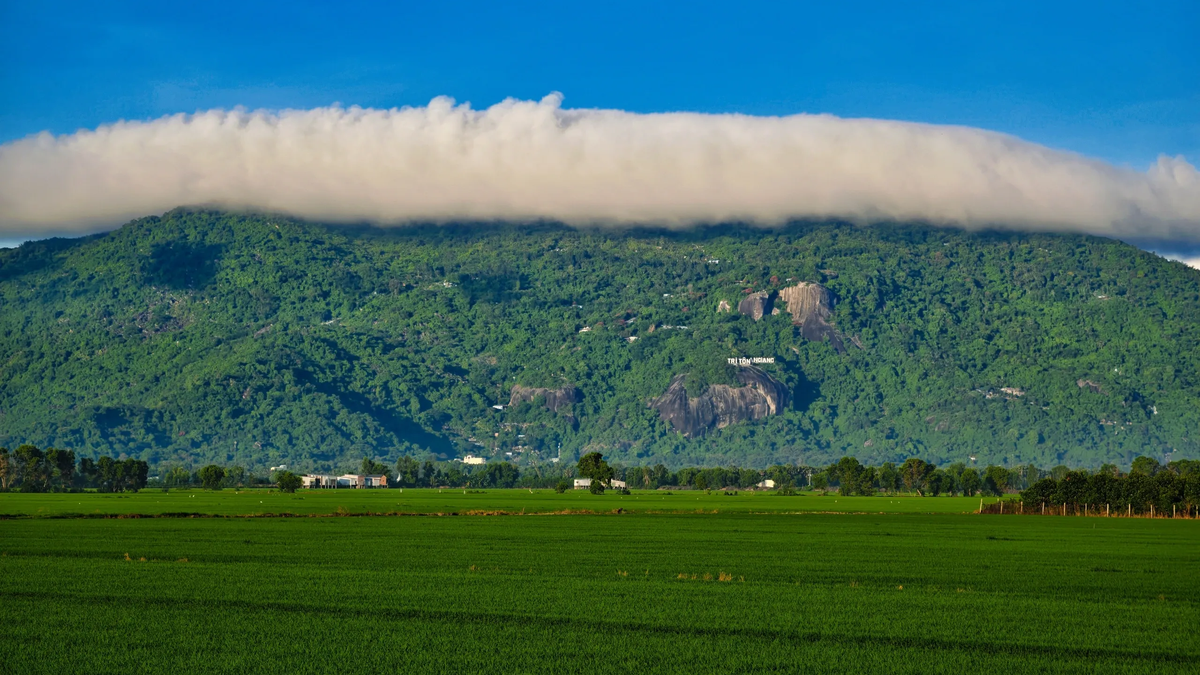
My maternal grandmother's house was right on Xẻ Mountain, in Ninh Mỹ commune, Gia Khánh district, Ninh Bình province. Now it's the boundary between Ninh Bình city and Hoa Lư district. Back then, Highway 1 ran through this section, winding through Xẻ Mountain. More precisely, it ran through the foot of the mountain, which had a giant rock jutting out across the road, forming a cave. Initially, people demolished the section that extended across the road to burn lime and use it for construction stone.
I remember that the whole village of Da Gia back then had a stone-breaking trade. From large boulders, the women would sit and use hammers to break them into 1x2, 2x3, and 3x4 stones… The young men would do the stone-breaking. From that giant boulder that jutted across the road, they "planned" the entire enormous Se Mountain, so now it's just one step away from becoming a street. But it's already a tangled mess of streets.
I recently returned from Hanoi . My younger brother told me, "I'll come pick you up at the crossroads." But it took a dozen phone calls before I finally arrived at the village. Of course, many houses have been built bigger and more beautiful. I remember back then, when I was little Hung, I was spoiled rotten whenever I went back to my hometown. My grandmother took me all over the village, and I loved playing with the snails crawling all over the stone walls, topped with cacti—flat, hand-shaped cacti—with lots of snails in them, all looking bewildered as they poked their heads out and wiggled their antennae.
My uncle, a middle school math teacher and radio repairman, was the first person here to raise goats. Every morning, he would go to the goat shed behind the house, milk a cup of goat's milk, and force me to drink it. He forced me because I found it smelly and refused to drink it. He had seven daughters at the time, and they probably didn't get to drink as much as I did. And because sons are highly valued in my hometown, it's considered a "birth" only if it's a son, so he had seven daughters in a row, and the eighth was... a boy. He was very proud, "See?" And from then on, this eighth uncle officially became the eldest son, the eldest uncle of the Le family, my mother's family. My maternal grandparents were also quite prolific, with a total of nine children: five daughters and four sons. My mother was the eldest, and I was nominally the oldest, both in age and lineage, but when this uncle appeared, he was naturally the eldest son. The hardest thing for me now, when I go back home, is remembering all the names of my brothers-in-law, sisters-in-law, and nephews and nieces...


(To be continued)
Source: https://baoninhbinh.org.vn/ninh-binh-ky-uc-me-947712.html
![[Photo] General Secretary and President To Lam receives Palestinian Ambassador Saadi Salama](https://vphoto.vietnam.vn/thumb/1200x675/vietnam/resource/IMAGE/2026/06/25/1782365384740_a1-bnd-9423-8322-jpg.webp)
![[Photo] General Secretary and President To Lam attends the 13th National Congress of the Ho Chi Minh Communist Youth Union](https://vphoto.vietnam.vn/thumb/1200x675/vietnam/resource/IMAGE/2026/06/25/1782356968989_ndo_br_1-jpg.webp)