

Every spring, the poem "The Calligrapher" by Vu Dinh Lien resonates in my mind, with the image of a dignified and venerable old calligrapher. I always hold calligraphers in high regard because I believe that the words they write are the result of their very hearts and souls. They are the words of the sages.
But it seems that such prestige now only exists in memory, as the development of life and the pursuit of practical pleasures have left no room for these calligraphers to showcase their skills. Some have hung up their pens, others have smashed their inkstones.
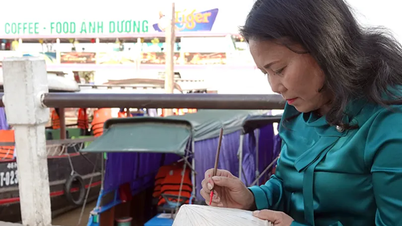
Five years ago, while visiting my hometown with a friend at the market, what caught my attention and moved me the most was a humble stall at the far end of the market. An old scholar sat solemnly beside a bamboo stool, with an inkstone and neatly arranged brushes in front of him, and behind him, calligraphy and paintings fluttering in the spring breeze. He sat there for an hour, but not a single customer came. Only curious children stopped to look, but were immediately pulled away by adults with the urging, "Hurry up, or the ink will stain your clothes!" The words were like salt rubbed into a wound, but the old scholar persevered at that corner of the market.
I knew he wasn't from my hometown. He came from Thanh Hoa City. Before that, he was a teacher at an art school. His passion, and perhaps a sense of responsibility, drove him to many places: markets, temple gates, sometimes even a village schoolyard. I didn't think of any grand mission that compelled him to travel everywhere in his turban, traditional four-panel dress, wooden clogs, and toolbox. I simply assumed he had a passion.
But clearly, that passion cost him a considerable amount of money. His personal passion is like bees contributing honey to life, at least helping children born in the digital age know that there are still Confucian scholars and the sacred writing system, even though they are dragged along by their parents.
The revival of traditional culture is the primary responsibility of the cultural sector, but it is also the responsibility of all of us. The artisans of traditional crafts, the singers of ca trù (a type of Vietnamese folk singing), the bamboo flute players, or even the humble calligraphers – each of them is a colorful thread contributing to the tapestry of culture.
A few days ago, I went back to my hometown to the market and waited to see if the calligrapher was still steadfast at his spot. I smiled because it was still the same old stall, but the calligrapher's face was no longer pensive, but silent. Many villagers were enthusiastic about the couplets or calligraphy, sometimes just any characters he wrote. Some gave more, some gave less, and some gave more, putting money into the plate on the table to thank him.
I used to think that the calligraphers of the past gave their services primarily to experience the atmosphere of spring, hoping to bring joy to those who requested their services. In this humble corner of the rural market today, I have seen that image after years of persistent effort by the calligrapher.
The couplets and calligraphy scrolls fluttering in the spring breeze on the sidewalks and market corners are truly coming back to life. I murmured the lines from the poem "The Old Calligrapher": "Every year when the peach blossoms bloom / We see the old calligrapher again..." with a sense of contentment. If Vu Dinh Lien were still alive, he surely wouldn't have written such sorrowful lines: "The old calligrapher still sits there / No one passing by notices / Yellow leaves fall on the paper / Outside, a fine rain is falling..."
Hanh Nhien
Source: https://baothanhhoa.vn/ong-do-o-goc-cho-phien-236561.htm
![[Photo] National Assembly Chairman Tran Thanh Man attends the groundbreaking ceremony for the National Highway 1A spatial axis project.](https://vphoto.vietnam.vn/thumb/1200x675/vietnam/resource/IMAGE/2026/05/19/1779161360398_ndo_br_bnd-1412-jpg.webp)
![[Photo] Capturing the moment the tide recedes at Yen Binh Son rapids - a million-year-old scenic spot in Quang Ngai.](https://vphoto.vietnam.vn/thumb/1200x675/vietnam/resource/IMAGE/2026/05/19/1779175463885_yen9-1199-jpg.webp)





![[Livestream] Opening Ceremony of the Traditional Culture Festival of Ethnic Minorities in Thanh Hoa Province, 2026](https://vphoto.vietnam.vn/thumb/402x226/vietnam/resource/IMAGE/2026/05/19/1779198270040_livestream-khai-w1200t0-di2620d272d2183324t11920l1-banner-live-191.webp)




























![[Photo] General Secretary and President To Lam receives Indian Defense Minister Rajnath Singh](https://vphoto.vietnam.vn/thumb/402x226/vietnam/resource/IMAGE/2026/05/19/1779184046302_anh-man-hinh-2026-05-19-luc-16-46-58.png)












Comment (0)