


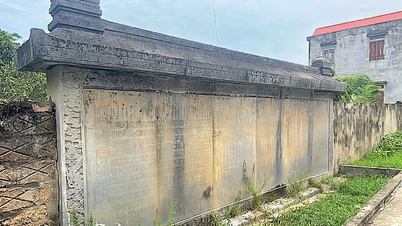
Three years after being reported by Văn Hóa (Culture) magazine , two over 300-year-old stone steles, valuable provincial-level historical relics, are still being used as fences and situated in the middle of a livestock area. The question is directly: why is this precious heritage being neglected, and who is responsible?
Despite provincial directives, the stone monument remains "standing still."
Exactly three years ago, a series of articles by Văn Hóa ( Culture) newspaper reflecting on the deterioration and neglect of two ancient stone steles at the Lê Thì Hải historical site in Thọ Phú commune, Triệu Sơn district (now Thọ Phú commune, Thanh Hóa province) caused public outrage. Immediately afterwards, the Vice Chairman of the Thanh Hóa Provincial People's Committee, Đầu Thanh Tùng, issued a directive to relevant agencies to investigate and handle the matter: “Proactively resolve... manage and protect the historical site according to the authority and regulations of the law on cultural heritage...; advise and direct the resolution of issues within the authority of the Provincial People's Committee before August 31, 2023.”
The content reflected in the Cultural section is accurate. The two ancient steles have exceptional historical and cultural value, but they are being neglected on private land, not being managed or protected as required by regulations.
Beyond simply confirming the site's status, the relevant authorities have proposed a series of solutions, including planning a conservation area, developing projects for restoration and beautification of the grounds, relocating affected households, and establishing a management board to oversee, protect, and promote its value. Sadly, however, these proposals remain largely on paper to this day.
Following this, the Department of Culture, Sports and Tourism also issued document No. 4008, assigning the Center for Historical Research and Cultural Heritage Preservation (now the Center for Heritage Preservation, Museums and Libraries of Thanh Hoa province) to coordinate with the local authorities to verify the reported content. On August 18, 2023, this Center issued document No. 382 confirming that the content reported by the Department of Culture was true. The two ancient steles, possessing exceptional historical and cultural value, were being neglected on private land, not being managed or protected according to regulations. Beyond simply confirming the findings, the specialized agency also proposed a series of solutions such as planning a conservation area, establishing a restoration and beautification project for the site, relocating the affected households, and establishing a monument management board to oversee, protect, and promote its value. Sadly, however, to this day, these proposals remain largely on paper.
On-site observations at the site reveal that the two ancient steles remain in their original positions, within the residential area of local residents. There are no signposts, no protective fences, no measures in place to prevent damage, and no indication of a provincial-level classified historical site. Even more concerning, one stele is being used by residents as a fence along a village road, while the other is situated in the middle of a livestock area. The damp, unsanitary environment is gradually eroding the value of this precious heritage.
The stark contrast between the decisive directives on paper and the "inaction" on the ground has caused considerable frustration and sorrow among local residents and historians and cultural researchers.

Gap of responsibility
According to research, these two ancient steles belong to the Le Thi Hai historical, cultural, and architectural stone sculpture complex, which was classified as a provincial-level relic in 1993 by Decision No. 161-VHQD. Both steles were erected in the 6th year of Vinh Thinh (1710), during the Le Trung Hung period, and have been documented and translated in the "Collection of Thanh Hoa Stele Inscriptions" (Volume 3, Thanh Hoa Publishing House, 2016). These are not only valuable historical documents but also representative works of art, showcasing the peak level of carving and calligraphy of a historical period.
The first stele, currently used as a fence, is called "Inscription on the Ancestral Worship Stele for Eternity," composed by Thám hoa Vũ Thạch, revised by Trạng nguyên Nguyễn Đăng Đạo and Bảng nhãn Phạm Xuân Trạch. The stele records the worship of ancestors, prescribed rituals, and assigned responsibilities to the 33 villages and hamlets in the region.
The remaining sides of the stele continue to record details of land allocation, money distribution, cultivation assignments, and the organization of commemorative ceremonies and festivals, demonstrating a tightly controlled social and religious management system with widespread influence. The second stele, currently located in the livestock area, is called "Le Tuong Cong Su Nghiep Huan Sanh Bi Ky," recording the merits and achievements of Le Thi Hai (also known as Phuc Toan), composed by Tham Hoa Vu Thach and revised by Trang Nguyen Dang Dao.
Looking at their content and form, these steles are clearly of great historical, cultural, artistic, and research value regarding the society, economy , and beliefs of the Le Trung Hung period. However, instead of being preserved and honored, these two ancient steles are being treated like ordinary objects. Using them as fences or placing them in livestock areas not only causes physical damage but also demonstrates a lack of respect and concern for the heritage. Some researchers believe that without timely protective measures, the carved patterns and ancient Chinese characters on the steles will gradually erode, or even be permanently lost, leading to an irreversible historical loss. This situation, which has persisted for many years, raises serious questions about the responsibility of managing historical relics in the area.
According to regulations, provincial-level classified historical sites must have an agency or unit responsible for their management and protection. Local authorities, specialized cultural agencies, and related units all have a role in preserving and promoting the value of the heritage. However, in this case, there seems to be a "gap in responsibility." When the historical site is located on residential land, management becomes even more complex, requiring close coordination and specific solutions such as relocation, compensation, and spatial replanning. The Thanh Hoa Provincial Center for Heritage Conservation, Museum and Library has previously proposed relocating the affected households, establishing a restoration project, and setting up a management board for the site, but the subsequent steps have not been implemented.
Speaking with a reporter from Văn Hóa newspaper, the leader of Thọ Phú commune's People's Committee stated that they would review the content and request reports from relevant departments to determine a course of action. This response partly reflects the delay in addressing the long-standing issue. Meanwhile, each passing day means another day of damage to the heritage. The two ancient steles, over 300 years old, are not only the property of a single locality but also a shared heritage of the community. Their value lies not in their material worth, but in the historical, cultural, and artistic information they preserve.
The reality is that preserving historical relics requires not only determination but also concrete, coordinated, and timely action. If the recommendations made since 2023 had been seriously implemented, perhaps the current situation would no longer exist. The story of the two ancient steles in Tho Phu is not an isolated case. It reflects a worrying reality in heritage management: discovery is quick, directives are decisive, but implementation is slow and ineffective. The question now is, how much longer will these two ancient steles have to plead for help before the government and relevant agencies pay attention and promote measures to protect and enhance the unique value of the relics?
Source: https://baovanhoa.vn/van-hoa/phai-keu-cuu-den-bao-gio-213116.html



















![[Photo] Tran Cam Tu, Standing Member of the Secretariat of the Central Committee, presides over the first meeting of the Central Steering Committee on the Development of Vietnamese Culture.](https://vphoto.vietnam.vn/thumb/1200x675/vietnam/resource/IMAGE/2026/03/19/1773895004549_ndo-br-bnd-1195-2-jpg.webp)

































































Comment (0)