

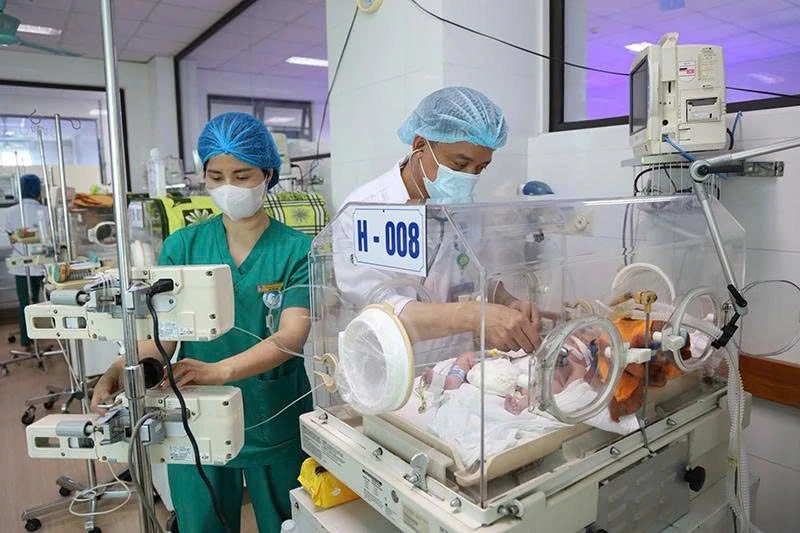
Doctors and nurses treat and care for premature babies.
This is the Neonatal Intensive Care Unit at Thanh Hoa Obstetrics and Gynecology Hospital – a place where day and night seem to have no clear boundary. While other departments and wards have become quieter, here the lights remain on, medical equipment operates continuously, and doctors and nurses are still working tirelessly to monitor each incubator.
In the spacious room, rows of incubators are neatly arranged. Each incubator holds a tiny life, but from the moment of birth, these babies must fight for survival. Among them are premature babies, many of whom experience complications or have illnesses immediately after birth. Some weigh less than one kilogram, their bodies still red and raw.
On the monitoring screens, fluctuating signal lines show the heart rate, breathing rate, and oxygen levels of each baby. If even one indicator changes, an alarm immediately sounds from the device. Doctors and nurses then quickly check, adjust the equipment, or perform necessary interventions.
Dr. Le Thi Dinh, Deputy Head of the Neonatal Intensive Care Unit, shared: “Treating premature infants with underlying medical conditions always requires close monitoring. Their bodies are very fragile, and their immune systems are weak. Even a small change in body temperature or respiration can cause their condition to deteriorate rapidly, so all procedures must be precise and timely, and aseptic technique is crucial.”
As he spoke, Dr. Dinh looked at the incubators and explained that many premature babies with severe respiratory distress needed close monitoring. In some cases, babies were on ventilators but still appeared cyanotic and had pulmonary hemorrhages. Upon noticing any abnormal readings, the medical team had to be on hand immediately to perform emergency procedures.
Dr. Dinh added: "In emergency cases, doctors need to be decisive, diagnose and treat quickly, and perform the correct techniques such as manual ventilation, endotracheal intubation, mechanical ventilation, umbilical vein catheterization for fluid administration, and resuscitation drugs... Then, they must closely monitor the patient hour by hour, minute by minute, and reassess the patient's condition promptly."
Along with the doctors, the nursing staff, acting as the babies' second mothers, provide comprehensive care 24/7. They take turns checking each incubator, monitoring body temperature, changing diapers, cleaning the babies, and feeding them through tubes or with breast milk sent by the family.
Nurse Vu Thi Hai shared: “Most of the newborns here are premature, so every procedure must be gentle and meticulous. Not only that, each nurse must love their profession, be dedicated to their work, and love children. Many babies are hospitalized for a long time; in addition to carrying out doctors' orders, feeding, and hygiene, we also massage and turn them over to prevent bedsores, promote good recovery, and help them return home to their families sooner.”
Despite the hardships, seeing the healthy children and the grateful smiles and eyes of their families, the doctors and nurses in the department always remind themselves to do their best to bring hope to these families.
In stark contrast to the tense and urgent atmosphere inside, the space outside the intensive care unit was quite different. There, the families of the infants waited anxiously. In the hallway leading to the unit, many families sat silently on benches. Some paced back and forth constantly, while others simply stood leaning against the wall, gazing towards the door.
Mr. Nguyen Van Thanh, residing in Dong Son ward, had a child born at 31 weeks of gestation. Immediately after birth, the baby was transferred to the intensive care unit due to premature birth and respiratory distress.
“It’s been 10 days since my child was admitted to the intensive care unit. Every day I sit here waiting for news. Every time the door opens, I feel nervous. But when the doctor informed me that my child’s condition was improving, I was very happy. My child has now been weaned off the ventilator,” Mr. Thanh said.
Following the intensive care unit is the Kangaroo Room – where stable babies from the intensive care unit are warmed in the arms of their loved ones. Ms. Nguyen Thuy Lien from Tho Ngoc commune shared: “After 7 days in the intensive care unit, my child is more stable today and has been moved out. In the Kangaroo Room, my child and I practice skin-to-skin contact. Holding my child in my arms all day, seeing her sleep peacefully, and feeling her breath makes me very happy.”
Such stories unfold daily in the Neonatal Intensive Care Unit. Some babies spend weeks in incubators, while others endure critical moments before gradually stabilizing. Every small step forward brings immense joy to the families and the entire medical team.
The doors of the neonatal intensive care unit remain closed every day to maintain a safe treatment environment for the babies. But behind those doors, silent hands tirelessly care for, monitor, and nurture each fragile breath. And in front of those doors, parents patiently wait, placing their faith in the doctors and nurses. It is in this quiet space between the two sides that the lives of many premature babies are saved, and they begin their journey to grow up like any other child.
Text and photos: Thùy Linh
Source: https://baothanhhoa.vn/phia-sau-canh-cua-phong-benh-281676.htm
![[Photo] Tran Cam Tu, Standing Member of the Secretariat of the Central Committee, presides over the first meeting of the Central Steering Committee on the Development of Vietnamese Culture.](https://vphoto.vietnam.vn/thumb/1200x675/vietnam/resource/IMAGE/2026/03/19/1773895004549_ndo-br-bnd-1195-2-jpg.webp)


![[Photo] The General Secretary and the Prime Minister attend the groundbreaking ceremony for multiple-level boarding schools in border areas.](https://vphoto.vietnam.vn/thumb/1200x675/vietnam/resource/IMAGE/2026/03/19/1773888999705_vna-potal-tong-bi-thu-va-thu-tuong-du-le-khoi-cong-dong-tho-dong-loat-cac-truong-noi-tru-lien-cap-bien-gioi-8649904-3885-jpg.webp)





































































Comment (0)