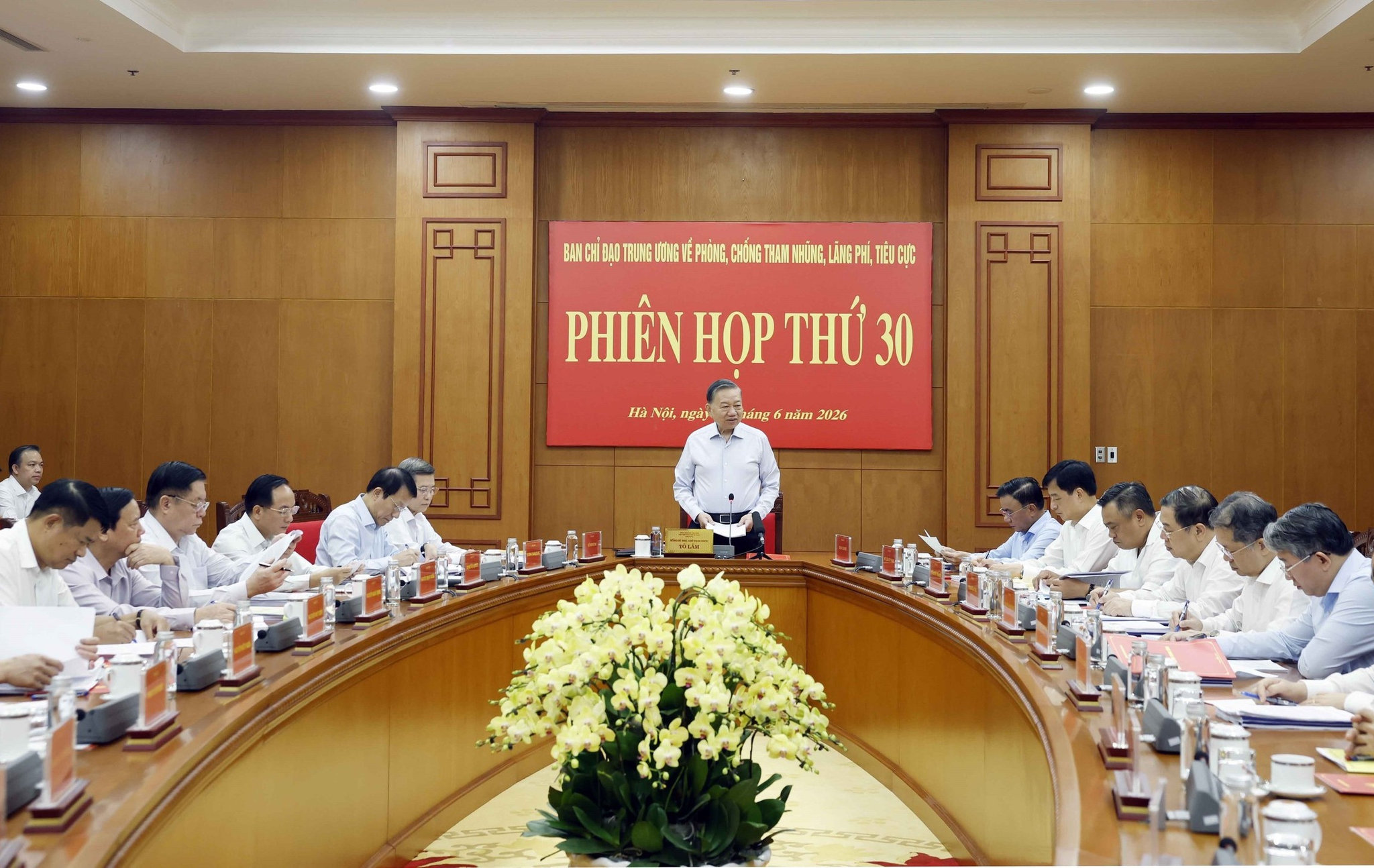
A highlight of the past period has been the work of building and perfecting institutions, implemented according to the principle of proactively taking a step ahead. Persistently pursuing solutions to create a solid foundation, in the first six months of 2026, the Central Committee of the Party, the Politburo , and the Secretariat issued more than 30 resolutions, directives, regulations, and conclusions on Party building, the political system, socio-economic development, and the prevention and fight against corruption, waste, and negative phenomena.
The National Assembly and the Government have directed the review, amendment, supplementation, and promulgation of nearly 300 legal documents to promptly institutionalize the Party's new policies, overcome loopholes and inadequacies, remove bottlenecks, and strengthen decentralization and delegation of power, while simultaneously controlling power and preventing corruption, waste, and negative practices.
Previously, in 2025, the Politburo and the Secretariat issued more than 130 documents on Party building, the political system, and the prevention and fight against corruption, waste, and negative phenomena. The National Assembly and the Government amended and promulgated 89 laws and more than 900 decrees, directives, and resolutions; focusing on addressing loopholes, inadequacies, contradictions, and overlaps in legal documents; perfecting the institutional framework for the operation of the state apparatus according to the three-tiered government model; and promoting socio-economic development.
Ministries, sectors, and localities have revised, supplemented, and issued nearly 12,000 guiding documents on the implementation of legal regulations on socio-economic management, contributing to improving the effectiveness of preventing and combating corruption, waste, and negative practices.
Notably, the Politburo has issued regulations on controlling power and preventing and combating corruption and negative practices in key areas to prevent violations at their root. These include five regulations in five areas: Regulation No. 114-QĐ/TW, dated July 11, 2023, of the Politburo on controlling power and preventing and combating corruption and negative practices in personnel work; Regulation No. 131-QĐ/TW, dated October 27, 2023, of the Politburo on controlling power and preventing and combating corruption and negative practices in Party inspection, supervision, and disciplinary enforcement, and in inspection and auditing activities; Regulation No. 132-QĐ/TW, dated October 27, 2023, of the Politburo on controlling power and preventing and combating corruption and negative practices in investigation, prosecution, trial, and execution of judgments; Decision No. 178-QD/TW, dated June 27, 2024, of the Politburo on controlling power and preventing and combating corruption and negative practices in lawmaking; Decision No. 189-QD/TW, dated October 8, 2024, of the Politburo on controlling power and preventing and combating corruption and negative practices in the management and use of public finances and assets.
Immediately after the Party's policies and regulations, and the State's laws were promulgated, they were implemented decisively and effectively, contributing to eradicating the roots of corruption, waste, and negative practices. More importantly, this gradually formed a comprehensive and rigorous prevention mechanism to make corruption, waste, and negative practices "impossible" and "unafraid" to occur; while simultaneously overcoming the fear of making mistakes, the reluctance to act, or the avoidance and shirking of responsibility in the performance of official duties.


Early and proactive prevention of corruption, waste, and negative practices is also emphasized through strengthening inspection, supervision, and auditing in sensitive areas prone to violations. A notable result is that from the beginning of the year until now, the Government, ministries, and localities have reviewed and updated an additional 1,501 projects, bringing the total to 4,492 projects that are stalled, prolonged, or facing difficulties and obstacles; of which 1,531 projects have been completed. Regarding surplus land and buildings after restructuring, a review has identified 30,595 surplus facilities nationwide; of which 14,992 have been completed and put into operation.
Furthermore, Party committees and inspection committees at all levels have focused on regular and early supervision of the implementation of new Party guidelines and policies, as well as key national projects and works; and the activities of agencies and units after the operation of the two-tiered local government. In particular, Party committees and organizations have strictly supervised and implemented the five regulations of the Politburo on controlling power, preventing and combating corruption, waste, and negative practices, primarily in personnel work.
The government, ministries, and localities will continue to accelerate the reduction, decentralization, and simplification of administrative procedures and business conditions; strengthen the application of science and technology and digital transformation, helping to save time and costs, and limit harassment and inconvenience for citizens and businesses.
Efforts to prevent corruption, waste, and negative practices at their root are further strengthened through propaganda and education, and by persistently building a culture of integrity within agencies, units, localities, and among cadres and Party members.
The Party and State of Vietnam are resolute and persistent in preventing and combating corruption, waste, and negative phenomena, based on the principle of no forbidden zones and no exceptions, and are shifting the focus to prevention from an early stage, from afar, and from the root. To realize this principle, the Central Steering Committee on Prevention and Combat of Corruption, Waste, and Negative Phenomena requires a continued comprehensive review of the legal system to fully identify bottlenecks and loopholes that give rise to corruption, waste, negative phenomena, shirking responsibility, avoidance, and fear of accountability.
The focus is on revising the Land Law; developing and promulgating specific resolutions on handling violations of laws related to the state-owned and private economies, and the application of science, technology, innovation, and digital transformation. Simultaneously, a comprehensive review of the legal system will be conducted to fully identify bottlenecks and loopholes that give rise to corruption, waste, and negative practices, thereby promptly and comprehensively revising, amending, and supplementing existing laws and establishing effective and strict control mechanisms.
Speaking at the 30th session of the Central Steering Committee on Anti-Corruption, Waste, and Negative Phenomena (held on June 18), General Secretary and President To Lam, Head of the Steering Committee, requested a strengthening of early and proactive prevention, coupled with power control at the grassroots level and data-driven monitoring. The focus is on strengthening power control, regularly monitoring the performance of duties and powers of officials and Party members at the grassroots level, completing the monitoring of the five Politburo regulations on power control, anti-corruption, waste, and negative phenomena, primarily in personnel work; and promptly replacing or accepting the resignation of officials who are incompetent, irresponsible, or exhibit signs of corruption, waste, or negative phenomena.


Along with focusing on resolving serious and complex cases and incidents, considering asset recovery as an important measure of the effectiveness of handling; the fight against corruption, waste, and negative phenomena is shifting strongly from dealing with consequences to preventing them from the root, early, and from afar; from handling cases to improving institutions; from reviewing and compiling statistics to resolving issues definitively; and from asset recovery at the final stage to monitoring using data.
The fundamental issue in preventing and combating corruption, waste, and negative practices is prevention from the outset, from afar, and from the root. This should foster a culture of "four no's": It is impossible, they dare not, they want, and they need not to engage in corruption, waste, or negative practices within agencies, units, and among cadres and Party members.
Source: https://hanoimoi.vn/phong-ngua-tu-goc-1208530.html

![[Photo] Opening Ceremony of the 13th National Congress of the Ho Chi Minh Communist Youth Union](https://vphoto.vietnam.vn/thumb/1200x675/vietnam/resource/IMAGE/2026/06/24/1782286753905_ndo_br_1-8510-jpg.webp)
![[Photo] General Secretary and President To Lam attends the Central Public Security Party Committee Conference](https://vphoto.vietnam.vn/thumb/1200x675/vietnam/resource/IMAGE/2026/06/24/1782302063612_a1-bnd-9302-9166-jpg.webp)

![[Photo] The 13th National Congress of the Youth Union conducts personnel work.](https://vphoto.vietnam.vn/thumb/1200x675/vietnam/resource/IMAGE/2026/06/24/1782299943080_ndo_br_1-6868-jpg.webp)