

 |
Pi Network's price has risen but it's still down 90% from its peak. Photo: CoinGape . |
The entire cryptocurrency industry is in the red as Bitcoin has plummeted in recent days. Most of the leading altcoins have also followed this trend, declining in value. Amidst this situation, Pi Network suddenly surged by over 10% in a short period. This price movement shows an unusual and unpredictable reaction from a cryptocurrency that has raised many questions about its transparency and total circulating supply.
Specifically, according to data from CoinMarketCap , Pi Network is currently trading around $0.24 , up about 7% from 24 hours ago. Over the past month, this asset has increased in value by 21%. This is happening during a period of market turmoil, with Bitcoin down 11% in the last 7 days. Other projects also experienced larger price drops. For example, ETH lost 14%, XRP fell 16%. SOL, TRON, and DOGE also suffered similar losses.
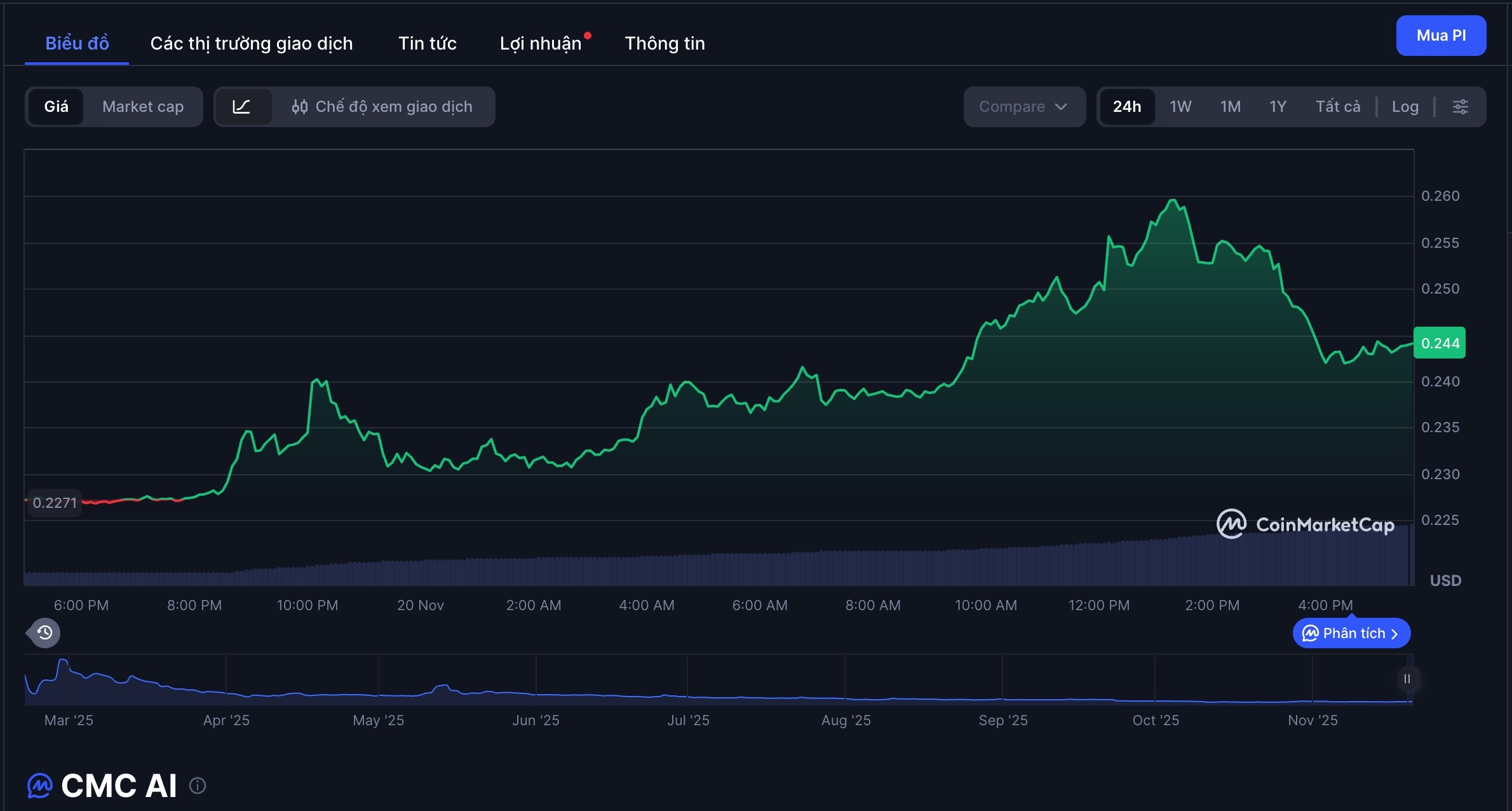 |
Pi Network's price unexpectedly bucked the market trend on November 20th. Photo: CCM. |
The Pi Network project hasn't seen much activity before this unusual price surge. The only good news is that the development team announced their whitepaper complies with European Commission regulations.
In reality, the total circulating supply of this cryptocurrency remains a great mystery. 8.31 billion out of 100 billion coins have been successfully mined. However, the actual amount held by users, the amount tradable without being locked on the network, remains outside the realm of transparency. According to analytics platforms, tens to hundreds of millions of Pi are unlocked each month. This amount is constantly increasing while its practical application is lacking, creating selling pressure and causing the price to continuously fall.
A short-term increase of about 10% is not enough to save the project. Compared to its IPO price, Pi Network has lost more than 90% of its value.
According to data from the blockchain tracking platform PiScan, Vietnam currently has 163 Pi Network nodes, accounting for nearly 49% of the total 334 global processing points. The majority of these nodes are located in the North with 75 machines, followed by the South with 54 and the Central region with 34.
The number of nodes in Vietnam far exceeds that of many regions with large Pi mining communities such as China, India, South Korea, or Europe. This indicates strong participation from domestic users, but raises concerns about the concentration of control based on geographical regions.
Currently, Pi Network only has two transaction validation machines globally, both managed by the development team, raising further questions about the network's decentralization. Domestic authorities have also repeatedly warned about the risk of fraud and losses associated with investing in this type of asset.
Source: https://znews.vn/pi-network-nguoc-dong-tang-manh-post1604416.html

![[Photo] Conference announcing the Politburo's Decision on organizational and personnel matters](https://vphoto.vietnam.vn/thumb/1200x675/vietnam/resource/IMAGE/2026/04/01/1775017881825_bnd-2410-1472-jpg.webp)


![[Photo] Conference on the transfer and reception of Party organizations and Party members between the Party Committee of the Government and the Party Committees of the Central Party Agencies](https://vphoto.vietnam.vn/thumb/1200x675/vietnam/resource/IMAGE/2026/04/01/1775036784472_ndo_br_bnd-2620-jpg.webp)



























































![[Photo] Prime Minister Pham Minh Chinh receives the Ambassador of the Russian Federation to Vietnam](https://vphoto.vietnam.vn/thumb/402x226/vietnam/resource/IMAGE/2026/04/01/1775046774818_anh-man-hinh-2026-04-01-luc-19-32-33.png)
































Comment (0)