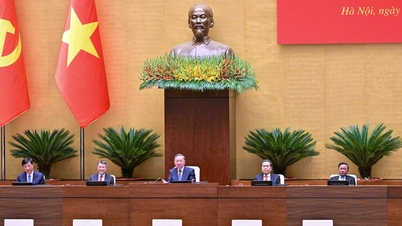
(kontumtv.vn) – Continuing the program of the 8th Session, on the afternoon of November 26, the National Assembly passed the amended Notarial Law with 450 out of 453 delegates voting in favor. The amended Notarial Law consists of 8 chapters and 76 articles, and will take effect from July 1, 2025.
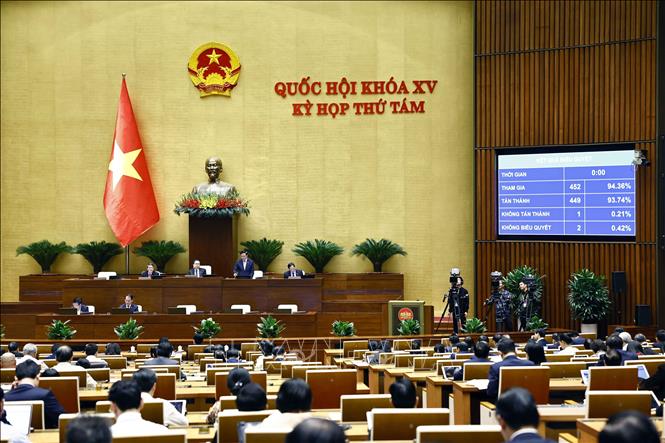
The Law on Notarization (amended) regulates notaries, notarization practice organizations, the practice of notarization, notarization procedures, and state management of notarization.
The summary report explaining, receiving feedback, and revising the draft Law on Notarization (amended) by the Standing Committee of the National Assembly shows that the criteria for transactions requiring notarization as stipulated in the draft Law are appropriate because the Law on Notarization is a formal law, and it is not advisable to specify all transactions that must be notarized in the Law to avoid duplication with provisions of specialized laws. However, the Law needs to stipulate general criteria to prevent each specialized legal document from defining transactions requiring notarization according to different criteria, leading to inconsistency or potential abuse, affecting the legitimate rights and interests of organizations and individuals.
Based on incorporating some of the Government's opinions, the Standing Committee of the National Assembly proposes amending the provision in Clause 1, Article 3 of the draft Law as follows: "Transactions requiring notarization are important transactions that demand a high level of legal security and are stipulated by law or mandated by law to be notarized by the Government."



This regulation has the advantage of being consistent with the conclusions of competent authorities, promptly implementing the policy of reforming legislative thinking and the directives of the Chairman of the National Assembly in Official Letter No. 15/CTQH dated October 29, 2024. It ensures harmony between the requirement for the uniformity of the legal system, strict control of transactions requiring notarization, and the stability of the law, flexibility, and responsiveness to practical requirements. It maintains the stability of regulations on transactions requiring notarization currently stipulated in government decrees, avoiding the situation of "legalizing" the provisions of decrees and circulars.
Furthermore, the Standing Committee of the National Assembly proposed retaining the content of Clause 13, Article 76 of the draft Law because currently, transactions requiring notarization are regulated in laws, decrees, and circulars; therefore, a review is needed to amend, supplement, or repeal them within a certain period to meet the criteria stipulated in the Law on Notarization. Simultaneously, a transitional provision should be added for regulations on transactions requiring notarization in decrees issued before the effective date of the amended Law on Notarization, which are not mandated by law to the Government but meet other requirements stipulated in Clause 1, Article 3 of the amended Law on Notarization, and for regulations on transactions requiring notarization in decrees issued to address the review results as stipulated in Clause 13, Article 76 of the amended Law on Notarization, so that they remain in effect to ensure the stability and coherence of the legal system.
Regarding regulations on dossiers, procedures, and processes related to notarization activities, and the content of state management of notarization activities, the Standing Committee of the National Assembly recognizes that, in order to promptly implement the policy of reforming legislative thinking and the directives of the Chairman of the National Assembly in Official Letter No. 15/CTQH, based on the feedback from National Assembly deputies, it is proposed to omit the regulations on dossiers, procedures, and processes in notarization activities from the draft Law submitted to the National Assembly at the beginning of the 8th Session. At the same time, it is proposed to add a provision assigning the Government to provide detailed regulations on the above-mentioned contents within its authority to ensure flexibility, timely amendments and additions when necessary, facilitating decentralization in accordance with practical realities and meeting the requirements of administrative procedure reform.
Regarding the Government's proposal to retain two articles on state management, the Standing Committee of the National Assembly recognizes that some aspects of state management of notarization proposed by the Government have already been specifically regulated in specialized laws; therefore, it is not necessary to re-regulate them in the Law on Notarization to avoid duplication. Some specific aspects of state management in notarization activities have already been incorporated into appropriate specific articles of the draft Law. Therefore, in response to part of the Government's opinion, the Standing Committee of the National Assembly requests the addition of Article 8, which stipulates the principles governing the state management responsibilities of the Government, the Ministry of Justice, ministries, ministerial-level agencies, and provincial People's Committees regarding notarization, ensuring compliance with Clause 2, Article 39 of the Law on Government Organization.
Thus, after receiving feedback and making revisions, the draft Law has reduced 2 chapters, 3 articles, and 5 clauses in some specific articles compared to the draft Law submitted to the National Assembly at the beginning of the 8th Session.



Regarding professional liability insurance for notaries, the Standing Committee of the National Assembly proposes that the National Assembly retain the provision on professional liability insurance for notaries as a mandatory type of insurance, as stated in Article 39 of the draft Law.
In addition to the issues mentioned above, the Standing Committee of the National Assembly has directed the study and full incorporation of the opinions of National Assembly deputies to revise and perfect the draft Law, both in terms of content and technical aspects, before submitting it to the National Assembly for consideration and approval.
Source: https://kontumtv.vn/tin-tuc/tin-trong-nuoc/quoc-hoi-thong-qua-luat-cong-chung-sua-doi

![[Image] National conference summarizing one year of operation of the overall organizational model of the political system, the three-tiered government model.](https://vphoto.vietnam.vn/thumb/1200x675/vietnam/resource/IMAGE/2026/07/01/1782882811691_ndo_br_1-jpg.webp)