

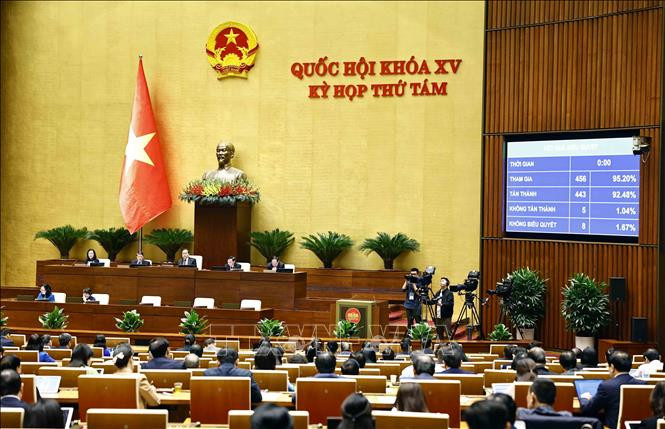
On the morning of November 27th, the National Assembly passed the amended Trade Union Law with 443 votes in favor, representing 92.48% of the total number of National Assembly delegates.
Verify the eligibility of members when joining the trade union.
The report of the National Assembly Standing Committee on the acceptance, explanation, and revision of the draft Law on Trade Unions (amended), presented by the Chairwoman of the Social Affairs Committee, Nguyen Thuy Anh, shows that the Trade Union is a "large political and social organization of the working class and laborers," placed under the leadership of the Party. Therefore, the establishment, membership, and operation of trade unions need to be regulated in a strict, synchronized, and unified manner within the legal system, while also ensuring the attraction of workers and workers' organizations in enterprises to participate in the Trade Union and meeting the requirements of international integration and the practical demands of the development process.
Responding to the opinions of National Assembly deputies, the Standing Committee of the National Assembly directed the revision of Article 5 of the draft Law on the establishment and membership of trade unions by Vietnamese workers and the membership of foreign workers. At the same time, the Standing Committee of the National Assembly requested the Vietnam General Confederation of Labor to promptly develop comprehensive solutions to promote the nature, role, and responsibilities of trade union members and trade union organizations in the new era.
Regarding suggestions for stricter regulations on the conditions for foreign workers to join trade unions, the Standing Committee of the National Assembly noted that Clause 5, Article 4 stipulates that "Trade union officials are Vietnamese citizens who are elected, recruited, appointed, or designated to perform the tasks of the trade union organization," including full-time and part-time trade union officials. Foreign workers, upon joining the trade union, are not allowed to run for or be nominated as trade union officials and can only participate in trade union activities at the grassroots level.
Clause 7 of Article 10 also prohibits "Abusing trade union rights to violate the law, infringe upon the interests of the State, and the legitimate rights and interests of agencies, organizations, units, enterprises, and individuals." Clause 3 of Article 5 stipulates that "The establishment, membership, and operation of trade unions shall be carried out in accordance with the provisions of the Vietnam Trade Union Charter, this Law, and other relevant legal provisions." Therefore, conditions for voluntary participation, agreement on the principles and objectives of the Trade Union, or the period of residence in Vietnam... will be specifically stipulated in the Vietnam Trade Union Charter and guided by the Vietnam General Confederation of Labor. Therefore, the Standing Committee of the National Assembly requests the National Assembly to retain the provisions as in the draft Law.
Regarding the accession of workers' organizations in enterprises to the Vietnam Trade Union (Article 6), taking into account the opinions of delegates, the proposals of the drafting agency, and the opinions of the Government, in order to ensure uniformity and consistency in the direction of the entire trade union system, the Standing Committee of the National Assembly directed the revision to add the authority of central and equivalent industry trade unions in recognizing workers' organizations in enterprises joining the Vietnam Trade Union in Clause 2 and to revise Clause 3 of Article 6.
At the same time, the Standing Committee of the National Assembly requested the Vietnam General Confederation of Labor to unify its direction and provide specific guidance, with appropriate solutions in the implementation process; and to supplement the regulations in the Charter of the Vietnam Trade Union regarding the conditions, standards, and procedures for rigorously verifying the legality and compliance with the law of the representative organization of workers in enterprises, as well as the qualifications and conditions of members when joining the Trade Union.

Agree with the Government when issuing standards and norms for the use of trade union finances.
Responding to the opinions of National Assembly deputies, the Standing Committee of the National Assembly directed the revision of regulations on trade union finances, specifically to strictly regulate the acceptance of aid, sponsorship, and technical support by trade unions at point d, clause 1, Article 29. Simultaneously, it added a provision assigning the Government the authority to regulate cases of non-payment or delayed payment of trade union fees at clause 2.
To ensure the rights of trade union officials, union members, and workers, in accordance with the capabilities of trade union finances, and to ensure transparency and openness, and in response to the opinions of National Assembly deputies and proposals from the drafting agency, the Standing Committee of the National Assembly directed a review and revision of the regulations on expenditure tasks of trade union finances in Clause 2 (Article 31). At the same time, Clause 4 stipulates the principles and grants the Vietnam General Confederation of Labor the authority to delegate the collection and distribution of trade union funds.
Regarding the suggestion to consider the provision stating "After consultation with the Government" when the Vietnam General Confederation of Labor issues standards, norms, expenditure regimes, and regulations on the management and use of trade union finances, the Standing Committee of the National Assembly believes that trade union finances are formed from sources of state budget support and from trade union funds as stipulated by law. Entrusting the Vietnam General Confederation of Labor with issuing these regulations without consultation with the Government could lead to the perception that the policies issued by the Vietnam General Confederation of Labor do not closely follow, update, or even deviate from the general policies of the State.
The provisions in the draft Law do not mean that every specific and detailed regulation and standard must be agreed upon by the Government. Trade unions still have the right to act independently based on the principles established jointly by the Trade Union and the Government (as is currently the case). This is also the Government's preferred option. Therefore, the Standing Committee of the National Assembly requests the National Assembly to retain the provisions as in the draft Law.
Source

![[Image] National Assembly discusses the implementation of the socio-economic development plan.](https://vphoto.vietnam.vn/thumb/1200x675/vietnam/resource/IMAGE/2026/04/20/1776696707422_ndo_br_img-20260420-185419-jpg.webp)



![[Photo] General Secretary and President To Lam meets with National Assembly delegates from ethnic minorities.](https://vphoto.vietnam.vn/thumb/1200x675/vietnam/resource/IMAGE/2026/04/20/1776696701056_a1-bnd-8331-3342-jpg.webp)









![[Infographic Series] Historical Sites in Dong Nai: Long Khanh Provincial Administrative Building, Long Khanh Town Party Committee Base, Xuan Loc Temple - Xuan Hoa Pagoda Complex](https://vphoto.vietnam.vn/thumb/402x226/vietnam/resource/IMAGE/2025/9/26/1331532306fb4ad18e4a849e5c64202a)




















































Comment (0)