

People's Artist Tran Ngoc Giau, Chairman of the Ho Chi Minh City Theatre Association, during his business trips and participation in international theatre festivals, has often encountered questioning frowns from foreign colleagues: "Why are Vietnamese plays so long?"
Mr. Giau stated: "In reality, in developed entertainment industries like South Korea or France, rhythm is a crucial element. A typical performance only lasts around 65-70-90 minutes. This duration is carefully calculated to suit the daily routines of working people: After work, they can stop by the theater using public transport, enjoy a complete work of art, and still have time to return home for dinner and rest with their families. At theater festivals in France, conciseness is always prioritized, by the ability to compress emotions and drama within a timeframe perfectly suited to the attention span of modern people."

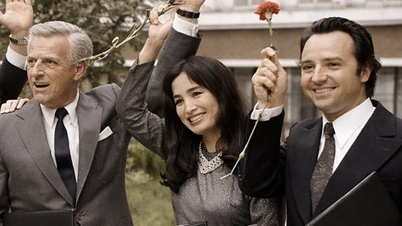
The play "The Short-Form Village" is concise, yet charming and touching.
PHOTO: HK
" THE EGO" OVERWHELMS THE COMMON.
The problem with many Vietnamese theatrical performances lies in their unnecessary length. One of the most direct causes is the lack of restraint in comedic elements. In an attempt to "please" the audience, many actors are willing to prolong comedic situations to the point of excess, sometimes overshadowing the main message under the guise of cheap laughter. Not only comedies, but even tragic scenes fall into this trap. Prolonged scenes of misery sometimes cause fatigue rather than empathy.
At a deeper level, it's a story about the artist's "ego." In a context where income from theater is modest compared to film or reality shows, those who cling to the stage are mostly driven by a burning passion. This passion, sometimes combined with the deference shown to producers and directors, has led to a situation where "love becomes a vice." Directors allow each actor to showcase a little more of their talent, blurring the lines between leading and supporting roles and creating a cumbersome production. Furthermore, the pressure to "maintain a full cast" forces productions to find ways to bring all actors to the stage so everyone has a chance to shine, turning the performance into an overloaded vehicle.

The Lunar New Year Cai Luong play "Ganh Cai Trang Nguyen" is concise yet captivating.
PHOTO: HK
Furthermore, the scriptwriting and staging approach is also a bottleneck. Many plays set in the past often have a very slow pace, from the dialogue to the action. Although the director wants to recreate the slow-paced thinking and lifestyle of previous generations, if not done skillfully, that authenticity can easily become sluggish and alien to the rhythm of contemporary life. Today's audience will find it difficult to patiently follow a story that can be resolved in half the time. In particular, cramming too many messages into a script is also inadvisable. When trying to solve too many problems at once, the work not only lacks depth but also appears complicated and drawn-out.
HOW LONG IS JUST RIGHT?
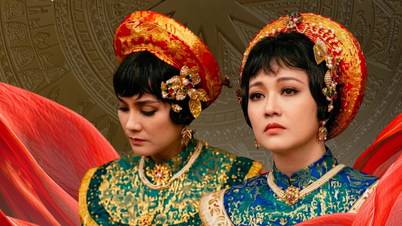
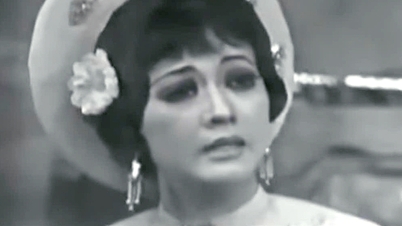
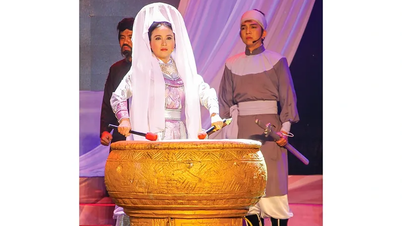
Looking back, classic theatrical works like "The Drum of Me Linh" or "Dạ cổ hoài lang" were only about 120-150 minutes long. Even earlier recordings or filmed versions were only about 90 minutes long, yet they captivated generations. Most recently, the 5B theater staged the play "Xóm Phông bạt" (The Tarpaulin Village), with a running time of 2 hours and 15 minutes, still conveying the full range of tragic and comedic emotions. Or the historical cải lương plays by director Hoa Hạ, which are grand and feature many actors, but with a fast and powerful pace, have proven that a successful performance doesn't need to be excessively long.
People's Artist Tran Ngoc Giau emphasized: "In South Korea, announcing the duration of a performance is mandatory. If it exceeds 90 minutes, the audience has the right to refuse to buy tickets because it disrupts their daily schedules." This demonstrates professionalism and respect for customer rights – an element that Vietnamese theaters often neglect.
Director Ton That Can, Vice President of the Ho Chi Minh City Theater Association, further shared: "In training or at professional festivals, the requirement for duration is always set as a strict criterion to cultivate concise thinking in the younger generation. This shows that professionals have identified the 'disease' of verbosity and are striving to change it. When each line of dialogue and each gesture is carefully selected and placed at the right moment, the stage can truly create powerful emotional impact."
And I think that plays and traditional Vietnamese operas should have a running time of about 2 to 2.5 hours, which is just right and suits the audience's viewing preferences and daily routines.
Source: https://thanhnien.vn/san-khau-mac-benh-dai-dong-185260304232031503.htm






































































Comment (0)