

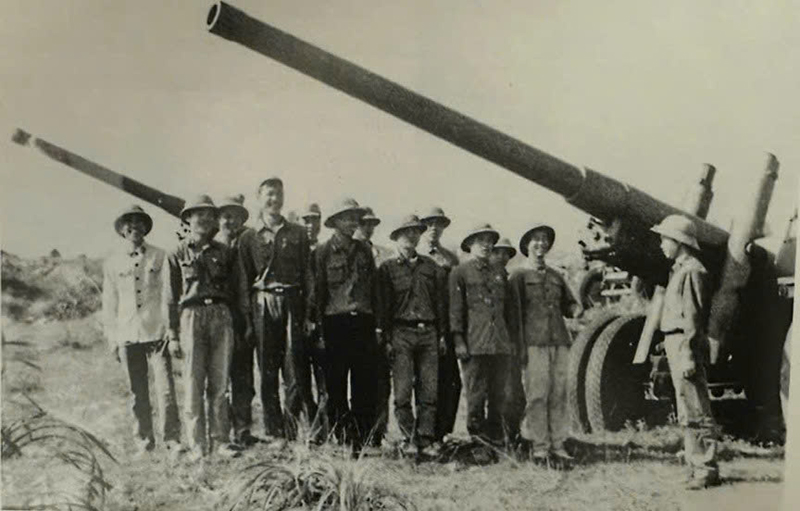
Main force troops and local militia train to be ready to shoot down American aircraft on the Ham Rong front. Photo: Archival material.
The escalating bombing campaigns against North Vietnam were identified by the US imperialists as one of their top priorities, aimed at supporting their military efforts in South Vietnam. Simultaneously with the deployment of ground troops to the South, the US used its air and naval forces to launch a large-scale bombing campaign against North Vietnam, with increasing intensity. Faced with the US's intensified and expanding war of aggression, the Party had already developed plans and countermeasures from the beginning of 1964.
The People's Air Defense Conference of the entire North (early 1964) focused on discussing measures to deploy and strengthen the three-branch People's Air Defense system; and measures to implement the plan to evacuate and disperse the population and factories and production facilities from key enemy-attacked areas. Simultaneously, the armed forces urgently reorganized their structure and personnel. Units were ordered to organize alert levels and enhance combat readiness. The Air Defense and Air Force Command finalized its combat plan, deploying forces to concentrate firepower on key targets; at the same time, it formed a widespread, localized combat force. The Navy, from July 1964, transitioned to a state of combat readiness, increasing patrols in coastal waters and establishing a forward command post in the waters of Military Region 4. Other branches of the armed forces also urgently developed combat plans and ensured transportation in the context of the war spreading throughout the country.
In addition, localities organized combat training exercises, combat support, evacuation, and the dispersal of assets and people. In coastal areas, military demarcation lines, and the western border regions, local People's Armed Forces were briefed on plans to counter enemy infantry, aircraft, warships, and artillery. Local armed forces intensified patrols and defenses to prevent enemy infiltration and sabotage. Main army units coordinated with armed police and militia to implement defense plans. In the interior, main army units assembled in designated areas, ready to mobilize for combat in necessary directions... Thus, by the end of 1964 and the beginning of 1965, North Vietnam had been fundamentally prepared and placed in a state of readiness to counter the destructive war waged by the US air force and navy.
Amidst the strenuous efforts of the entire Party, people, and army in preparing for combat, at the end of March 1964, President Ho Chi Minh convened a special political conference. This is considered a "Dien Hong Conference" in the Ho Chi Minh era, with a firm affirmation of the fighting spirit of our people: "If they dare to attack the North, they will certainly suffer a disastrous defeat!" Bearing in mind his sacred call to save the nation: "Let us all unite as one. Let us be determined to defeat the American invaders," the army and people of Thanh Hoa resolved to build Thanh Hoa into a province with strong economic and defense potential, ready to counter any destructive actions of the American imperialists and ready to support the battlefield in the South.
Following the directives of the Central Party Committee and the close guidance of the Central Military Commission and the Command of Military Region 3, the Thanh Hoa Provincial Party Committee determined: "The main target of enemy attacks on the military region at this time is Thanh Hoa, and the key target in Thanh Hoa is Ham Rong. Protecting the Ham Rong bridge contributes to ensuring uninterrupted transportation." Based on this, the Provincial Party Committee promptly directed the entire Party, army, and people to consolidate the people's war strategy, shift economic, cultural, and transportation development towards wartime conditions, and redirect ideological and organizational work to meet new requirements. The Provincial Party Committee also directed the supplementation and revision of combat plans, air defense evacuation plans, and plans for building and developing the armed forces in the province. Simultaneously, it directed the Irrigation Department, the Transportation Department, and related sectors to camouflage and protect infrastructure; the commercial, food, and fuel sectors to evacuate warehouses; and the police force to practice fire prevention and control plans and maintain social order in the event of enemy air attacks. In addition, the postal service organized standby radio units and installed additional loudspeakers for air defense signaling; the health sector organized surgical training and established emergency and medical teams; the transportation sector prepared vehicles and personnel ready to repair bridges and roads and serve in combat; the forestry, agriculture, electricity, and other sectors and levels in the province actively prepared forces to participate in combat. In Thanh Hoa town alone, the militia and self-defense forces established 7 combat clusters and set up 7 emergency and casualty evacuation stations. The self-defense forces also reinforced their arsenals with additional weapons...
Clearly recognizing the enemy's plot to attack Thanh Hoa, with Ham Rong as the main target, the Air Defense Command deployed two 57mm artillery companies from the 234th Regiment; the 3rd Military Region Command deployed four 37mm anti-aircraft artillery companies from the 213th Regiment to Thanh Hoa. Later, an additional 37mm and 14.5mm artillery company from the 304th and 350th Divisions were deployed to the Ham Rong area. On March 3, 1965, the Air Defense Command reinforced Thanh Hoa with the 14th Battalion of 37mm and 14.5mm anti-aircraft artillery, coordinating with units of the Military Region and the Provincial Military Command in combat.
With the comprehensive preparations mentioned above, for the first time on a front against the war of destruction, the main army, local troops, and militia coordinated their fighting. The forces participating in the battle in the Ham Rong area were organized into 5 mixed firepower clusters, with the anti-aircraft artillery company as the core. Each firepower cluster was capable of fighting independently in its assigned direction, while also effectively coordinating with other units. The cluster north of the bridge included the 3rd Company of 57mm artillery of the 234th Regiment, the 17th Company of 37mm anti-aircraft artillery stationed in Yen Vuc, and 3 positions of the Yen Vuc militia. This position directly engaged the enemy from the northeast and north, coordinating support for the southwest when necessary and intercepting the enemy when they used the Ham Rong mountain range to launch an attack from the west.
In the South there are 2 clusters, including: (1) The town cluster has the 3rd Company of 37mm anti-aircraft guns and the 4th Company of 14.5mm anti-aircraft guns of Battalion 14, Division 330 and the town's self-defense units deployed combat positions at Thanh Hoa station and Bo Ho. This cluster has the task of attacking the enemy from the South and controlling the enemy to prevent them from approaching the Ham Rong target, directly protecting Thanh Hoa station and the town. (2) The Nam Ngan cluster has the 2nd Company of 37mm anti-aircraft guns of Regiment 213, deployed combat positions at Dinh Huong and 3 Nam Ngan self-defense positions. This cluster is tasked with ambushing the enemy when they get close to the target, controlling the Southeast direction and coordinating with the naval unit.
The southwestern cluster consisted of the 1st Company of 57mm artillery of the 234th Regiment stationed at the Dong Tac battleground; the 4th Company of 37mm anti-aircraft artillery of the 213th Regiment stationed on an unnamed hill; the 4th Company of 14.5mm anti-aircraft artillery of the 14th Battalion, 350th Division stationed on Hill 75; and three positions of the power plant's self-defense forces tasked with engaging the enemy from the southwest, directly protecting the Ham Rong bridge and power plant. The cluster of two bridge piers included the machine gun squad of Pham Gia Huan, Nguyen Huu Nghi, and Tran Van Lien of the Thanh Hoa Provincial Military Command, stationed on Ngoc Mountain; the 14.5mm anti-aircraft platoon of the Provincial Military Command stationed on Hill 74 (Rong Mountain); the machine gun squad of the 3rd People's Armed Police detachment; the Lo Cao self-defense force; and the Ham Rong Police Station. Although this battleground cluster lacked large anti-aircraft guns, it held a crucial position in engaging the enemy at low altitudes and protecting the bridge. Furthermore, the 4th Company of 37mm anti-aircraft guns of the 213th Regiment and the 4th Company of 14.5mm anti-aircraft guns of the 14th Battalion, with the support of the people, fully exploited the strengths of the terrain, overcoming difficulties to transport guns, cannons, and ammunition to build fortifications right on the unnamed hilltops, Hill 75, etc.
With the slogan "All for the front lines, all to defeat the American invaders," the Ham Rong front was ready for the "historic confrontation" on April 3rd and 4th, 1965. The army and people of Thanh Hoa were determined to contribute their efforts and sacrifice their blood and lives to fight alongside the army and people of the North to defeat the destructive war waged by the American invaders.
Liu Jie
(This article uses material from the book "Ham Rong - A Historic Confrontation," Thanh Hoa Publishing House - 2010).
Source: https://baothanhhoa.vn/san-sang-cho-cuoc-dung-dau-lich-su-244313.htm


![[Photo] Prime Minister Pham Minh Chinh receives the Director of RMIT University Melbourne (Australia)](https://vphoto.vietnam.vn/thumb/1200x675/vietnam/resource/IMAGE/2026/04/02/1775142120087_thiet-ke-chua-co-ten-2026-04-02t214220784-png.webp)

















![[Infographics] Cultural, sports and tourism events in Thanh Hoa province in April 2026](https://vphoto.vietnam.vn/thumb/402x226/vietnam/resource/IMAGE/2026/04/02/1775102507332_infographics-ca-w1200t0-di2613d199d4100842t11358l1-skt4-026.webp)



























































Comment (0)