|
| People in Dong Phuc commune are harvesting Shan Tuyet tea. |
Precious trees on the high mountains
In Ban Moc village, Yen Binh commune, the Shan Tuyet tea plants grow at an altitude of nearly 1,000 meters above sea level. The village is home to 76 households, mainly of the Tay ethnic minority, whose generations have been involved in tea cultivation. These tea plants, some decades old, have trunks covered in silvery lichens and roots clinging to the high mountain slopes perpetually shrouded in clouds. Each harvest season, the villagers have to walk along steep paths, sometimes taking nearly an hour to reach the location, to pick the tender, dew-covered tea buds.
Ms. Ma Thi Hanh, a resident of Ban Moc village, shared: "Since I was little, I've followed my parents up the mountain to pick tea. Back then, we only made tea for ourselves to drink; later, we started selling it. For the people in this village, the tea plant is like a friend that has been with us from our grandparents' generation to the present day."
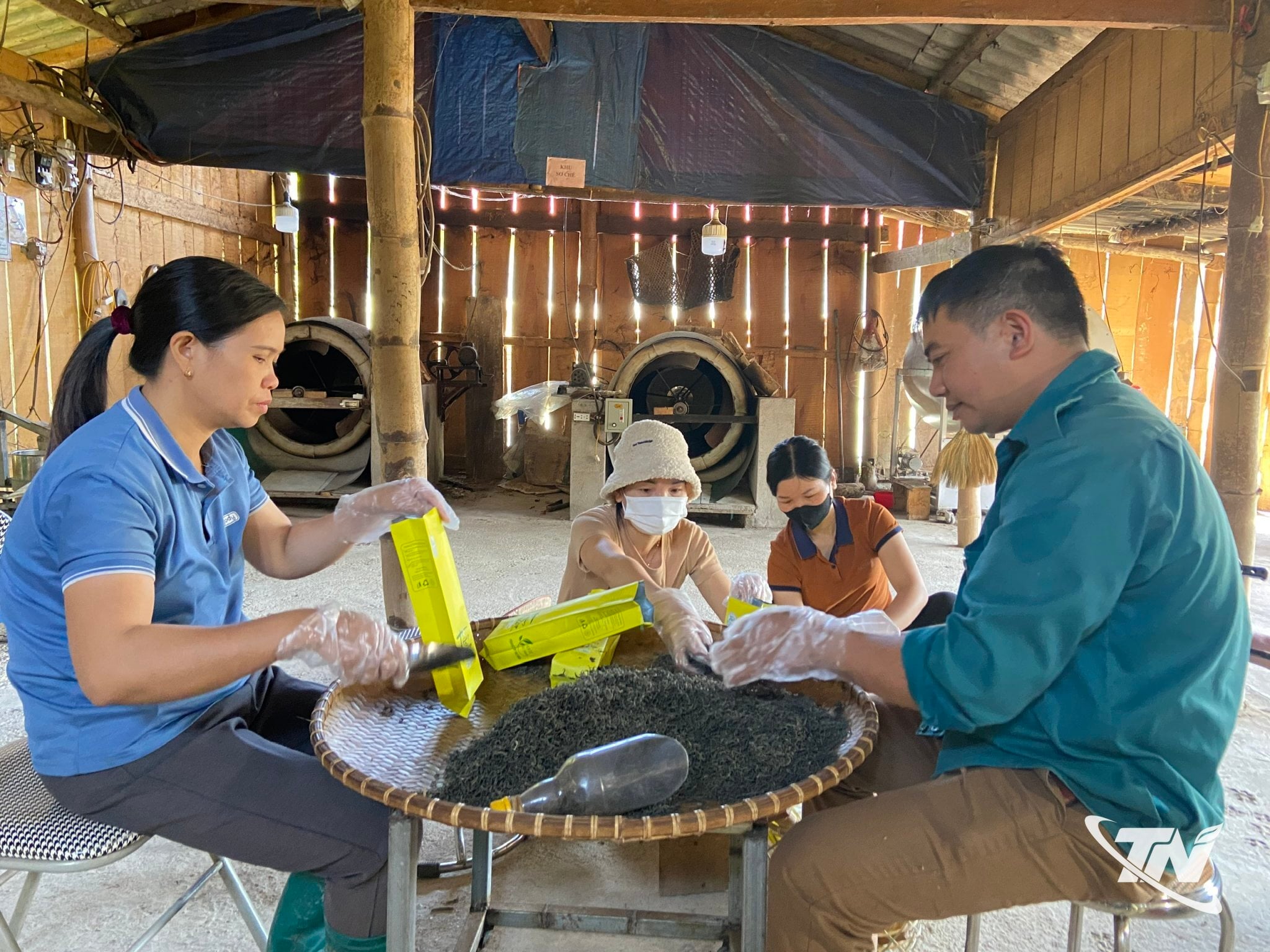 |
| Members of the Ban Moc Agricultural Cooperative are packaging Shan Tuyet tea products. |
Although deeply rooted in local life, Shan Tuyet tea has only recently begun to take a new direction as people have formed cooperatives and changed their production methods. In Ban Moc village, the Ban Moc Agricultural Cooperative was established in 2023, gradually standardizing production processes according to VietGAP and organic standards, building concentrated raw material areas, and ensuring product traceability. The cooperative's green and black tea products made from Shan Tuyet tea have received OCOP 3-star certification.
Mr. Ma Van Thong, Director of Ban Moc Agricultural Cooperative, said: "We have determined that to achieve sustainable development, we must improve product quality and build a brand. When consumers become aware of Ban Moc Shan Tuyet tea, the value of the tea plant will increase, and people will also have more income."


Not only in Ban Moc, Dong Phuc commune, the largest Shan Tuyet tea growing area in the province, but both the government and the people are changing their economic practices related to tea cultivation. The entire commune currently has about 600 hectares of Shan Tuyet tea, of which more than 316 hectares are yielding stable harvests. Many areas have met organic and VietGAP standards. Nearly 400 households in the commune are involved in planting, caring for, processing, and trading tea, creating jobs for about 1,000 local workers.
From tea buds grown high in the mountains, relying solely on rainwater, farmers in Dong Phuc have received support to build a production chain from cultivation, harvesting, processing to consumption. As a result, income from Shan Tuyet tea production has increased. Products offered to the market include traditional hook-shaped tea and new varieties such as black tea and white tea, with prices ranging from 500,000 VND to several million VND per kilogram. Shan Tuyet tea products are no longer found only in highland markets but have reached many major markets, even being exported to the United States.
From heritage to driving force for development
Looking at the situation in Bản Mộc and Đồng Phúc, the economic value of Shan Tuyet tea is becoming increasingly evident. From a plant associated with traditional farming practices, Shan Tuyet tea is gradually becoming a high-value commodity, creating jobs and providing many households with additional income right in their hometown.
 |
| The organic Shan Tuyet tea production model will be implemented in Ban Moc village starting in 2025. |
As tea plants gained a foothold in the market, many localities began considering exploiting their tourism value. Amidst tea hills shrouded in morning mist, tourists can follow locals up the mountain to pick tea leaves, listen to stories about centuries-old tea trees, experience the traditional tea processing method, and then enjoy a hot cup of tea in the vast wilderness.
In Yen Binh commune, the idea of developing experiential tourism linked to the Tay ethnic culture is gradually taking shape. Meanwhile, Dong Phuc commune is also aiming to combine ancient tea hills and traditional tea processing with community tourism. If infrastructure and services are properly invested in, this will be a promising direction for the province's Shan Tuyet tea growing regions.
Mr. Trieu Duc Thong, Vice Chairman of the People's Committee of Dong Phuc commune, said: The locality is orienting tea production with the development of experiential tourism and connecting it with the Ba Be Lake tourist route. This is not only a way to increase the value of the product but also contributes to preserving the landscape and culture and creating more economic development opportunities for the people.



As evening falls on the mountain slopes, the shadows of ancient tea trees stretch long across the hillsides. The villagers silently carry sacks of fresh tea buds down the mountain after a day of hard work harvesting. From these tea buds, a traditional craft is being preserved and continued, the lives of the people are changing day by day, and the high mountain regions of Thai Nguyen are gradually finding their way forward from their inherent local values.
| According to estimates, the province currently has over 700 hectares of Shan Tuyet tea. Although it accounts for a small percentage of Thai Nguyen's total tea area, Shan Tuyet tea buds grow in a cool climate year-round, absorbing the essence of the mountains and forests to create a unique aroma, a rich yet sweet aftertaste, and a characteristic shimmering golden color. Thanks to this, Shan Tuyet tea is increasingly asserting its position among Thai Nguyen's specialty products. However, the value of Shan Tuyet tea comes not only from the product itself, but also from the cultural and livelihood values that this plant brings to the highlands. |
Source: https://baothainguyen.vn/kinh-te/nong-nghiep/202607/shan-tuyet-do-bong-dai-ngan-23445e0/


![[Image] National conference summarizing one year of operation of the overall organizational model of the political system, the three-tiered government model.](https://vphoto.vietnam.vn/thumb/1200x675/vietnam/resource/IMAGE/2026/07/01/1782882811691_ndo_br_1-jpg.webp)