

In the first quarter of 2026, almost all major smartphone brands launched new flagship models. Along with design improvements, these product lines received hardware and software upgrades to adequately meet the demands of deep integration of AI (artificial intelligence) directly into the devices.
Elevate the experience
After many years, Samsung has decided to change the design of its newly launched high-end Samsung Galaxy 26 Series smartphones. The Galaxy S26 Ultra has abandoned the familiar square design, opting instead for rounded corners to align with the S26+ and S26 versions.
This redesigned camera module gives Samsung more room to upgrade the lens. Specifically, with this new generation main camera, Samsung has made a breakthrough by achieving a record-breaking aperture of f/1.4 on a smartphone (a significant leap from f/1.7 in the previous generation). The zoom capability combines optics and AI algorithms, boosting digital zoom to over 100x (like the Samsung Galaxy S26 Ultra with Space Zoom 100X, and the Reno15 Series with up to 120x zoom), allowing for high-detail shots from a distance. Users can capture a panoramic image and then crop it into multiple close-up shots.
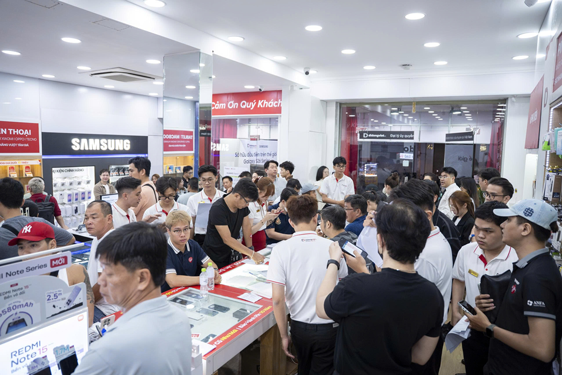
Hundreds of people experience and wait to receive Samsung's newly launched S26 Ultra at a Di Dong Viet store in Ho Chi Minh City. Photo: LE TINH
The Xiaomi 17 Series has officially launched with comprehensive features and powerful performance, featuring a Leica camera system with enhanced optics for improved night photography and Xiaomi HyperOS 3 with deep integration of Xiaomi HyperAI. Equipped with a triple camera system, the Xiaomi 17 Series offers versatile photography capabilities across various focal lengths. The main camera utilizes a Leica Summilux lens combined with a 95mm Light Fusion sensor, maintaining a balance between bright and dark areas, especially in night or backlit situations. Additionally, the Xiaomi 17 Series incorporates a 60mm Leica telephoto lens with 50MP resolution, supporting macro photography at a distance of 10cm. The 50MP ultrawide camera expands creative possibilities with its wide-angle view, while the 50MP front camera ensures sharp image quality. The Xiaomi 17 Ultra supports 4K 120fps Dolby Vision and 4K 120fps Log ACES, offering flexible post-production capabilities and bringing the filming experience closer to cinematic standards. Xiaomi's Surge battery technology continues to be upgraded with a capacity of 6,000 mAh on the Xiaomi 17 and 6,330 mAh on the Xiaomi 17 Ultra.
This year, the retail prices of the Galaxy S26 Series have all increased compared to the Galaxy S25 Series, mainly due to the global shortage of memory chips and overall supply. Specifically, the launch price starts from VND 25,990,000 for the Galaxy S26, from VND 29,990,000 for the Galaxy S26+, and from VND 36,990,000 to VND 51,990,000 for the Galaxy S26 Ultra. Despite the higher price, Vietnamese users still prefer the Galaxy S26 Ultra version. The Xiaomi 17 Ultra, with two memory versions (16GB + 512GB and 16GB + 1TB), is priced at VND 39,990,000 and VND 42,990,000 respectively. The Xiaomi 17 comes in two memory versions: 12GB + 256GB and 12GB + 512GB, priced at VND 26,990,000 and VND 28,490,000 respectively.
Defining customer segments
Sharing his thoughts on the trend of phone manufacturers focusing on launching flagship models priced in the tens of millions of VND, tech KOL Huynh Hoang Thien Tai ("Tai Xai Tech") said that the smartphone market is gradually becoming more clearly differentiated. The group of tech-savvy users who want to experience new features like AI, high-end cameras, or powerful performance tend to gravitate towards flagship models with increasingly higher prices.
The budget segment still exists with its own advantages. Many models in the price range of 6-7 million VND are still equipped with large-capacity batteries from 5,000-7,000 mAh, adequately meeting the basic needs of users. In the mid-range segment, Xiaomi's Redmi Note 15 Series is priced from 5,990,000 VND for the 15 4G version and 12,990,000 VND for the 15 Pro+ 5G. The POCO M8 Series is priced from 7,490,000 VND for the standard version and 12,490,000 VND for the top-of-the-line version. The Realme 16 is priced from 11,490,000 VND for the Realme 16 and 14,490,000 VND for the Pro version. OPPO's Reno15 Series starts at VND 11,990,000 for the Reno15F 5G and VND 19,990,000 for the top-of-the-line Reno15 Pro 5G.
Another tech KOL (Key Opinion Leader) stated that many major smartphone manufacturers such as Apple, Samsung, Xiaomi, OPPO, and Vivo are continuously launching flagship models with high price tags, attracting market attention. This trend reflects the general strategy of manufacturers: focusing on the high-end segment to improve profit margins in an increasingly competitive smartphone market. Simultaneously, many businesses are building brand ecosystems to define customer segments. For example, Redmi and Realme are positioned in the mainstream segment, while their main brand products are increasingly being pushed into the mid-to-high-end category. Therefore, it's not surprising to see many Xiaomi and OPPO smartphones currently listed at around 12 million VND or more. According to experts, this is a move to reposition brands, shifting from price competition to competition in technology, user experience, and brand value in the global market. Market reality also shows the strong appeal of flagship models. At the Di Dong Viet store at midnight on March 6th, Samsung Galaxy S26 phones were handed over to customers. Hundreds of buyers lined up to receive their devices, despite the product costing over 40 million VND. Tony Tran (residing in Thanh My Tay ward, Ho Chi Minh City), one of the customers who stayed up all night to "unbox" the Samsung Galaxy S26 Ultra early, said: "I upgraded when Samsung launched the new series to have a better experience. The most impressive feature of the new Galaxy generation is the camera system with a large aperture, allowing for better night photography, which is very suitable for my work needs of frequently shooting and recording content."
According to a representative from Di Dong Viet, the Ultra series of the Samsung S26 continues to account for a large proportion of total pre-orders, indicating a trend of users being willing to choose the premium version when upgrading their devices.
Security screen
Samsung first introduced the Galaxy 26 Ultra with Privacy Display technology to the mobile world . This is a proactive "anti-peeping" screen. Combining hardware and software, when Privacy Display is enabled, it can prevent people around you from seeing (sensitive) content displayed on the screen. Because it is still so new, this screen is causing various debates about its usability. However, it is a technological breakthrough and opens up a new goal for other companies to research, develop, and perfect.
Source: https://nld.com.vn/soi-dong-thi-truong-smartphone-cao-cap-196260307205147044.htm








![[GALLERY] Witnessing the first landing of an Italian F-35B fighter jet on a highway.](https://vphoto.vietnam.vn/thumb/402x226/vietnam/resource/IMAGE/2026/05/24/1779625960562_f-35b-della-marina-militare-2-jpg.webp)




















































































Comment (0)