


Focus on sowing rice.
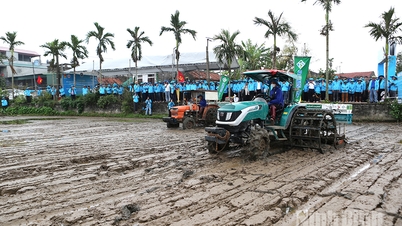
According to the plan of the Department of Agriculture and Environment (DARD) of Can Tho City, the 2025-2026 winter-spring rice crop will be planted on an area of 290,747 hectares with a yield of 2,064,752 tons. The planting schedule is expected to be divided into 3 phases and conclude on December 12, 2025. According to compiled data from the Crop Production and Plant Protection Sub-Department of the DARD of Can Tho City, as of December 31, 2025, farmers had planted 195,058 hectares, reaching 67% of the plan and 40% lower than the 2024-2025 winter-spring crop. Of this, 55,657 hectares are in the seedling stage, 56,548 hectares in the tillering stage, 18,154 hectares in the heading stage, and 64,699 hectares in the flowering-ripening stage. The main rice varieties include ST25 (16%), ST24 (6%), RVT (3%), Dai Thom 8 (44%), OM varieties (24%), and other varieties (7%).

For early-sown rice fields, which are currently in the fertilization period, the Department of Agriculture advises farmers to regularly inspect their fields to detect pests and diseases early and take timely preventive and control measures.
Mr. Nguyen Van Ben, residing in Hamlet 11A, Vi Thuy Commune, Can Tho City, who recently planted nearly 1 hectare of winter-spring rice with the RVT variety, said: “Due to the high and prolonged floodwaters this year, farmers planted their rice more than half a month later than the same period last year. This is the main rice crop of the year, usually with high yields, so farmers prepare the land carefully, waiting for the water to recede before starting to sow, especially to effectively control pests and diseases at the beginning of the season to avoid affecting the rice plant's development.”
In Vinh Vien, Xa Phien, and Luong Tam communes, farmers have just begun pumping water and leveling the fields in preparation for planting the 2025-2026 winter-spring rice crop. Mr. Nguyen Trung Kien, from Hamlet 8, Luong Tam commune, said: “Because the rice fields are located within the pumping station area, we have to wait for the water to drain before we can proceed with simultaneous planting. I just finished sowing nearly 4 hectares of OM 18 rice, so I'm worried about the impact of drought and salinity at the end of the season. Currently, the price of urea and DAP fertilizers has increased by 50,000-100,000 VND per bag, significantly raising the cost of rice production for farmers.”
The Department of Agriculture and Environment of Can Tho City recommends that localities and farmers implement a comprehensive technical process in rice production. Regularly update meteorological and hydrological information, as well as water sources and water quality for production. Strengthen meteorological and hydrological forecasting, especially regarding the impact of tidal surges. Pay attention to the development of brown planthopper populations in the fields and monitor local light traps to guide planting according to a schedule that avoids planthopper infestations, thereby minimizing the spread of disease. Conduct thorough investigations, detection, and timely forecasting of pest and disease outbreaks to develop management plans and minimize losses. Farmers should apply the "3 reductions - 3 increases" and "1 must - 5 reductions" technical packages to reduce input costs, such as reducing seed quantity, using fertilizers rationally and economically, increasing the use of organic fertilizers, and only carrying out pest control when the threshold for control is reached as recommended by specialized agencies.
Proactive pest control
The winter-spring rice crop in Can Tho City is currently in various stages from seedling to heading and ripening. According to the Can Tho City Department of Crop Production and Plant Protection, as of December 31, 2025, the city recorded over 6,000 hectares of winter-spring rice infected with pests and diseases, mostly at a mild level. Besides golden apple snails and rats, low temperatures in the early morning and high humidity create favorable conditions for fungal diseases to develop and spread, causing rice blast disease during the tillering and heading stages.
The Department of Crop Production and Plant Protection of Can Tho City recommends that for areas where winter-spring rice has already been sown, farmers should combine various measures to manage golden apple snails, such as using stakes to collect and destroy egg clusters, placing nets to prevent snails when flooding the fields, increasing the use of manual methods to catch snails, and applying biological methods and soil preparation to facilitate snail collection. Currently, rice leaf rollers are appearing sporadically on rice plants from the tillering to heading stages. Farmers need to regularly inspect their fields, monitor the density of rice leaf rollers, and limit the spraying of pesticides in the early stages of rice growth to protect natural enemies and reduce the risk of outbreaks of pests and other diseases in later stages.
For early-sown winter-spring rice crops during the second and third fertilization periods, the City's Crop Production and Plant Protection Sub-Department recommends that farmers regularly inspect their fields, carefully checking for disease symptoms on rice leaves, especially the lower canopy. When the disease first appears, they should flood the field with water and maintain a water level of 3-5 cm, using specific fungicides to reduce the spread of rice blast disease. They should stop applying nitrogen fertilizer and supplement with potassium-containing fertilizers to allow the rice plants to recover. They should not combine foliar fertilizer application with fungicides. Rice blast disease management and control should follow the principles of integrated pest management and the "four correct principles" of pesticide application. Integrated rodent control measures such as trapping crops, using lure traps, and biological rodenticides should be implemented. Absolutely no electric traps, oil traps, or prohibited pesticides, or pesticides not on the list of those permitted for use in Vietnam, should be used to kill rodents.
Ms. Nguyen Thi Giang, Deputy Director of the Department of Agriculture and Environment of Can Tho City, said: The department has requested the Plant Protection and Crop Production Sub-Department to conduct investigations, detect and predict the time of occurrence, scope and level of damage caused by pests, promptly notify and propose and guide technical measures to prevent and control pests on crops. In coordination with relevant units, the plan for the Sustainable Development Project of one million hectares of high-quality, low-emission rice cultivation associated with green growth in the Mekong Delta region by 2030 is being implemented in the city. The City's Agricultural Extension and Services Center, in coordination with relevant units, is organizing training to transfer techniques and apply technology to rice production, promoting the implementation of rice production processes, and training to improve the capacity of community agricultural extension groups, agricultural extension and plant protection collaborators to guide farmers in producing rice effectively.
Text and photos: HOAI THANH
Source: https://baocantho.com.vn/tang-toc-xuong-giong-lua-dong-xuan-a196644.html
























































Comment (0)