


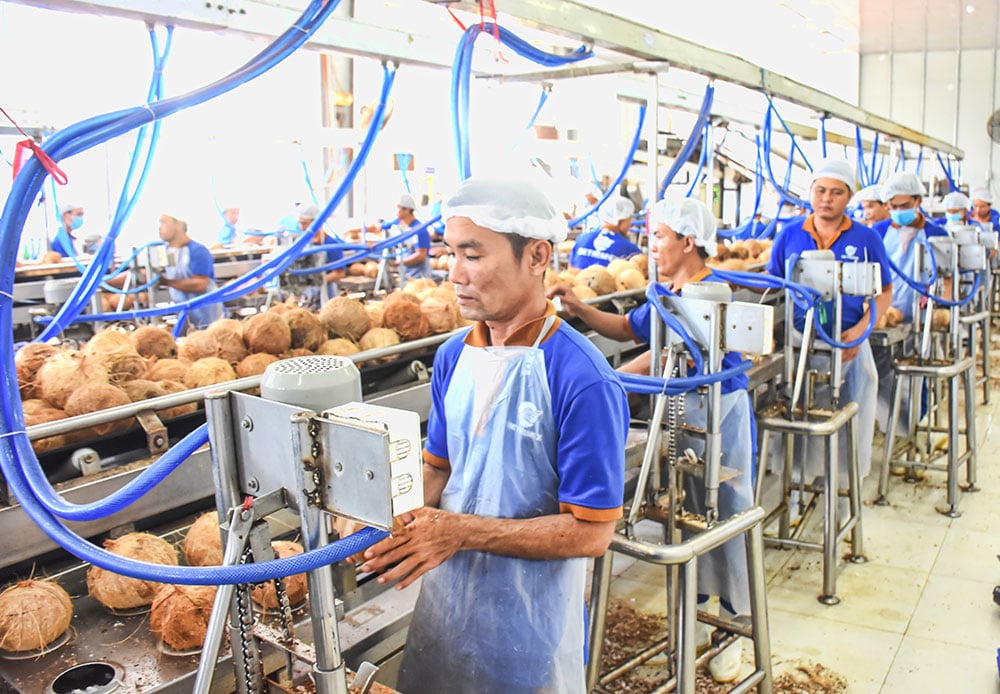
 |
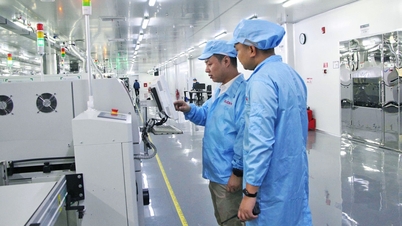
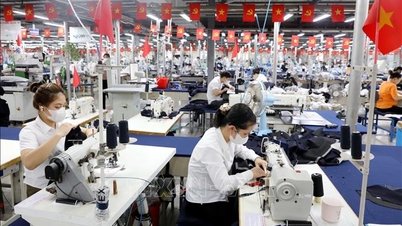
| Coconut product manufacturing line at Betrimex. |
A sustainable and promising economic sector.
The coconut tree has been recognized by the Ministry of Agriculture and Environment as one of the six key national industrial crops (January 2024). In 2025, the value of coconut industry production is expected to reach VND 11,000 billion. This represents stable growth during the 2020-2025 period. This demonstrates the sustainability and potential of this economic sector, especially in the context of Vietnam's promotion of green agriculture and the need to adapt to climate change.
In recent years, the province's coconut industry has experienced a strong surge thanks to the remarkable development of the processing industry and the ability of leading enterprises in the coconut sector to master science and technology.
The province has 183 businesses operating in this sector, providing employment for over 9,000 workers and creating a diverse range of products from coconut water, coconut milk, dried shredded coconut, coconut candy to coconut shell charcoal and handicrafts.
In 2025, coconut export turnover is expected to reach 500 million USD, an increase of 2.9% compared to 2024. In particular, key products such as dried shredded coconut and coconut milk are projected to grow by over 10%. This figure demonstrates the strong international demand for processed agricultural products from Vinh Long.
Ben Tre Import-Export Joint Stock Company (Betrimex) is a leading enterprise in the coconut industry of Ben Tre province in particular and Vietnam in general; it has pioneered the application of advanced technologies such as UHT sterilization, aseptic packaging, and pure oil extraction using cold centrifugation technology.
“By 2025, the company aims to become the world leader in canned coconut water exports. This success stems from strong investment in organic raw material areas and strict quality control according to international standards…,” said Mr. Pham Hong Duong, Deputy General Director of Betrimex.
According to the Deputy Director of the Department of Agriculture and Environment, Van Huu Hue, the province currently has 30,355 hectares of industrial coconut plantations producing according to organic standards (USDA, EU, China, JAS, Kora...), accounting for 25.45% of the province's total coconut area. In addition, there are 156 fresh coconut growing areas (11,012 hectares) and 17 coconut packaging facilities that have been granted codes by Chinese Customs, making them eligible for export to the Chinese market.
The process of renovating inefficient coconut plantations, applying technological advancements, and gradually forming effective production linkage models between businesses and farmers has affirmed the ability of coconut growers to apply and master science and technology in coconut cultivation, helping to increase yields.
Specifically, coconut productivity has steadily increased, from 10.98 tons/ha in 2020 to 11.95 tons/ha in 2025, higher than the average for the Mekong Delta region and the whole country; raising the total provincial production in 2025 to an estimated 1.316 million tons, an increase of more than 243,000 tons compared to 2020.
Synchronize solutions
Looking back at 15 years of coconut industry development, Mr. Chau Huu Tri, Deputy Director of the Agricultural Extension Center under the Department of Agriculture and Environment, believes that the coconut tree has affirmed its significance and value from both an economic and ecological perspective, as well as in responding to climate change. Although the province has mastered 90% of the world's coconut processing technology, it must continue to innovate technology, create differentiation, and exploit its multifaceted value in the future.
"We need to develop more specific policies for the coconut industry; in particular, the overall planning, especially for the 24,000 hectares of organic coconuts, needs to be re-certified in the future, and at the same time, clearly assess the practical difficulties in the implementation process..." - Mr. Tri proposed.
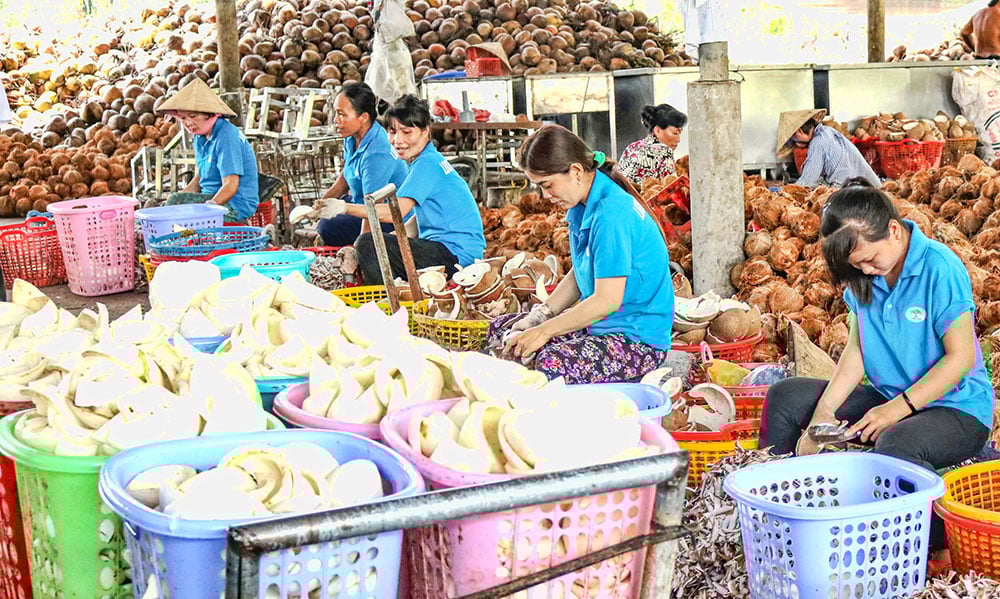 |
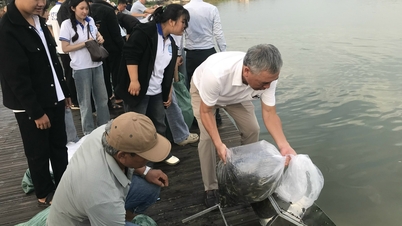
| The preliminary processing of coconuts provides raw materials for manufacturing plants in the province. |
According to Associate Professor Pham Anh Tuan, Director of the Institute of Agricultural Mechanization and Technology, after harvest, the country produces more than 2 million tons of coconuts annually, making Vietnam the fourth largest coconut exporter in the Asia-Pacific region and the fifth largest in the world. However, the industry still faces many challenges.
challenge.
To enhance added value and competitiveness, Associate Professor Pham Anh Tuan believes that it is necessary to clearly identify the target products, key products, and production scale suitable for each ecological region; assess investment potential, raw material sources, and consumer markets to choose a sustainable development direction. At the same time, it is crucial to advise and support businesses in selecting technology, equipment, and designing processing plants that meet international standards and satisfy the stringent requirements of major markets such as the US, EU, and Japan.
“The State and specialized agencies should strengthen support for businesses in technical innovation, receiving international technology transfer, and connecting and cooperating with foreign businesses. In addition, it is necessary to synthesize the needs for technological innovation to propose and implement appropriate science and technology tasks. From there, connect and solve problems from seeds and genes to consumer markets,” said Associate Professor Pham Anh Tuan.
The province has identified three main pillars for the development of the coconut industry: raw material areas, deep processing, and value chain linkages. Mr. Van Huu Hue, Deputy Director of the Department of Agriculture and Environment, emphasized that in the coming time, it is necessary to focus on solutions revolving around these three pillars. Specifically, the goal is to build specialized organic coconut farming areas that meet international standards; at the same time, strengthen research and expand the cultivation of coconut varieties that are tolerant to salinity and drought. Besides organic farming processes, water conservation, and emission reduction, the province must focus on biological pest and disease management, developing ecotourism, traditional crafts, and OCOP products associated with coconuts, especially products from waxy coconuts.
The focus will be on attracting businesses to invest in modern technology, developing high-value products, and maximizing the utilization of all parts of the coconut tree, aiming for a zero-waste production system. Industry 4.0 technologies will be applied in quality management, traceability, and trade promotion. In addition, the development of new-style cooperatives, closely linked with businesses, will be encouraged, along with enhanced trade promotion, protection of the Vinh Long coconut brand, and expanded international cooperation.
Text and photos: CAM TRUC
Source: https://baovinhlong.com.vn/kinh-te/nong-nghiep/202512/tap-trung-phat-trien-nganh-dua-9de08de/









































































Comment (0)