


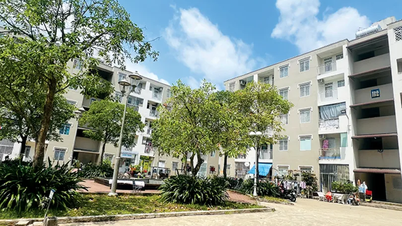
The Hong Loan residential area (lot 5C) has complete infrastructure, but the pace of housing development is very slow, partly due to the impact of rising construction material prices.
The Ministry of Construction forecasts that construction material prices will continue to rise in the coming period. The increase in fuel and construction material prices directly impacts the investment costs of construction projects, especially key transportation projects. With the fluctuations in construction material and fuel prices (gasoline, diesel) in March alone, the estimated construction costs for these projects are expected to increase by 1.91-8.09% (depending on the type of construction project) compared to February 2026. The largest increase is seen in transportation projects (8.09%), followed by agricultural and rural development projects (4.55%). In addition to price increases, some materials such as sand and stone are experiencing localized shortages, further complicating matters for investors and contractors.
Besides rising construction material prices, many construction contractors are currently facing a labor shortage, especially for freelance construction workers (laborers). In many areas, contractors are finding it difficult to recruit laborers, even though daily wages have increased to 400,000 VND/day. While labor may seem like manual work that anyone can do from the outside, the reality is far more challenging. Scorching sun, heavy rain, dusty environments, and the constant risk of accidents are ever-present. Many construction sites lack protective clothing, clear labor contracts, insurance, and adequate compensation mechanisms in case of accidents. Furthermore, work is irregular, and laborers are entirely dependent on the project schedule and the contractor. Days off due to rain, material shortages, or waiting for the next stage mean they have no income. Not to mention the temporary living conditions, constant relocation to different construction sites, and unstable living conditions. Therefore, it's understandable that most older people take up this job, while younger people can't handle being a construction worker.
All of these difficulties will hinder the development of the country's infrastructure in general, as well as civil works, affecting the daily lives of many people. The government has managed gasoline and diesel prices reasonably (reducing all gasoline and diesel taxes to 0% until June 30) to minimize the impact on production, business, investment, construction, and the country's economic growth. The Ministry of Construction also requested the People's Committees of the provinces to proactively balance resources, prioritize the completion of key projects; strictly implement regulations on the management, publication, and updating of construction material prices; closely control gasoline and construction material businesses; and prevent hoarding, speculation, and price gouging.
However, regarding the shortage of manual labor in the construction industry, policymakers need to carefully study and enact policies that are appropriate for these vulnerable groups. These policies could include housing (prioritizing affordable rentals), social security, healthcare, education (for their children), labor contract regulations, accident insurance, etc., to attract younger workers to this physically demanding sector. Before long, older generations will no longer have the physical strength to do strenuous work like construction labor, while younger people with better education and job opportunities will choose more suitable jobs. In the not-too-distant future, how many people will choose to work as construction laborers if there are no appropriate preferential policies for them, or if our country has to import manual labor from abroad to do these jobs?
AN KHANH
Source: https://baocantho.com.vn/thach-thuc-cho-nganh-xay-dung-a202660.html


![[Image] National Assembly discusses the implementation of the socio-economic development plan.](https://vphoto.vietnam.vn/thumb/1200x675/vietnam/resource/IMAGE/2026/04/20/1776696707422_ndo_br_img-20260420-185419-jpg.webp)
![[Photo] General Secretary and President To Lam meets with National Assembly delegates from ethnic minorities.](https://vphoto.vietnam.vn/thumb/1200x675/vietnam/resource/IMAGE/2026/04/20/1776696701056_a1-bnd-8331-3342-jpg.webp)








































































Comment (0)