This change contributes to disease control, reduces environmental pollution, and builds a sustainable shrimp farming area.
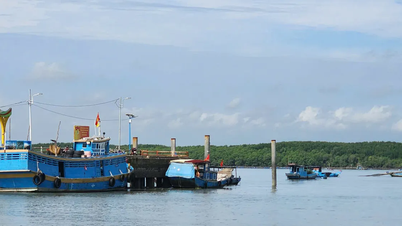
An Luong commune has the advantage of land along the lagoon and coast, favorable for aquaculture development. However, traditional farming methods such as extensive, semi-intensive, and earthen pond farming reveal many limitations: dependence on weather, difficulty in controlling diseases, low productivity, unstable efficiency, and potential environmental pollution risks.
This reality forces shrimp farmers to change their mindset, shifting from production based on experience to the application of science and technology.
In 2015, Mr. and Mrs. Ngo Van Cuong (Xuan Binh Nam village) decided to sell their four wedding gold bars to invest in shrimp farming in ponds lined with tarpaulin. The ponds were completely lined with tarpaulin at the bottom and banks, combined with a water fan system, bottom aeration, and siphons, which helped to control environmental parameters and limit disease outbreaks. In the very first farming season, Mr. Cuong earned a profit of over 200 million VND.
Mr. Cuong said that before investing, he had researched and learned from shrimp farming experiences in many localities. “Raising shrimp in earthen ponds using the old method easily leads to disease outbreaks and low efficiency. Although ponds lined with tarpaulin require a large investment and strict techniques, if the process is followed correctly, the efficiency is many times higher,” Mr. Cuong shared.
Following the success of Mr. and Mrs. Cuong, many shrimp farmers in the area have sought to learn from and emulate their methods. To date, in some villages such as An Xuyen 1, An Xuyen 3, etc., the percentage of households raising shrimp in ponds lined with tarpaulin has reached 100%.
According to shrimp farmers, if they raise shrimp in earthen ponds using the traditional method of relying on weather and water levels, the maximum profit is only about 20 million VND per crop. Meanwhile, with ponds lined with tarpaulin and applying new techniques, when prices are favorable, profits can reach over 200 million VND per crop on an area of approximately 500 m².
This outstanding efficiency is encouraging farmers to invest boldly and expand the area of intensive farming.
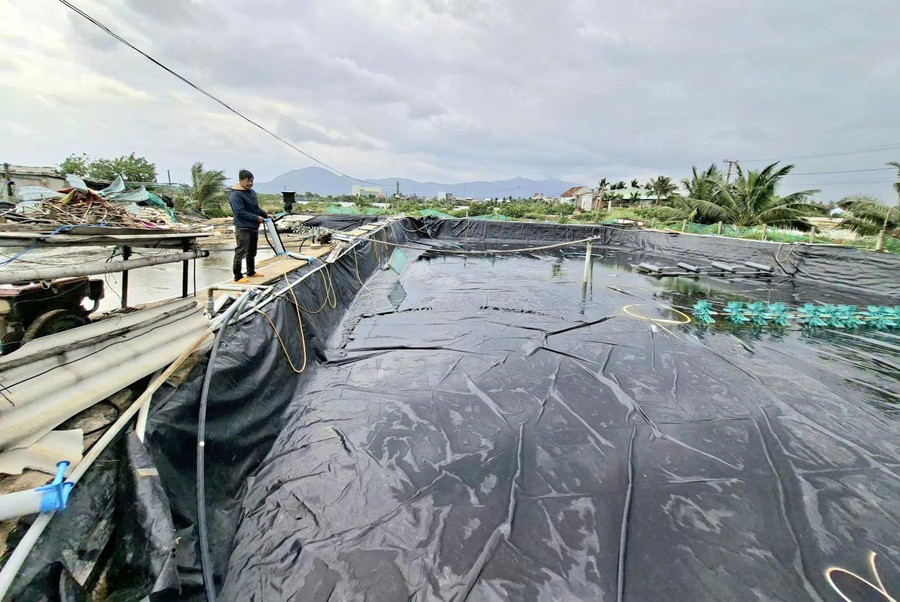
On the morning of January 7th, Mr. Tran Quoc Toan, Head of An Xuyen 3 village, was present at his family's shrimp farm, which covers nearly 3,000 square meters and consists of 5 ponds lined with tarpaulin. He stated that the recent storms, floods, and high tides had inundated and swept away all of his family's shrimp, along with those of more than 100 other shrimp farming households in the village.
Currently, many households are hiring workers to re-liner their ponds and clean them, planning to release the first crop of shrimp fry after Tet. "Shrimp farmers in the village will continue to raise shrimp using the pond lining method and strictly adhere to technical procedures," Mr. Toan affirmed.
According to the People's Committee of An Luong commune, by 2025, the total area for shrimp farming in the commune will be approximately 490 hectares, of which over 230 hectares will be for intensive farming. The promotion of advanced scientific and technical applications is being implemented in the following direction: People are proactively learning and applying scientific and technical advancements and strengthening linkages with high-tech shrimp farming enterprises in the area.
Mr. Tran Dinh Vuong, Vice Chairman of the People's Committee of An Luong commune, said that the locality is guiding people to focus on developing intensive and semi-intensive whiteleg shrimp farming models, including farming in greenhouses; applying biotechnology and automation to control diseases, improve quality, ensure traceability, and aim for sustainable development and increased value of local aquatic products.
Some households and businesses have boldly adopted biosafety farming practices, limiting or eliminating the use of antibiotics. By 2026, the commune aims to expand the area for whiteleg shrimp farming to over 580 hectares, striving to achieve a production of approximately 5,000 tons.
"Scientific pond management helps farmers reduce feed costs, improve awareness of wastewater treatment, use biological products to replace harmful chemicals, thereby reducing environmental pollution in farming areas and nearby residential areas, and at the same time increasing the survival rate of shrimp," Mr. Vuong said.



However, the application of advanced techniques still faces many difficulties due to high investment costs, inconsistent infrastructure in farming areas, and limited access to technology for some households.
Looking ahead, An Luong commune proposes that all levels of government continue to provide support in terms of capital and preferential credit; strengthen training and technology transfer; invest in infrastructure for concentrated farming areas; and encourage chain linkages between farmers, cooperatives, and businesses.
Source: https://baogialai.com.vn/thay-doi-tu-duy-nuoi-tom-de-phat-trien-ben-vung-post576953.html