

This was the first face-to-face meeting between the two countries' defense ministers since 2022. At the Shangri-La Dialogue held around this time last year, Washington proposed a meeting between Secretary Austin and his then-Chinese counterpart, Li Shangfu. However, Beijing rejected Washington's proposal.
The focal point of Taiwan.
According to a Pentagon statement, Secretary Austin expressed concern about the "provocative" activities of the Chinese military. Recently, China conducted large-scale military exercises encircling Taiwan and its remote islands. Some believe the exercises are aimed at preparing for a military attack on Taiwan.
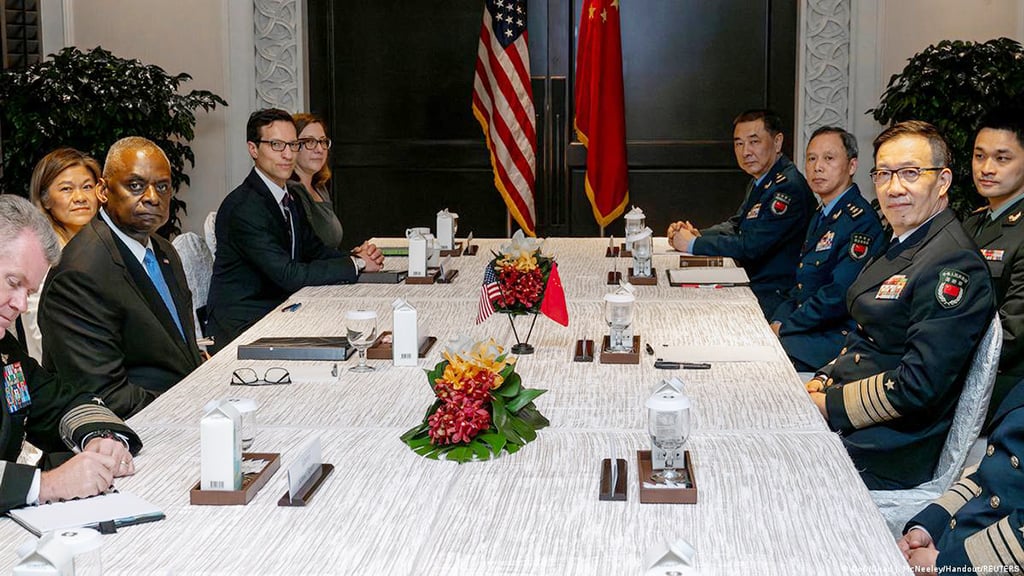
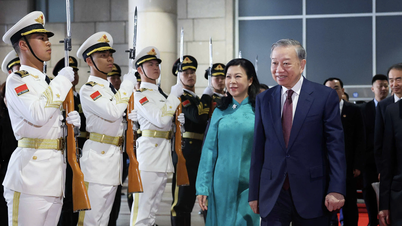
US and Chinese military delegations at yesterday's talks.
Austin added that Beijing "should not use Taiwan's political transition as a pretext for coercive measures."
In response, General Dong Jun warned the U.S. against interfering in China's affairs with Taiwan. Following the meeting, a spokesperson for the Chinese Ministry of Defense stated that Washington's approach to Taiwan was sending a "wrong signal" to "separatist forces" in Taipei.
Specifically, Minister Tung was alluding to Washington's congratulations to Lai Ching-te on assuming the leadership of Taiwan on May 20th, and its sending a delegation to attend the ceremony.
The meeting between Secretary Austin and General Dong lasted approximately 75 minutes, longer than expected. However, despite the tense atmosphere, both sides managed to stabilize relations.
The Pentagon chief emphasized the importance of maintaining open channels of communication between the two countries' armed forces and "welcomed" plans to convene a media crisis management working group later this year. General Dong also stated that bilateral relations should be cherished and that neither side should "slander the other." Beijing described the talks as typical of a "positive, practical, and constructive" effort.
Also related to the talks, according to Nikkei Asia , Beijing reiterated its position on the war in Gaza, calling for a ceasefire and arguing that the US should be held responsible. Meanwhile, Washington said Secretary Austin "discussed Russia's military attack on Ukraine" and China's role in supporting Russia's defense industry.
The important talks
Speaking to Thanh Nien newspaper last night, May 31st, Dr. Satoru Nagao (Hudson Institute, USA) analyzed three reasons why the talks are important for both sides.
First, in the short term, the talks are taking place while the US is devoting significant resources to Ukraine and Israel. At the same time, the administration of US President Joe Biden needs to focus on the upcoming presidential election. Therefore, this is an opportunity for China to maximize its activities in the South China Sea, East China Sea, and Taiwan Strait, with escalating developments. Washington wants to control that escalation.
Secondly, in the medium term, these negotiations are aimed at addressing concerns about the situation in Taiwan. Beijing is boosting its military strength and increasing military pressure on Taiwan. There are even many who believe that Beijing is about to use military force to unify Taiwan.
Third, in the long term, the talks are taking place as the balance of missile power shifts. Because China is aggressively upgrading its missile arsenal, with missiles like the DF-17, DF-21, and DF-26 posing a significant threat to US forces in the region. In response, in April, the US announced the deployment of a new medium-range missile launch system in the Philippines.
Amidst these tensions, according to Dr. Nagao, the two sides held talks to have an opportunity to discuss and avoid miscalculations. "However, such a negotiation is not a strong message to China," Dr. Nagao analyzed.
Minimize risks
There are reports that the two sides have agreed to establish a military hotline between the US Indo-Pacific Command and the Chinese military's Eastern Theater Command – a move that would follow commitments made by Chinese President Xi Jinping and US President Joe Biden during their summit late last year. However, I think it will have minimal impact on the risks in the relationship. China continues to view the hotline and crisis communication as a bargaining chip. Meanwhile, tensions over Taiwan and the South China Sea remain high.
Dr. Jonathan Berkshire Miller (Expert at the Institute for International Studies, Japan)
Source: https://thanhnien.vn/the-co-hoi-dam-quoc-phong-my-trung-185240531224440107.htm




































































Comment (0)