Joining the CPTPP not only helps businesses increase footwear export turnover but also expands sources of imported raw materials for production, allowing them to benefit from preferential treatment.
Double your chances.
The footwear industry is one of the sectors that has benefited most from the preferential treatment under the Comprehensive and Progressive Trans-Pacific Partnership (CPTPP) agreement and from the United Kingdom's accession to this agreement.
According to Ms. Phan Thi Thanh Xuan, Vice President and General Secretary of the Vietnam Leather and Footwear Association, the UK is currently a key export market for the leather and footwear industry, with exports reaching hundreds of millions of USD annually. From 2020 to the end of 2024, leather and footwear exports to the UK doubled.
 |
| Ms. Phan Thi Thanh Xuan - Vice President and General Secretary of the Vietnam Leather and Footwear Association |
While in 2020, footwear exports to the UK, including both shoes and handbags, only reached $577 million, this figure has now exceeded $1.1 billion in 2024, a 23% increase compared to 2023. This growth rate is higher than the overall industry growth rate in 2023.
Thus, this growth rate confirms that Vietnamese footwear and handbags are favored and well-received by British consumers, thereby contributing to affirming the position of Vietnamese goods in the global market.
At this point, it can be affirmed that up to 90% of exported footwear and handbags have been and are taking full advantage of the benefits from the Vietnam-UK Free Trade Agreement (UKVFTA). Furthermore, the UK's accession to the CPTPP has not only not created barriers but has also brought more advantages and opportunities for domestic footwear and handbag businesses.
Firstly, domestic businesses have been doing very well in handling the procedures to take advantage of the CPTPP's preferential treatment for exporting to member countries of the Agreement. With the addition of the UK market, businesses can utilize existing procedures, thus saving costs, time, and administrative procedures.
Furthermore, footwear and handbag businesses will have more opportunities to expand their raw material supply sources from member countries, including the UK, for production and export within the CPTPP bloc.



Proactively striving to achieve high standards and approaching sustainable goals.
The market opportunities for the footwear industry are clear when the UK joins the CPTPP. However, according to Ms. Phan Thi Thanh Xuan, both the CPTPP and UKVFTA are new-generation free trade agreements, requiring exporting countries and businesses to improve their internal capabilities. In particular, businesses need to pay attention to provisions on the environment and labor to meet the sustainable development criteria in these agreements.
Green production, social responsibility, and sustainable development are key terms frequently mentioned by footwear businesses and experts when discussing the long-term prospects for the industry's exports. This issue is becoming increasingly pressing as many major footwear and handbag importing countries are introducing new requirements for importing socially and environmentally responsible products.
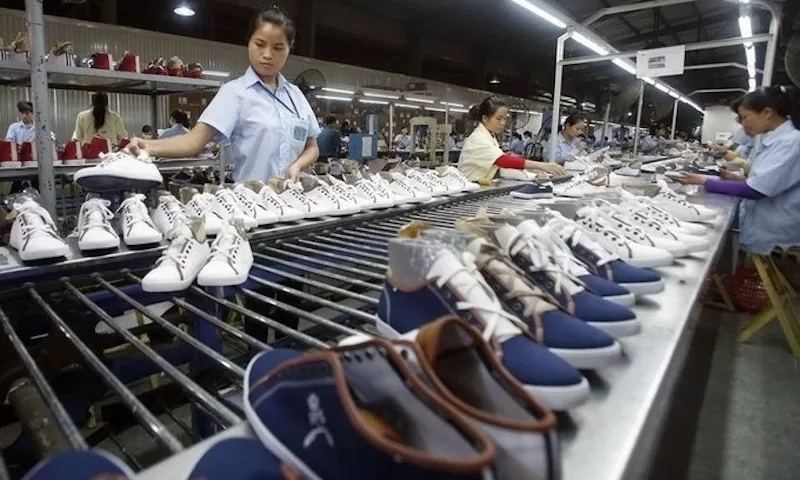 |
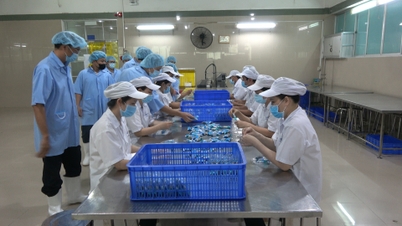
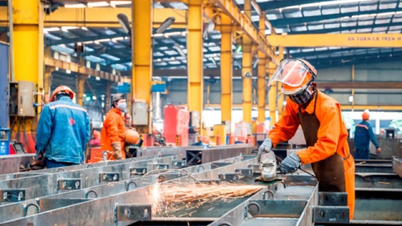
| Meeting green standards and pursuing sustainable development is an irreversible trend for footwear manufacturers. (Illustrative image) |
The EU is a prime example; its regulations on green production and carbon emission reduction are creating higher standards for market access while adding complex accountability obligations for producers and supply chains.
Ms. Phan Thi Thanh Xuan stated that while sustainable development was previously only a criterion encouraged to enhance the competitive advantage of brands, it has now become a mandatory trend and is being legalized.
This is clearly demonstrated through a series of EU laws and policies that have been enacted and implemented, such as supply chain assessment, anti-deforestation policies, emissions inventories, and carbon border adjustment mechanisms.
These policies are currently being implemented on a large scale; however, this does not mean that small and medium-sized enterprises will not be affected. Next, there are several policies under discussion, such as ecodesign and the law on producer responsibility…
For the EU, the UK, and the CPTPP market, green standards are a very "hot" issue and an irreversible trend. " The current problem is that while policymakers in export markets are working diligently, information reaching businesses remains very limited ," worried the leader of the Vietnam Leather and Footwear Association.
At the same time, as standards become increasingly high, the compliance costs for businesses also increase, and these costs are not used to improve product quality but rather to carry out numerous overlapping procedures.



In this context, Ms. Phan Thi Thanh Xuan emphasized that compliance is mandatory if businesses do not want to be pushed out of the supply chain. Therefore, businesses should not wait for customers to request it but need to proactively change technology, undergo digital transformation, improve the quality of human resources, and meet green production requirements to create a competitive advantage for their products and brands.
Rapidly improve and increase transparency in the product supply chain, starting from the raw materials stage, promoting sustainable production towards a circular economy , and ensuring social and environmental responsibility.
On the part of government agencies, it is necessary to streamline specialized management structures to minimize time and costs for businesses.
| From 2020 to 2024, Vietnam's leather and footwear exports to the UK doubled. With the UK's accession to the CPTPP, it is expected that this figure will be further expanded for Vietnam. |
Source: https://congthuong.vn/anh-gia-nhap-cptpp-them-co-hoi-cho-xuat-khau-da-giay-374739.html
![[Image] National conference summarizing one year of operation of the overall organizational model of the political system, the three-tiered government model.](https://vphoto.vietnam.vn/thumb/1200x675/vietnam/resource/IMAGE/2026/07/01/1782882811691_ndo_br_1-jpg.webp)