

Each day, the farmers have a different "menu," limited to a few items depending on the harvest. Short-term crops aren't considered "gourmets," but anyone visiting this mountainous region wants to sample them. Familiar produce includes young chayote, chayote shoots, peanuts, sweet potatoes, taro, wild vegetables, bitter herbs, bamboo shoots, and berries... Not just for snacking, in one corner of Tri Ton market, there are 5-6 bicycles and roadside stalls selling these items from very early in the morning. People buy them for breakfast, a common way for most people in the Mekong Delta to get energy for the day.
The mountain dwellers traditionally practice "harmony with nature," primarily cultivating crops during the rainy season, with plant growth and yield heavily dependent on the weather. Consequently, the fruits and vegetables are typically small to medium in size, with some potatoes as tiny as two fingers... However, they avoid excessive use of fertilizers and pesticides, ensuring cleanliness, safety, and natural flavor. "I don't know how to describe it, but naturally grown vegetables, or those not treated with fertilizers or pesticides, have a distinct aroma, reminiscent of the fruits and vegetables from our own gardens when we were children," shared Anh Khoa, a resident of Tri Ton.
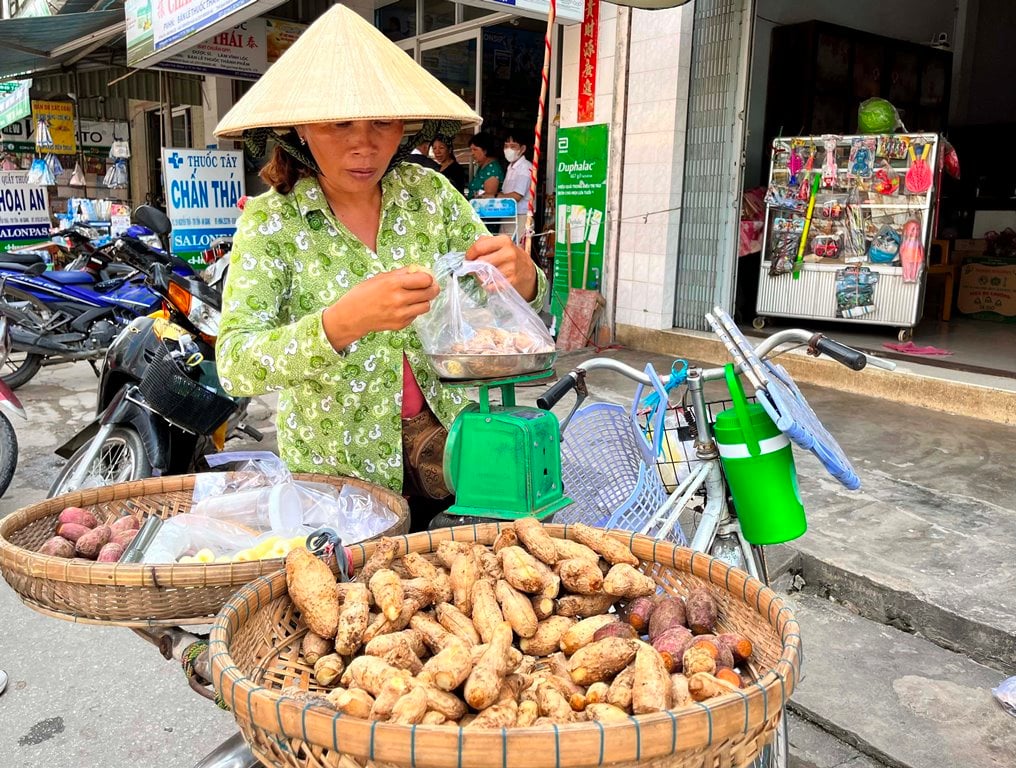
Mountain specialties are available in many markets and urban areas.
Besides the fixed stalls in the market, mobile vendors on bicycles can be found all along the roads and at tourist spots and check-in locations. Taking advantage of their free time, locals buy goods from the market to sell cakes and fruits to earn extra income. For travelers from other places, the vendors selling "specialties" are especially popular, from palm fruit and palm juice to custard apples, mangoes, and palm sugar rice cakes. Items not meant for snacking but mainly for souvenirs are displayed along the roadside, making it convenient for passersby to choose, such as bamboo shoots, chayote, and star fruit.
With abundant yields and increasing demand from distant buyers, in addition to local supply, many people have devised ways to bring agricultural products to town and city markets for sale. These baskets of produce, carried in baskets through the heart of the city, are unmistakable and reflect the hard work and diligence of the simple mountain people. The difference with these baskets of produce brought to the city is that the sellers have carefully selected the freshest and tastiest products, so buyers don't have to bother choosing again.
Following the example of many who carry their goods down to the city, Chau Tren (Tri Ton) said that traveling long distances to carry goods can earn him an income of 300,000 - 400,000 VND per day. From someone unfamiliar with the city, he is now familiar with every alley and has regular customers at My Xuyen Market, My Quy Market, and Long Xuyen Market. On lucky days, he can sell out his two baskets of goods before 10 am, and go home early to rest and prepare goods for the next day; on later days, he still manages to get home by 4 pm. However, he doesn't go down the mountain every day, but depending on the amount of agricultural products he collects, both his own and his neighbors', he spends most of his time in the fields tending his garden…
At My Binh market, Neang Sa Tram's family is there every few days, setting up a small corner to sell young shoots of the durian tree, tamarind, custard apple, and palm sugar rice cakes. She says she's been selling there for many years, so many people recognize her, and customers remember her to find her "mountain food." Despite the long journey, everything sells out by morning. Since getting a phone and posting on Zalo, before each trip she announces what items she'll have the next day, allowing customers to order in advance. Thanks to her connections, even for fruits and vegetables she doesn't grow herself, she's willing to ask around in the neighborhood to help her customers find what they need.
Ms. Thu Thuy, a small business owner in My Xuyen market, shared: “The Khmer people in the mountains are very honest and kind, so I let them ‘borrow’ a corner in front of my yard to sell their goods. I’m happy to see that shoppers are supportive and caring; few people haggle because the neighbors help them out. They come all the way from Tinh Bien and Tri Ton, which is very difficult, with heavy loads and long journeys, and they also spend money on transportation…” Since having a corner to display their goods, housewives have been delighted and gradually become accustomed to this “specialty” spot, with the goods changing every few days, not remaining fixed. This image also creates a unique feature in the heart of the city, with hardworking people quietly bringing the “specialties” of the Bay Nui region to markets throughout the city.
Source: https://baoangiang.com.vn/theo-chan-ganh-hang-dac-san-a423113.html




![[Photo] Prime Minister Pham Minh Chinh presides over a dialogue with Japanese businesses.](https://vphoto.vietnam.vn/thumb/1200x675/vietnam/resource/IMAGE/2026/03/21/1774097547316_ndo_br_dsc-0448-jpg.webp)

















































































Comment (0)