The Vong La Conference of 1943 and the creation of the "Outline of Vietnamese Culture"

"Outline on Vietnamese Culture" was drafted by General Secretary Truong Chinh. Photo: Archival material.
From February 25-28, 1943, the Standing Committee of the Central Committee of the Indochinese Communist Party convened a conference in Vong La (Dong Anh, Hanoi ), with the participation of key leaders such as Truong Chinh, Hoang Van Thu, Hoang Quoc Viet, etc.
According to archival documents, the Conference comprehensively discussed preparations for the general uprising: consolidating the Party organization, building revolutionary base areas, developing armed forces, and expanding the National United Front; the most important highlight was the adoption of the "Outline of Vietnamese Culture" drafted by General Secretary Truong Chinh.
This document established three major principles of the new culture: national, scientific, and popular, opening a cultural front alongside political and military struggles. Many researchers consider it the first theoretical foundation for the development of revolutionary Vietnamese culture.
Establishment of the 3rd National Salvation Army Platoon
On February 25, 1944, the 3rd National Salvation Army Platoon was established in the Khuoi Kich forest, Son Duong (Tuyen Quang). The unit consisted of 24 soldiers operating in the areas of Dai Tu, Bac Kan, Tuyen Quang, and Vinh Yen; the official recognition ceremony was conducted by Comrade Hoang Quoc Viet on behalf of the Central Committee of the Party.
According to Vietnamese military history documents, the National Salvation Army was one of the precursor armed forces of the Vietnam People's Army. Platoon III was formed during the period when the revolutionary armed movement was transitioning to directly preparing for an uprising to seize power.
This unit simultaneously fought, built revolutionary bases, propagated and mobilized the masses, and protected the Viet Bac base area. The formation of this force, along with other armed units, created an important foundation for the birth of the Vietnam Liberation Army at the end of 1944 and the August Revolution of 1945.
Congress to establish the Vietnam Historical Science Association
On February 25, 1966, in Hanoi, the founding congress of the Vietnam Historical Science Association was held, bringing together a large number of historians, researchers, and history teachers from across the country.
This is the first time Vietnam has had a unified professional organization, from the central to local levels, dedicated specifically to historians. The association has become a core force in researching, collecting documents, compiling national history, training historical personnel, and preserving the nation's memory heritage.
For over half a century, the Association has participated in the evaluation of many major historical works, contributing to the compilation of the national history, textbooks, and local history research. Beyond serving science, this organization has also contributed to strengthening cultural identity and historical awareness in modern Vietnamese society.
Birthday of playwright Dao Tan
February 25, 1845 is the birthday of Dao Tan, a great cultural figure of Vietnamese traditional theater, who hailed from Binh Dinh province.
According to traditional theatrical studies, he was both a high-ranking official in the Nguyen dynasty and a cultural figure with profound influence. Dao Tan passed the imperial examination in 1867, served as Governor-General of Nghe An, and later as Associate Grand Scholar. After the political upheavals of the early 20th century, he retired to his hometown and devoted himself to developing the arts.
He established a school for teaching traditional Vietnamese opera (hat boi) – the precursor to folk theater training centers in Binh Dinh province – and trained many famous artists. His plays, such as "Tu Quoc Lai Vuong" and "Quan Tran Hieu Thoai," are considered the pinnacle of classical Vietnamese opera art. Researchers regard Dao Tan as the person who elevated Vietnamese opera to a scholarly level, contributing to shaping traditional Vietnamese theater.
Writer Pham Duy Ton has passed away.
The writer Pham Duy Ton (1881-1924) passed away on February 25, 1924, leaving a significant mark on the modernization process of Vietnamese literature in the early 20th century.
According to Vietnamese literary sources, he graduated from the School of Interpreters, worked in administrative agencies and the Bank of Indochina, and collaborated with newspapers in Hanoi and Saigon. He belonged to the first generation of Western-educated intellectuals who used vernacular prose to reflect social life.
The two short stories "Life and Death Don't Matter" and "The Scoundrel" are considered foundational works for the modern short story genre in North Vietnam. Through his sharp, realistic writing style, Pham Duy Ton criticized the semi-feudal colonial society, paving the way for subsequent generations of realist writers.
Declaration on the dissolution of the Warsaw Pact
On February 25, 1991, member states announced the dissolution of the Warsaw Pact, a military alliance led by the Soviet Union established in 1955.
According to international diplomatic documents, this decision took place against the backdrop of political reforms in Eastern Europe and the disintegration of the socialist system in the region. The termination of the military bloc marked the end of the East-West military confrontation that lasted throughout the Cold War.
This event paved the way for the restructuring of European security, while also setting the stage for the expansion of NATO and geopolitical shifts that lasted into the 21st century.
Birthday of the renowned painter Pierre-Auguste Renoir

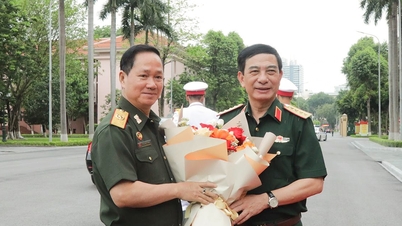
Vietnam encourages US businesses to expand investment in high technology.On the morning of June 26th, at the Government Headquarters, Deputy Prime Minister Ho Quoc Dung received Mr. Jeff Place, Supply Chain Director of Coherent Group (USA). During the meeting, the Deputy Prime Minister affirmed that Vietnam encourages US businesses to expand investment, especially in high-tech, innovation, and semiconductor industries. February 25, 1841, is the birthday of Pierre-Auguste Renoir, one of the leading figures of the French Impressionist school.
According to international art sources, Renoir contributed to changing the thinking of 19th-century European painting by focusing on light, movement, and everyday life. Works such as Bal du moulin de la Galette and Luncheon of the Boating Party became icons of modern painting.
Renoir's influence spread globally, contributing to the formation of Western modern art and having a strong impact on 20th-century visual arts.
Source: https://baovanhoa.vn/van-hoa/thong-qua-de-cuong-van-hoa-viet-nam-206616.html







































































![[Infographic] Which types of behaviors are strictly prohibited in digital transformation from July 1, 2026?](https://vphoto.vietnam.vn/thumb/402x226/vietnam/resource/IMAGE/2026/07/02/1783004068098_thumb_5_hanh_vi_nghiem_cam_20260702184923.jpeg)