

Understanding American culture inevitably requires a thorough study of religion. America is fertile ground for both old and new religions to flourish with diverse tendencies.
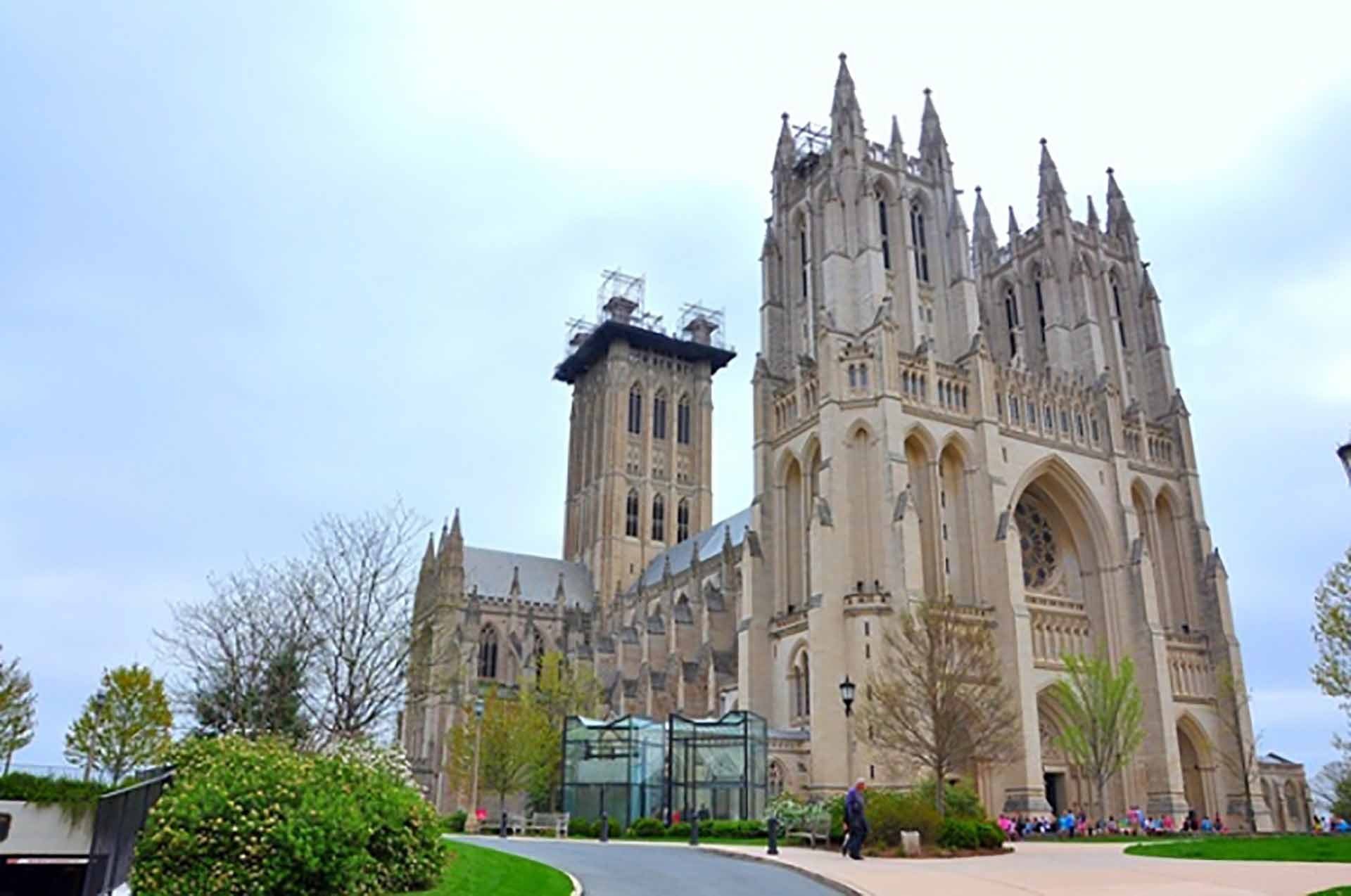 |
| Washington National Cathedral, USA. (Source: Vietnamplus) |
Most major religions in the world teach their followers to place their faith in the afterlife and disdain worldly possessions. The religious spirit in American folklore, however, has evolved in the opposite direction: accumulating wealth in the world is seen as serving God. Perhaps this is also a driving force behind the development of capitalism in America.
Today, in the United States, there are over 200 officially recognized religions, large and small, divided into more than 300,000 local organizations. Unlike many developed countries, the number of people who follow a religion, or are affiliated with a religion, in the US accounts for 82% of the population (approximately 18% are non-religious). Of these, 76% identify themselves as Christians (52% Protestant and 24% Roman Catholic); about 2% are Jewish, and 4% follow other religions (Islam, Buddhism, Mormonism, etc.). Approximately 45 million children, not including adults, attend classes offered by religious organizations. Weekly radio and television broadcasts feature programs dedicated to various religions. The Bible is a very popular book. Religions survive thanks to contributions from their followers. The government does not directly subsidize any religion.
It seems that in America, decent people tend to believe in God. Moral standards stem from religion. The American president might begin his state of the nation address with a prayer to God, and if someone asks him what he does during a crisis, his first response might be to pray. The God referred to here should be the God of Christianity.
The most important and largest religion in America is Christianity, but there are also Islam, Buddhism, and others. All religions have equal rights. Religious equality in America was established through historical events, especially since the nation's founding. To this day, religious influences remain quite prominent in American society.
After the Spanish landed on the shores of the Americas (15th century), the French (1608) and the Dutch (1609) sought to establish themselves in North America. However, the English, who arrived relatively late (1583), rose to become masters of the territory and built the Americas as we know them today. The first Englishmen to arrive in America brought with them the Protestant denominations: the Episcopal Church to Virginia, Puritanism to New England, the Baptist Church to Rhode Island, and the Quaker sect to Pennsylvania. Subsequently, many more followers of these Protestant denominations continued to immigrate to America from England and Germany.
When America gained independence from Great Britain, the Protestant denominations split into several new sects, vying for influence. The Methodist and Baptist denominations, both belonging to the "Political" movement, gathered many followers who were immigrants who had settled in the new land. These two denominations belonged to the Evangelical Church, which flourished in the South, particularly among the Black community.
At the same time, "prophets" emerged, establishing new religions. Mormonism, in particular, may be named after a mystical prophet. This sect was founded by Joseph Smith in 1830, after he claimed that an angel had appeared and given him the Mormon scriptures.
Besides the Mormon faith, there is also the Christian Science faith, founded by Mary Baker Eddy in 1866. This faith believes that human nature is primarily spiritual. In the United States, there are many Christian "spiritual healers" who practice healing through spirituality.
The second largest religious denomination in America is Roman Catholicism, brought by immigrants from European countries. Initially, they faced mistreatment, prejudice, and discrimination, especially in political voting. However, their prestige grew as more and more immigrants from Christian countries in Europe came to America. Notably, a Catholic candidate, John F. Kennedy, was elected president. By the 1850s, Catholics held many leadership positions in labor unions, business, and politics.
Judaism, like Christianity, was initially a small minority when it first arrived in America, but it gradually developed to become one of the three most important religions by the 1950s: Protestantism, Christianity, and Judaism. Until the end of the 19th century, the majority of American Jews were of German descent. When conservative Russian and Polish Jews flooded into America, they established close-knit Jewish communities. Their descendants received good education, and some became prominent intellectuals. Some maintained their Jewish religious traditions. Others, deep down, still held traditional beliefs, but outwardly showed no distinction from other citizens. When faced with discrimination, Jewish people organized themselves into effective resistance groups.
The Amish or Mennonite sect was founded by a Swiss religious reformer in the 18th century. Originally Protestant, they sought out rural life and disliked modern life. Many sects also competed to build isolated communities, becoming a traditional trend that persisted into the 20th century.
Smaller religious sects share several common traits, viewing society as corrupt and beyond redemption. Most are pessimistic and prophetic of the end times. Some groups die out prematurely, while others thrive. Many advocate healing through faith.
Eastern religions, especially Buddhism, held a strong appeal for those following the "counterculture" movement in the 1960s-1980s; the number of Buddhists may have reached hundreds of thousands. Twenty Muslims live in the United States; they are immigrants, descendants of immigrants, or newly converted American citizens (including Black people). There are hundreds of thousands of Hindu immigrants. Native Americans are reviving their old faith.
Source


















































































































Comment (0)