Combining forces creates new opportunities.
From July 2025, Ho Chi Minh City will merge with Ba Ria- Vung Tau and Binh Duong provinces, becoming a megacity spanning over 6,770 km2 with a population of over 14 million people. Chairman of the Ho Chi Minh City People's Committee, Nguyen Van Duoc, recognizes this as a strategic decision by the Party and State in the revolutionary restructuring of the administrative apparatus; creating new momentum and opportunities for higher-level, more sophisticated development, with the vision of becoming one of the top 100 most livable cities in the world by 2030 and extending to 2045.

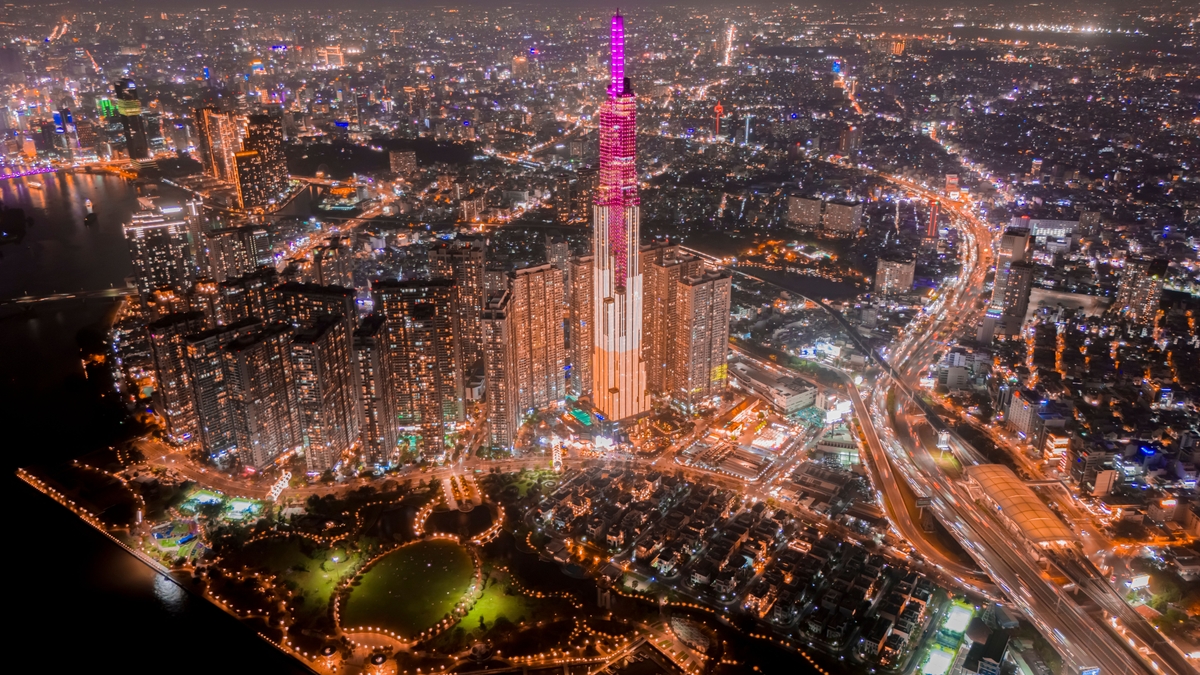
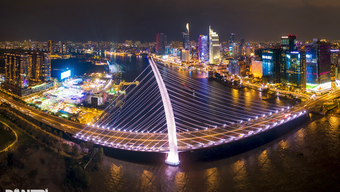
The new vision for Ho Chi Minh City is to become a smart, green, and innovative "international megacity".
PHOTO: NHAT THINH
The new vision for Ho Chi Minh City is to become a smart, green, and innovative "international megacity," exemplary not only in economic strength but also in its rich culture, arts, sports, entertainment, and modern, dynamic lifestyle. At the time of the merger a year ago, in an interview with Thanh Nien Newspaper, the Chairman of the People's Committee of Ho Chi Minh City, Nguyen Van Duoc, stated that the city would prioritize reviewing, adjusting, and developing a new master plan for the new Ho Chi Minh City with a vision of 1 space - 3 regions - 1 special zone.
In this plan, the former Ho Chi Minh City area plays the role of a "financial and high-tech hub"; the former Binh Duong area plays the role of an "industrial hub"; and the former Ba Ria-Vung Tau area is the "maritime economic hub," serving as an international seaport gateway and energy industry center.
With Resolution 260/2025 of the National Assembly, Ho Chi Minh City is the second locality in the country (after Hanoi) allowed to integrate various planning schemes into a single master plan. Currently, Ho Chi Minh City is developing its master plan for the period 2025-2050, with a 100-year vision, expected to be approved by the end of October 2026. The outline of the plan identifies that by 2050, Ho Chi Minh City will be among the top 100 cities with the best quality of life in the world; and simultaneously a major economic, financial, commercial, logistics, education , science and technology, and innovation center of the region.

MINH TUONG
The Ho Chi Minh City Party Committee requires that the overall master plan for the entire city ensure integration, suitability with the new development space, synchronization, modernity, and high connectivity, especially in technical and social infrastructure. In the upcoming planning work, Ho Chi Minh City will also focus on covering the entire new administrative boundary with comprehensive planning, improving the quality of zoning plans, detailed plans, and specialized plans.


Reducing costs for the urban economy.
The master plan, along with the draft law on Special Urban Areas, is considered one of the two crucial "institutional levers" that will help Ho Chi Minh City achieve sustainable double-digit growth for many years to come. Dr. Nguyen Do Dung, an urban planning expert, believes that the important question for Ho Chi Minh City after the merger is whether the new city will operate more efficiently. Simply adding a new geographical boundary will create a larger administrative unit, but if the urban structure, infrastructure, and land use are re-planned, Ho Chi Minh City could become a mega-urban region with significantly higher competitiveness than before.

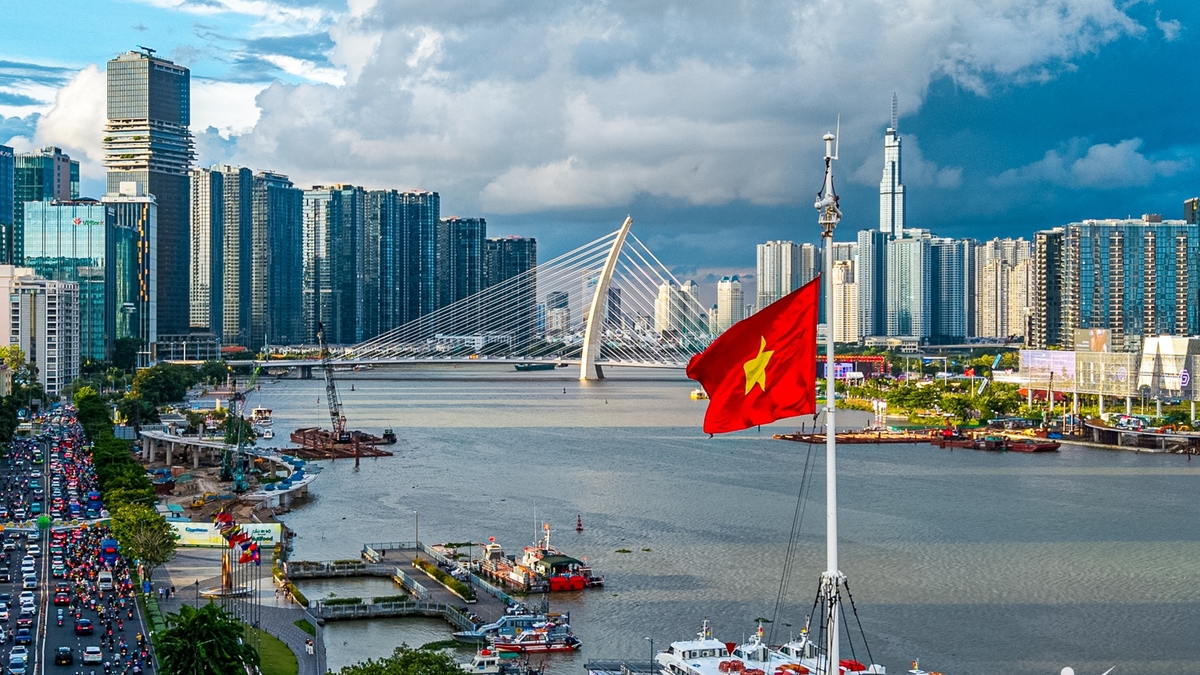
The new vision for Ho Chi Minh City is to become a smart, green, and innovative "international megacity".
Photo: Nhat Thinh
To achieve rapid growth, Ho Chi Minh City must solve two fundamental problems: ensuring workers have access to more affordable housing and employment, and transporting goods from production sites to ports, airports, and international markets at lower costs. "Double-digit growth doesn't come from expanding its administrative boundaries, but from reducing the costs of the urban economy," Mr. Dung said.
Regarding the spatial structure of the new Ho Chi Minh City, Dr. Nguyen Do Dung recommends organizing it according to a principle that avoids further extending the urban core to the periphery, instead limiting it to the area around Ring Road 3. Accordingly, the area inside Ring Road 3 should be the core zone for redevelopment, selectively compacted around metro stations, financial centers, service centers, educational institutions, healthcare facilities, cultural centers, and converted former industrial zones. The other side should be a green belt, water reservoir, ecological corridor, and infrastructure reserve space. The area outside Ring Road 3 should not develop as dependent residential areas, but rather as self-sufficient satellite cities with jobs, amenities, schools, hospitals, affordable housing, and quick transportation connections to the central area.
According to Mr. Dung, the new Ho Chi Minh City should be viewed as a system of three major centers: the urban core bounded by Ring Road 3, the northern urban-industrial zone, and the urban-industrial-maritime economic zone around Can Gio Bay - Ganh Rai. After the merger, Ho Chi Minh City has the opportunity to close off the bay area and plan Can Gio - Cai Mep - Thi Vai - Phu My - Long Son - Vung Tau as a whole. "If Thu Thiem is where Ho Chi Minh City connects with capital flows, and Binh Duong is where it connects with production chains, then Ganh Rai must be where Ho Chi Minh City connects with global goods, energy, and maritime trade flows," Dr. Nguyen Do Dung stated.
Restructuring urban areas through metro networks.
Many urban planning experts believe that when zoning for development, Ho Chi Minh City needs to prioritize infrastructure investment to reorganize its multimodal transportation network (metro, roads, elevated roads, waterways, high-speed rail, etc.) connecting centers, facilitating faster travel for residents and goods movement. In a multi-polar, multi-centered urban structure, Transport-Oriented Development (TOD) is considered an effective tool for developing a compact city. Recently, the Ho Chi Minh City People's Committee approved the planning boundaries for five TOD zones around the stations of Metro Line 2 (Ben Thanh - Tham Luong), with a total planned area of nearly 940 hectares.

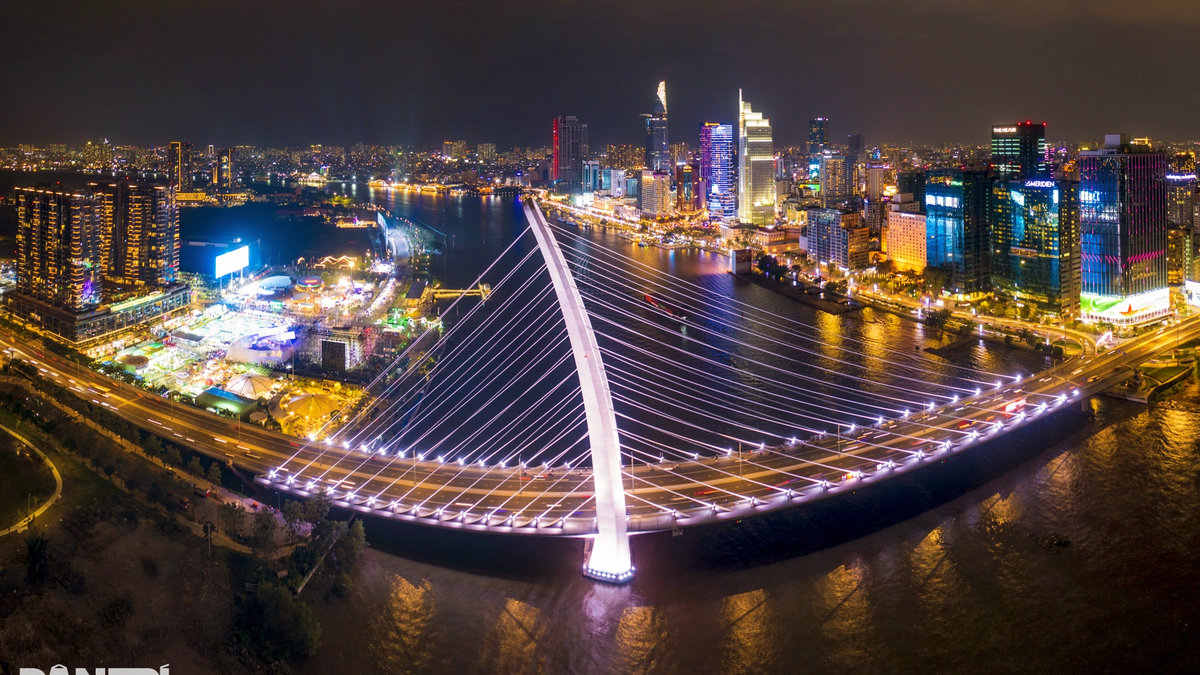
The new vision for Ho Chi Minh City is to become a smart, green, and innovative "international megacity".
Photo: Nhat Thinh



Architect Khương Văn Mười, former Vice President of the Vietnam Association of Architects, analyzed the experience of the formation and development of large cities, showing that the living environment and the high-capacity public transportation network are two decisive factors in urban restructuring in the coming period. With the TOD (Transit-Oriented Development) urban model, residents have simultaneous access to basic amenities on-site and services such as hospitals, entertainment areas, administrative areas, the city center, and industrial zones through metro line transfers.
Architect Khương Văn Mười stated that the central government has tasked Ho Chi Minh City with putting 200 km of metro into operation by 2030 and completing the network by 2050. Therefore, Ho Chi Minh City can use the planned metro system layout with two ring lines and planned stations to create a "transportation service map" with a 1 km radius around each station. This map will also identify "blank" areas not yet directly covered, allowing for the design of connecting transport routes using minibuses, express buses, or shared transportation to create a "second layer of transport" to complete the city's TOD (Transit-Oriented Development) structure. For suburban stations and depots, TODs can be developed to serve resettlement housing areas, social housing, and additional functional facilities, thus reducing pressure on the city center.
Meanwhile, the Director of the Ho Chi Minh City Department of Construction, Tran Quang Lam, stated that the city is implementing numerous large-scale infrastructure projects to develop to the level of international cities. Regarding metro systems, Ho Chi Minh City has commenced construction on the Ben Thanh - Can Gio high-speed railway project, Metro Line 2 (Ben Thanh - Thu Thiem section), and the Ben Thanh - Tham Luong section. In the near future, the Thu Thiem - Long Thanh line, Metro Line 6 (from Phu Huu to Tan Son Nhat Airport), and metro lines connecting to the former Binh Duong area will also be started. The seaport system and logistics infrastructure are also being invested in comprehensively to transform Ho Chi Minh City into one of the world's leading seaport centers. Currently, Ho Chi Minh City has selected an investor for the Can Gio international transshipment port project and has commenced construction on phase 2 of the Gemalink port.
Ho Chi Minh City is also planning to build more housing, social housing, rental housing, and resettlement housing for people in urban renovation and upgrading projects. Currently, Ho Chi Minh City has more than 40,000 houses along rivers and canals that need renovation, with a preliminary total investment of approximately 300,000 billion VND. Mr. Lam said that these projects not only improve urban areas and environmental sanitation but also help people have better living conditions.
Source: https://thanhnien.vn/tphcm-kien-tao-do-thi-dang-song-185260701225219311.htm