

According to many experts, the felling and relocation of trees to implement a series of infrastructure projects has increased the density of concrete, shrinking the green lungs that regulate the climate, making Ho Chi Minh City increasingly suffocating, with intense heat in the dry season and flooding in the rainy season, disrupting people's lives.
If you touch it, chop it down.
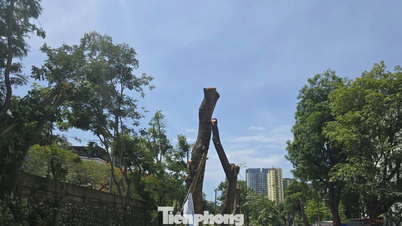
In early May 2024, dozens of trees on Hoang Hoa Tham Street (Tan Binh District) were cut down to make way for the expansion project connecting Terminal 3 of Tan Son Nhat International Airport. According to our reporter's observations, approximately 90 trees were slated for felling and relocation. Many of these were mature, large trees providing ample shade.
Mr. Mai Van Hieu (residing in Ward 13, Tan Binh District) stated that Hoang Hoa Tham Street is quite narrow and often experiences traffic congestion during rush hour at the intersection with the Cong Hoa overpass. Many residents support the road widening project to reduce traffic jams. However, witnessing the trees being cut down one by one has left many feeling regretful. “When the trees are bare and the heat intensifies, we realize the value of green spaces. We hope the project will be completed soon, and that new trees will be planted to provide shade as before,” Mr. Hieu shared.
Previously, many trees on Truong Chinh Street (Tan Binh District) were also cut down to make way for the Tran Quoc Hoan - Cong Hoa connecting road project (connecting Terminal 3 - Tan Son Nhat International Airport). In addition, a portion of Hoang Van Thu Park (Tan Binh District) has also been used for this project. More than 300 trees in the park have been cut down or relocated.
In addition to the projects mentioned above, Ho Chi Minh City has recently had many projects requiring the felling and relocation of trees, such as the An Phu intersection (Thu Duc City) where nearly 1,100 trees were relocated and over 200 trees were felled; the project to enhance connectivity for metro line 1 (148 trees were uprooted and moved elsewhere, 37 trees were felled); and the technical infrastructure project to prepare the ground for metro line 2 (404 trees were felled and 49 trees were relocated).
The Ho Chi Minh City People's Committee has instructed local authorities to review and reclaim public land designated as park land that is currently being leased for park construction. For land currently being used improperly or with expired leases, local authorities are to coordinate with the Department of Construction to assess the needs and necessity for implementing park construction projects.
The felling of many trees amidst the increasingly congested city is not only causing public outrage but also raising concerns among many experts. According to Dr. Vo Kim Cuong, former Deputy Chief Architect of Ho Chi Minh City, for projects requiring the felling of many trees, such as Metro Line 2, the investor needs to implement alternative solutions, such as: constructing trellises to create green spaces or green structures, or opening local parks in areas where trees have been cut down… “Cutting down trees should only be done as a last resort for construction projects. The relevant units must take responsibility for replanting the trees,” said Dr. Vo Kim Cuong.
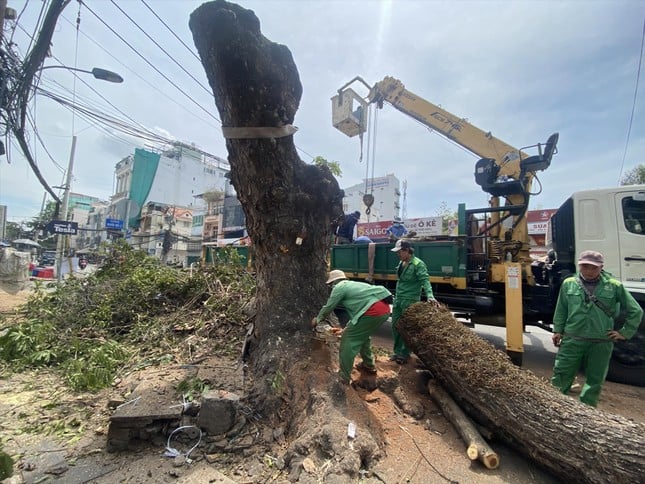 |
Trees are being cut down on Hoang Hoa Tham street. Photo: HH |
Dr. Ngo Viet Nam Son, an urban planning expert and architect, expressed concern: The proportion of green space in Ho Chi Minh City is decreasing due to infrastructure projects. Currently, the city's green space area is only 0.55 m²/person, 20 times lower than UNESCO's minimum standard (10 m²/person).
According to Mr. Son, green spaces play a crucial role in regulating the urban climate, especially in the context of intense heatwaves like those experienced recently. Green spaces also act as air filters, reduce noise, and create cool breezes in urban areas due to temperature differences.
"The city has too few trees; if they are cut down, they won't grow big enough to be replanted. Therefore, Ho Chi Minh City needs to adjust its approach. When a project requires cutting down trees, it should be implemented quickly and replanted promptly. We need to plant twice or three times as many trees to be proportionate, because cutting down large trees and replanting smaller ones is necessary," Mr. Son advised.
Rapidly restore the green lungs.
According to a representative of the Ho Chi Minh City Traffic Construction Investment Project Management Board (referred to as the Traffic Board), the project to expand Hoang Hoa Tham Street is approximately 800 meters long, from the foot of the overpass intersecting with Cong Hoa Street to the border of Tan Son Nhat Airport. The trees were cut down because they could not be transplanted. After the project is completed, other trees will be planted in the area to ensure urban aesthetics.
The investor of the Tran Quoc Hoan - Cong Hoa connecting road project also stated that after the project is completed, the contractor will return nearly 700 square meters of park land for replanting trees. Regarding the Metro Line 2 project, a representative from the Ho Chi Minh City Urban Railway Management Board (the investor) also stated that the reallocation of trees and green spaces will be carried out within the "Sustainable Urban Transport for Metro Line 2 in Ho Chi Minh City" project. The replanting plan will be implemented after the completion of station construction. The replanting of trees in the later phase will ensure that the total area of newly planted trees is greater than or equal to that of the previous trees.
On May 7th, the Ho Chi Minh City People's Committee issued a plan for implementing the program to develop public parks and green spaces in the city for the period 2024-2025. The plan sets a target of developing at least 68 hectares of public parks and planting or renovating 12,000 trees. Furthermore, the Ho Chi Minh City People's Committee requested that localities with ample land, such as Thu Duc City, Districts 7, 12, Binh Tan, and the districts of Binh Chanh, Hoc Mon, Cu Chi, and Nha Be, accelerate the development of parks and green spaces. Localities are to propose their own investment targets. The minimum area must be 50 hectares (100 hectares for Thu Duc City), and these targets must be included in the resolutions of the Party Congresses of each locality for the period 2026-2030.
Source: https://tienphong.vn/tphcm-ngay-cang-thieu-cay-xanh-post1635832.tpo























































































Comment (0)