(NLĐO) - Scientists have just found an explanation for the mysterious cosmic signals that Earth observatories regularly detect from distant galaxies.
For a long time, "fast radio bursts" (FRBs), a type of explosive, extremely short, powerful, and rapid radio signal traveling from very distant worlds —mostly from other galaxies—to Earth have puzzled scientists.
Several "suspects" have been mentioned in previous studies: aliens, black holes, neutron stars, types of cosmic collisions...
A research team led by Dr. Dang Pham from the University of Toronto (Canada) has uncovered new clues.
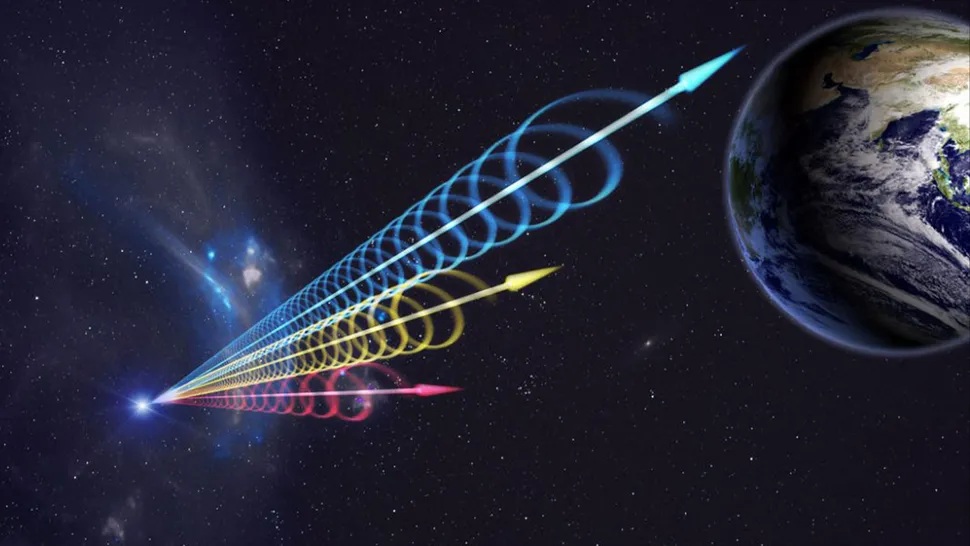
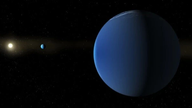
Illustrative image of a type of burst signal called a "radio burst" reaching Earth - Photo: CHINA ASTRONOMICAL CENTER
Astronomers have detected FRBs from all over the sky. It is estimated that 10,000 FRBs may occur at random points in the Earth's sky each day.


Therefore, rare events such as black hole collisions or neutron star collisions would not fully explain the origin of FRBs.
New research suggests that this strange type of signal may be emitted from a more frequent event: Neutron stars being struck by asteroids or comets, releasing powerful radio bursts like a terrifying scream echoing throughout the universe.
Neutron stars are dead worlds. They are the remnants of massive stars that have reached the end of their life cycle, collapsing and clumping together into a tiny but energy-rich sphere.
"Neutron stars are extreme places, with masses many times greater than the Sun compressed into a sphere about 20 km in diameter, giving them some of the strongest gravitational and magnetic fields in the universe," explains co-author Matthew Hopkins from the University of Oxford (UK).
Therefore, even a small impact is enough to cause an explosion, releasing an extremely powerful, bright radio signal under the "eyes" of radio observatories.
It is estimated that the energy released from a single small asteroid colliding with a neutron star would be enough for humanity to use for 100 million years.
Therefore, radio pulses from the collision were more than capable of traveling millions of light-years to reach Earth.



The authors' model also points to interstellar objects (ISOs), a class of asteroids and comets that have not been studied much, present between stars in galaxies throughout the universe.
They are present in sufficient numbers to continuously bombard neutron stars, explaining the large number of FRBs that humanity has detected.
The study also revealed the expected characteristics of this type of collision, consistent with existing FRB data, including their duration, energy, and speed throughout the universe's lifespan.
Source: https://nld.com.vn/trai-dat-bat-duoc-tieng-thet-tu-the-gioi-da-chet-19624121110023151.htm





![[Image] National conference summarizing one year of operation of the overall organizational model of the political system, the three-tiered government model.](https://vphoto.vietnam.vn/thumb/1200x675/vietnam/resource/IMAGE/2026/07/01/1782882811691_ndo_br_1-jpg.webp)



![[GALLERY] The blockbuster game worth 1.5 million VND plummets, only a few players left.](https://vphoto.vietnam.vn/thumb/402x226/vietnam/resource/IMAGE/2026/07/01/1782914927077_sao-1-png.webp)