


 |
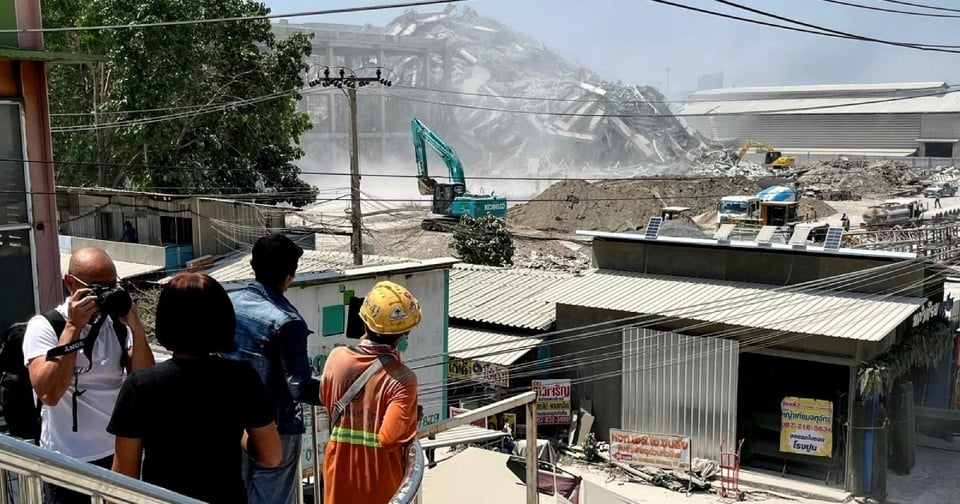
A building collapses in Myanmar after the earthquake on March 28. Photo: Reuters . |
At just after 1 PM on March 28th, a powerful 7.7 magnitude earthquake struck west of Mandalay city, Myanmar. This major earthquake affected many Southeast Asian countries, including Vietnam.
According to the U.S. Geological Survey (USGS), earthquakes with a magnitude of 7.0-7.9 are considered "major," capable of causing widespread and serious damage, especially near densely populated areas. The agency also estimates a high probability of 1,000-10,000 casualties and economic losses of $1-10 billion .
In Ho Chi Minh City and Hanoi , at around 1:30 PM, many residents in apartment buildings and offices felt their buildings shaking and experienced dizziness, similar to symptoms of low blood pressure.
Speaking to Tri Thuc - Znews , Mr. Nguyen Xuan Anh (Director of the Institute of Geophysics) said that the earthquake in Myanmar was very strong, so people in high-rise buildings in Hanoi and Ho Chi Minh City could easily feel it.
"The earthquake was very large, so it's normal for its impact to reach hundreds of kilometers," Mr. Xuan Anh explained why tremors were felt in locations far from the epicenter, such as Ho Chi Minh City, and added that the Institute of Geophysics is continuing to monitor the situation.
A major earthquake, causing far-reaching damage.
The strength of an earthquake is measured in magnitude, a number that indicates the amount of energy released at the source. Magnitude is different from intensity, which describes how much shaking occurs at a particular location and depends on distance and geology.
Scientists use different earthquake scales to ensure accuracy. The Richter scale is used for small earthquakes, while the moment scale is used for large earthquakes.
 |
Several office buildings in Ho Chi Minh City shook at noon on March 28. Photo: Linh Huynh . |
The Richter scale, developed by Charles F. Richter in 1935, was initially used to measure local earthquakes in California. It is based on the amplitude (height) of the largest seismic wave recorded on a Wood-Anderson tachymeter, after adjusting for distance from the epicenter.
This scale is logarithmic, meaning that each increase (for example, from 5 to 6) corresponds to a 10-fold increase in wave amplitude and approximately 31.6 times the released energy. However, the Richter scale is only accurate for small to medium earthquakes (below magnitude 7) and is not suitable for large earthquakes due to saturation.
Currently, the moment magnitude scale (Mw) is preferred, especially for large earthquakes, based on seismic moment, calculated from fault area and slip. It is not saturated like the Richter scale, making it more accurate for earthquakes of magnitude 8 and above. The moment magnitude scale is now the global standard, enabling more accurate measurements of major events.
For example, the 1960 Chile earthquake, considered the strongest earthquake ever recorded by humankind, had a magnitude of 8.6 on the Richter scale, but a moment magnitude of 9.5.
Moment scales are also calculated using logarithms. An earthquake with a magnitude of 7.7 will be more than five times stronger than an earthquake with a magnitude of 7.
 |
Office workers in the Phu My Hung area flee their buildings due to the effects of the earthquake in Myanmar. Photo: Son Tran. |
To differentiate, earthquake strength on the Richter scale is usually denoted in units of ML, while on the moment scale it is usually denoted in units of M, Mw, or Mwg.
Where can I find earthquake information?
Vietnam is not a country where major earthquakes occur frequently. Therefore, people do not have much experience in researching information related to this phenomenon.
Currently, there are many free tools available on the internet that provide up-to-date and highly accurate information related to earthquakes that users can utilize.
For domestic users, the most comprehensive source of information is the website http://igp-vast.vn/ of the Institute of Geophysics ( thuộc the Vietnam Academy of Science and Technology). The website provides complete data on geological events in Vietnam, including aftershocks that are often not updated in international reports.
 |
For major or localized earthquakes, searching for the keyword "earthquake" on Google will provide basic information. Photo: Xuan Sang. |
The USGS earthquake website is a source of information used by technology companies and international media outlets when reporting on this phenomenon. Users can access https://earthquake.usgs.gov/earthquakes/ to track recorded earthquakes in real time. The site organizes events chronologically, with the most recent one at the top. Additionally, the magnitude of the earthquake is indicated on the Richter scale.
In addition, the USGS also provides a visual map for users to track. Colored dots represent the locations of earthquakes. The size corresponds to the magnitude and extent of the impact.
Additionally, domestic users can quickly check earthquake information using the Google search engine. By searching for the keyword "earthquake," the platform will return information directly from the U.S. Geological Survey. Events are listed chronologically and include their locations. Google's graphical representation is also more intuitive, accurately depicting the epicenter and affected areas.
Source: https://znews.vn/tran-dong-dat-o-myanmar-manh-den-dau-post1541513.html



































































































Comment (0)