

Who was Steve Jobs, and should we use specific "cultural codes" to represent him?
Immediately after the exam questions were released, the question related to "Steve Jobs in Vietnam" quickly attracted the attention of teachers, students, and the public. Some opinions suggested that the question was timely, encouraging innovation and creativity, and aligned with what modern education is striving for. However, there were considerable concerns surrounding the fairness of the candidates' understanding.
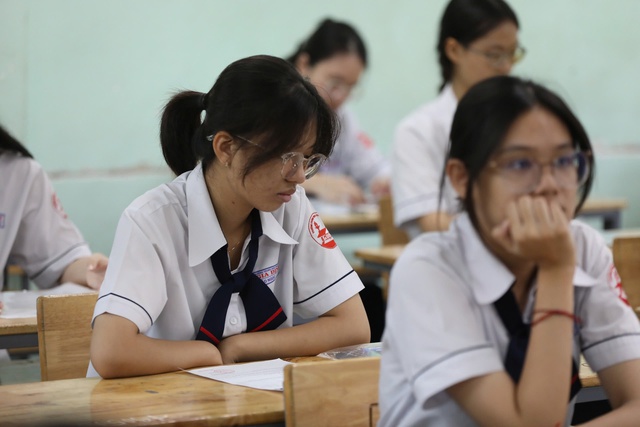
Candidates in Ho Chi Minh City in the Literature exam room of the 2026 High School Graduation Exam.
Photo: Ngoc Duong
The main reason for the debate lies in the fact that the question uses a specific role model: Steve Jobs – a globally renowned technology entrepreneur. While many urban students have easy access to information about such figures, this name is not familiar to students in remote, mountainous areas. This difference in access to information creates a sense of "mismatch" right from the start.
In the context of an exam, even a single unclear detail can cause candidates to become confused and lose confidence. Not knowing who Steve Jobs was might lead some students to waste time guessing, or even misunderstand the question's requirements. This is why many teachers are questioning whether national exams should use specific "cultural codes" that not all students have access to.
Furthermore, some argue that using a specific individual as a role model could inadvertently create the perception that success is only associated with prominent figures in the technology field, while society needs many different types of talent...
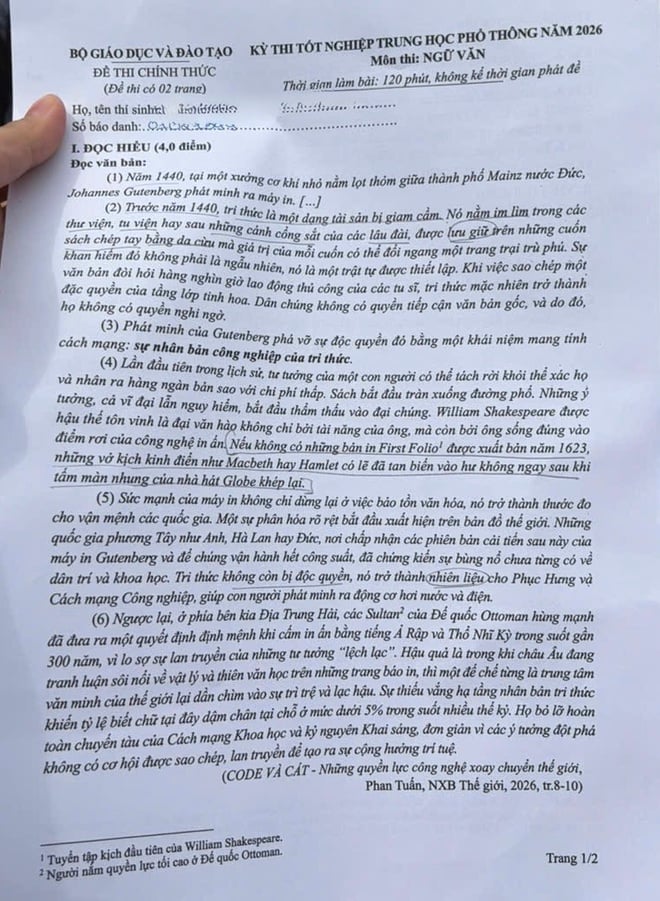
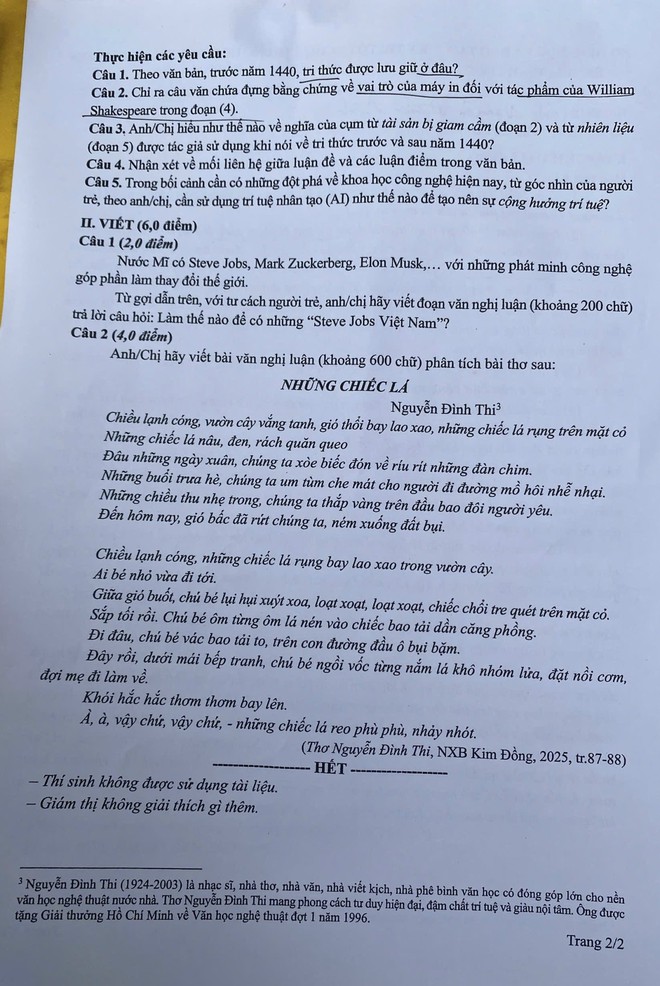
The literature exam for the 2026 high school graduation exam includes a controversial question about "Steve Jobs of Vietnam".
Photo: Tue Nguyen
Judging from the structure of the exam , are the questions really "difficult"?
However, a closer analysis of the exam structure reveals that the questions are not designed to test knowledge of a specific individual. The introductory text (The United States has Steve Jobs, Mark Zuckerberg, Elon Musk... with technological inventions that have contributed to changing the world ) places the issue in a clear context, while also suggesting general concepts such as creativity, innovation, and daring to think differently. In particular, the reading comprehension text serves as a guide for critical thinking, providing "material" for students to develop their essays.
The high school literature exam question asked about 'Steve Jobs of Vietnam'; which Vietnamese person did the student cite as an example?
Debate on 'Steve Jobs of Vietnam' as an essay topic: What standard should be used as a benchmark?
High school graduation exam question in Literature: How can we create 'Vietnamese Steve Jobs'?
Therefore, even without knowing exactly who Steve Jobs was, candidates can still approach the issue from a general perspective: how to nurture creative individuals capable of creating new value for society. In other words, the exam aims to assess reading comprehension, reasoning, and problem-solving skills, rather than testing knowledge of a specific person.
From this perspective, the question still meets the requirements of a social commentary essay that is thought-provoking, suggestive, and encourages students to express their personal opinions. The use of the image of "Steve Jobs" can be seen as a way to concretize the issue, making the essay topic more relevant to the realities of integration.
Tell a story about how exam questions are formulated.
However, this debate also raises an issue that needs further consideration in the future: How can exam questions be both relevant to the times and ensure fairness in cognitive assessment among different groups of students?
A sensible approach might be to include brief notes or more general statements, so that all candidates have a relatively equal starting point.
Source: https://thanhnien.vn/tranh-luan-tu-de-van-steve-jobs-viet-nam-nay-sinh-tu-dau-185260612092223301.htm


![[Photo] General Secretary and President To Lam presides over the meeting to approve the draft report on the results of inspection and supervision of the Standing Committee of the Hanoi City Party Committee (phase 3)](https://vphoto.vietnam.vn/thumb/1200x675/vietnam/resource/IMAGE/2026/09/17/1789654292939_ndo_br_1-jpg.webp)


























Comment (0)