

NDO - "AI will get even better in the coming years, but currently, AI still has limitations and is far from creating a certain level of intelligence, not yet reaching the intelligence level of a cat," Professor Yann Lecun of New York University and Director of Artificial Intelligence Science at Meta, USA, opened the scientific seminar "Implementing AI in Practice".
On the afternoon of December 4th, at the Ahmaz Convention Center, the scientific seminar "Implementing AI in Practice" received special attention from many young people. Here, scientists all agreed that AI is in its developmental stage, with much potential but also many challenges for organizations to implement AI in practice.
"AI is not a panacea in every field."
Professor Yann Lecun of New York University and Director of Artificial Intelligence Science at Meta, USA, says that we currently have countless differing opinions about AI, both positive and negative. Some people worry that AI will replace them, while others believe that AI-powered computer systems are better, performing millions of calculations more efficiently than humans.
He stated that in the 1960s, people predicted that AI would replace humans in 10 years, but even now, AI is still in its early stages of development. Establishing a clear direction for AI development remains very difficult. "We need to understand that if there is an entity more intelligent than us, it doesn't mean it will be smarter than humans in every field. For AI to develop, humans need to teach it the necessary skills," Professor Yann Lecun said.
Professor Yann Lecun of New York University and Director of Artificial Intelligence Science at Meta, USA, offers recommendations for the direction of AI, suggesting that we should abandon generative, probabilistic, or supervised learning AI models and instead choose a different approach to make AI smarter.
 |
Professor Yann Lecun, New York University and Director of Artificial Intelligence Science at Meta, USA. |
Therefore, human knowledge should be added to artificial intelligence so that the AI platform is open; future AI should be trained to speak every language in the world . And thus, we need open source for artificial intelligence.
In 2019, when Dr. Bui Hung Hai returned to Vietnam to assume the position of CEO of VinAI, he stated that affordability and access to AI were two crucial factors.
Therefore, VinAI's mission is to expand accessibility and affordability to bring AI to everyone. "A synchronized approach is needed so that AI can understand all the world's languages. Chat GPT is a powerful and popular open-source model because it runs on computers and isn't too large," Dr. Hai shared.
The potential applications of artificial intelligence in healthcare.
Professor Do Ngoc Minh, from the University of Illinois at Urbana-Champaign (UIUC, USA), VinUni University (Vietnam), and a member of the VinFuture Award Preliminary Judging Panel, stated that the university currently has 50 master's students, 50 doctoral students, and 10 research fellows working on research related to AI applications in healthcare, and has achieved some notable results.
He cited the example of VinUniversity (VinUni) and the University of Illinois at Urbana-Champaign (UIUC) inaugurating the VinUni-Illinois Smart Health Center (VISHC) in 2022. This project combines research between the two institutions on cancer treatment to find treatment protocols for chemotherapy, surgery, etc., that minimize cell removal.
In breast cancer, taking cell samples to check if cancer cells have been completely removed requires multiple attempts, causing patients fatigue and pain. At this point, AI can help scan thousands of samples quickly, greatly reducing the burden on patients.
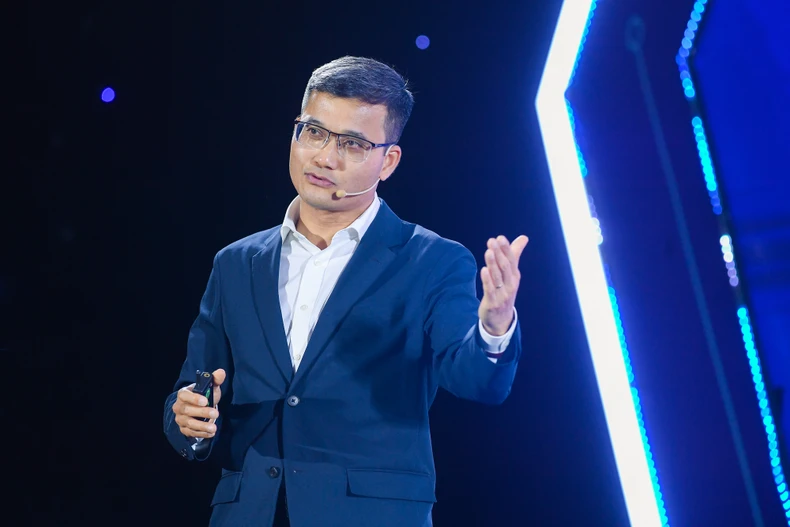 |
Professor Do Ngoc Minh, University of Illinois at Urbana-Champaign (UIUC, USA), VinUni University (Vietnam). |
Accordingly, he affirmed that many applications are in the research and development phase. Numerous publications from 10 years ago have shown that AI can recognize an object quickly and with absolute accuracy. He argued that AI needs to be utilized more effectively and adapted to the real world, becoming more practical and relevant to the technology.
Regarding the practical application of AI in the pharmaceutical industry, Professor Do Ngoc Minh also stated that Vietnam lacks an advantage because it does not have large pharmaceutical companies or companies with a foundation in drug research and development. Therefore, Vietnam does not meet the crucial conditions for AI to collect data from the field.
However, Professor Do Ngoc Minh also pointed out the advantage that Vietnam has a large population and diverse health conditions, so using AI to collect health information is a field that can be exploited and utilized.
Source: https://nhandan.vn/trien-khai-ai-trong-thuc-te-con-nhieu-thach-thuc-post848480.html
![[Photo] General Secretary and President To Lam meets with National Assembly delegates from ethnic minorities.](https://vphoto.vietnam.vn/thumb/1200x675/vietnam/resource/IMAGE/2026/04/20/1776696701056_a1-bnd-8331-3342-jpg.webp)
![[Image] National Assembly discusses the implementation of the socio-economic development plan.](https://vphoto.vietnam.vn/thumb/1200x675/vietnam/resource/IMAGE/2026/04/20/1776696707422_ndo_br_img-20260420-185419-jpg.webp)



















































































Comment (0)