

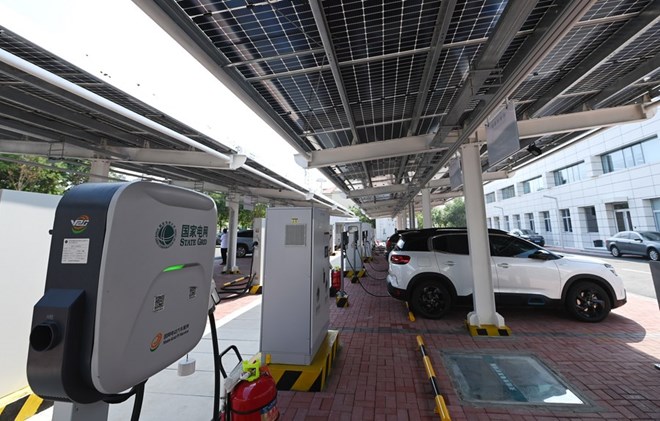
To meet the goal of net-zero emissions, many countries around the world have been actively implementing solutions to support electric vehicles. One of these is building a charging station infrastructure to quickly integrate electric vehicles into people's lives.
India is one of the countries embracing cost-effective and environmentally friendly transportation methods. According to the Indian Energy, Environment and Water Council, in 2022, more than 1 million electric vehicles were sold in the South Asian country. By 2030, this number is expected to increase to approximately 14 million vehicles per year.
For the first time in India, the Maharashtra Housing and Development Authority (MHADA) has provided electric and solar-powered parking in residential apartments. Many individuals and construction companies have been actively installing electric vehicle charging stations in residential areas to make it easier for residents to charge their vehicles overnight. This not only generates additional income but also helps them attract more potential customers. Apartments equipped with electric vehicle charging simplify the daily lives of car owners, saving them time and money.
China is also one of the countries accelerating the electrification of vehicles. Last September, oil and gas company Shell and electric vehicle manufacturer BYD planned to build the world's largest electric vehicle charging system in Shenzhen. A large-scale charging station will be built with 258 charging points and a total power generation capacity of 300,000 kW/h. Currently, Shell operates approximately 800 electric vehicle charging stations through joint ventures or wholly owned subsidiaries across the country.
When discussing the development trend of electric vehicles, the United States cannot be overlooked. The 2021 Infrastructure Investment and Jobs Act approved $7.5 billion in funding for electric vehicle charging infrastructure. More recently, the Inflation Reduction Act has provided tax credits for both passenger and commercial electric vehicles. The state of California has announced it will ban the sale of internal combustion engine vehicles by 2035. California also requires that 3% of total parking spaces in commercial buildings be prepared for charging stations. Since 2017, the city of Atlanta has passed an "EV Readiness" ordinance, requiring all new residential developments and public parking lots to be electric vehicle-friendly. In addition, 20% of space in all commercial and residential parking lots must be dedicated to electric vehicles.
The number of charging points in the US is projected to increase from approximately 4 million currently to around 35 million by 2030. The electric vehicle charging equipment market could grow from $7 billion to $100 billion by 2040 at a compound annual growth rate of 15%. According to PwC's analysis, the number of electric vehicles in the US is estimated to reach 27 million by 2030 and 92 million by 2040. Workplace and public electric vehicle charging systems are likely to experience the fastest growth until 2030.
In Europe, the number of public charging points increased by 48% in 2022 compared to 2021, from 320,000 to 475,000. The Netherlands led in public charging infrastructure. In 2022, the country below sea level had the highest number of public charging points in the EU with 111,721, followed by Germany (87,674) and France (83,317). This indicates that 24% of all public charging points in the EU were located in the Netherlands, and the combined market share of the Netherlands, Germany, and France was 59% of all electric vehicle charging stations in the EU in 2022.
Source










































































































Comment (0)